Acts 9:1–9
The NET BibleOther versions
English
- NET The NET Bible
- DARBY 1890 Darby Bible
- ASV American Standard Version
- AV 1873 The Cambridge Paragraph Bible of the Authorized English Version
- CSB Christian Standard Bible
- D-R Douay-Rheims Bible
- ESV English Standard Version
- GW GOD’S WORD Translation
- GNB Good News Translation
- HCSB The Holman Christian Standard Bible
- KJV 1900 King James Version
- LSB Legacy Standard Bible
- LEB The Lexham English Bible
- MSG The Message: The Bible in Contemporary Language
- NASB95 New American Standard Bible (1995)
- NCV New Century Version
- NIrV New International Reader’s Version (1998)
- NIV New International Version (2011)
- NKJV The New King James Version
- NLT New Living Translation
- NRSVue New Revised Standard Version: Updated Edition
- RSV The Revised Standard Version
- RSVCE The Revised Standard Version, Catholic Edition
- TNIV Today’s New International Version
- YLT Young’s Literal Translation
Arabic
Czech
French
German
Greek
Hungarian
Italian
Korean
Latin
Portuguese
Russian
Simplified Chinese
Spanish
Traditional Chinese
The Conversion of Saul
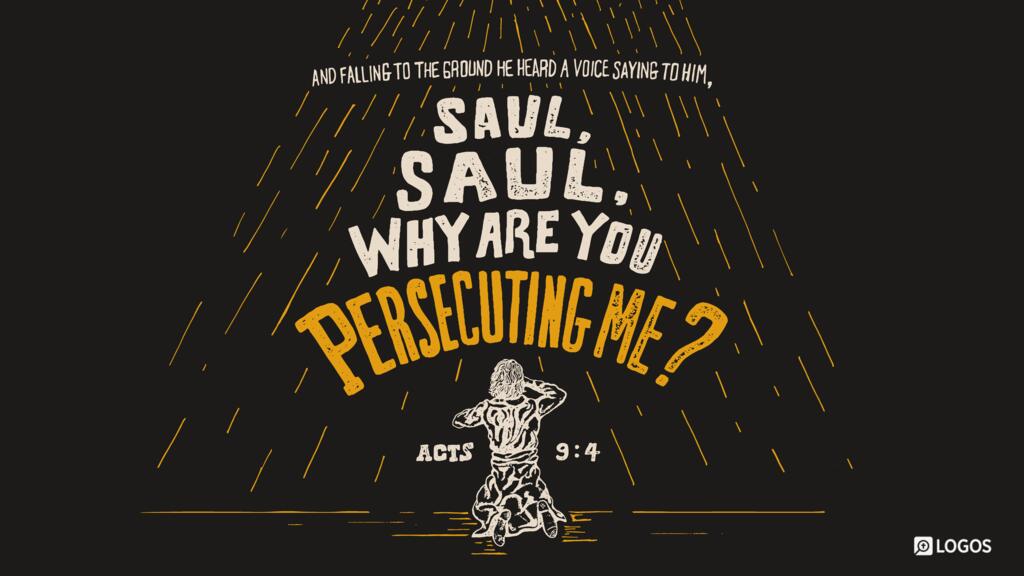
9:1Meanwhile Saul, still breathing out threats1 to murder2 the Lord’s disciples, went to the high priest 9:2and requested letters from him to the synagogues3 in Damascus, so that if he found any who belonged to the Way,4 either men or women, he could bring them as prisoners5 to Jerusalem.69:3As he was going along, approaching7 Damascus, suddenly a light from heaven flashed8 around him. 9:4He9 fell to the ground and heard a voice saying to him, “Saul, Saul,10 why are you persecuting me?”119:5So he said, “Who are you, Lord?” He replied, “I am Jesus whom you are persecuting! 9:6But stand up12 and enter the city and you will be told13 what you must do.” 9:7(Now the men14 who were traveling with him stood there speechless,15 because they heard the voice but saw no one.)169:8So Saul got up from the ground, but although his eyes were open,17 he could see nothing.18 Leading him by the hand, his companions19 brought him into Damascus. 9:9For20 three days he could not see, and he neither ate nor drank anything.21
Footnotes
- 1 Or “Saul, making dire threats.”
- 2 The expression “breathing out threats and murder” is an idiomatic expression for “making threats to murder” (see L&N 33.293). Although the two terms “threats” and “murder” are syntactically coordinate, the second is semantically subordinate to the first. In other words, the content of the threats is to murder the disciples.
- 3 See the note on synagogue in .
- 4 The expression “the way” in ancient religious literature refers at times to “the whole way of life fr. a moral and spiritual viewpoint” ( ὁδός 3.c), and it has been so used of Christianity and its teachings in the book of Acts (see also 19:9, 23; 22:4; 24:14, 22). It is a variation of Judaism’s idea of two ways, the true and the false, where “the Way” is the true one ( 91:18; 30:15).
- 5 Grk “bring them bound”; the translation “bring someone as prisoner” for δεδεμένον ἄγειν τινά (dedemenon agein tina) is given by δέω 1.b.
- 6 From Damascus to Jerusalem was a six-day journey. Christianity had now expanded into Syria. For location see ; ; ; ; ; ; ; ; .
- 7 Grk “As he was going along, it happened that when he was approaching.” The phrase ἐγένετο (egeneto, “it happened that”), common in Luke (69 times) and Acts (54 times), is redundant in contemporary English and has not been translated.
- 8 Or “shone” ( περιαστράπτω). The light was more brilliant than the sun according to Acts 26:13.
- 9 Grk “and he.” Because of the length of the Greek sentence, the conjunction καί (kai) has not been translated here. Instead a new English sentence is begun.
- 10 The double vocative suggests emotion.
- 11 Persecuting me. To persecute the church is to persecute Jesus.
- 12 Or “But arise.”
- 13 Literally a passive construction, “it will be told to you.” This has been converted to another form of passive construction in the translation.
- 14 The Greek term here is ἀνήρ (anēr), which is used only rarely in a generic sense of both men and women. In the historical setting here, Paul’s traveling companions were almost certainly all males.
- 15 That is, unable to speak because of fear or amazement. See ἐνεός.
- 16 This is a parenthetical note by the author. Acts 22:9 appears to indicate that they saw the light but did not hear a voice. They were “witnesses” that something happened.
- 17 Grk “his eyes being open,” a genitive absolute construction that has been translated as a concessive adverbial participle.
- 18 He could see nothing. This sign of blindness, which was temporary until v. 18, is like the sign of deafness experienced by Zechariah in Luke 1. It allowed some time for Saul (Paul) to reflect on what had happened without distractions.
- 19 Grk “they”; the referents (Saul’s companions) have been specified in the translation for clarity.
- 20 Grk “And for.” Because of the difference between Greek style, which often begins sentences or clauses with “and,” and English style, which generally does not, καί (kai) has not been translated here.
- 21 The word “anything” is not in the Greek text, but is implied. Direct objects were often omitted in Greek when clear from the context, but must be supplied for the modern English reader. The fasting might indicate an initial realization of Luke 5:33–39. Fasting was usually accompanied by reflective thought.
The NET Bible First Edition, Copyright 1996-2005 by Biblical Studies Press
In other versions
ESVEnglish Standard Version
But Saul, still breathing threats and murder against the disciples of the Lord, went to the high priest and asked him for letters to the synagogues at Damascus, so that if he found any belonging to the Way, men or women, he might bring them bound to Jerusalem. Now as he went on his way, he approached Damascus, and suddenly a light from heaven shone around him. And falling to the ground, he heard a voice saying to him, “Saul, Saul, why are you persecuting me?” And he said, “Who are you, Lord?” And he said, “I am Jesus, whom you are persecuting. But rise and enter the city, and you will be told what you are to do.” The men who were traveling with him stood speechless, hearing the voice but seeing no one. Saul rose from the ground, and although his eyes were opened, he saw nothing. So they led him by the hand and brought him into Damascus. And for three days he was without sight, and neither ate nor drank.
Copyright 2001 Crossway Bibles
NIVNew International Version (2011)
Meanwhile, Saul was still breathing out murderous threats against the Lord’s disciples. He went to the high priest and asked him for letters to the synagogues in Damascus, so that if he found any there who belonged to the Way, whether men or women, he might take them as prisoners to Jerusalem. As he neared Damascus on his journey, suddenly a light from heaven flashed around him. He fell to the ground and heard a voice say to him, “Saul, Saul, why do you persecute me?”
“Who are you, Lord?” Saul asked.
“I am Jesus, whom you are persecuting,” he replied. “Now get up and go into the city, and you will be told what you must do.”
The men traveling with Saul stood there speechless; they heard the sound but did not see anyone. Saul got up from the ground, but when he opened his eyes he could see nothing. So they led him by the hand into Damascus. For three days he was blind, and did not eat or drink anything.
Copyright 1973, 1978, 1984, 2011 Biblica, Inc.
CSBChristian Standard Bible
Now Saul was still breathing threats and murder against the disciples of the Lord. He went to the high priest and requested letters from him to the synagogues in Damascus, so that if he found any men or women who belonged to the Way, he might bring them as prisoners to Jerusalem. As he traveled and was nearing Damascus, a light from heaven suddenly flashed around him. Falling to the ground, he heard a voice saying to him, “Saul, Saul, why are you persecuting me?”
“Who are you, Lord?” Saul said.
“I am Jesus, the one you are persecuting,” he replied. “But get up and go into the city, and you will be told what you must do.”
The men who were traveling with him stood speechless, hearing the sound but seeing no one. Saul got up from the ground, and though his eyes were open, he could see nothing. So they took him by the hand and led him into Damascus. He was unable to see for three days and did not eat or drink.
Copyright 2017 Holman Bible Publishers
NLTNew Living Translation
Meanwhile, Saul was uttering threats with every breath and was eager to kill the Lord’s followers. So he went to the high priest. He requested letters addressed to the synagogues in Damascus, asking for their cooperation in the arrest of any followers of the Way he found there. He wanted to bring them—both men and women—back to Jerusalem in chains.
As he was approaching Damascus on this mission, a light from heaven suddenly shone down around him. He fell to the ground and heard a voice saying to him, “Saul! Saul! Why are you persecuting me?”
“Who are you, lord?” Saul asked.
And the voice replied, “I am Jesus, the one you are persecuting! Now get up and go into the city, and you will be told what you must do.”
The men with Saul stood speechless, for they heard the sound of someone’s voice but saw no one! Saul picked himself up off the ground, but when he opened his eyes he was blind. So his companions led him by the hand to Damascus. He remained there blind for three days and did not eat or drink.
Holy Bible, New Living Translation, copyright © 1996, 2004, 2015 by Tyndale House Foundation. Used by permission of Tyndale House Publishers. All rights reserved.
LEBThe Lexham English Bible
But Saul, still breathing threats and murder against the disciples of the Lord, went to the high priest and asked for letters from him to the synagogues in Damascus, so that if he found any who were of the Way, both men and women, he could bring them tied up to Jerusalem. Now as he proceeded, it happened that when he approached Damascus, suddenly a light from heaven flashed around him. And falling to the ground, he heard a voice saying to him, “Saul, Saul, why are you persecuting me?” So he said, “Who are you, Lord?” And he said, “I am Jesus, whom you are persecuting! But get up and enter into the city, and it will be told to you what you must do.” (Now the men who were traveling together with him stood speechless, because they heard the voice but saw no one.) So Saul got up from the ground, but although his eyes were open he could see nothing. And leading him by the hand, they brought him into Damascus. And he was unable to see for three days, and he did not eat or drink.
Copyright 2012 Lexham Press
KJV 1900King James Version
And Saul, yet breathing out threatenings and slaughter against the disciples of the Lord, went unto the high priest, And desired of him letters to Damascus to the synagogues, that if he found any of this way, whether they were men or women, he might bring them bound unto Jerusalem. And as he journeyed, he came near Damascus: and suddenly there shined round about him a light from heaven: And he fell to the earth, and heard a voice saying unto him, Saul, Saul, why persecutest thou me? And he said, Who art thou, Lord? And the Lord said, I am Jesus whom thou persecutest: it is hard for thee to kick against the pricks. And he trembling and astonished said, Lord, what wilt thou have me to do? And the Lord said unto him, Arise, and go into the city, and it shall be told thee what thou must do. And the men which journeyed with him stood speechless, hearing a voice, but seeing no man. And Saul arose from the earth; and when his eyes were opened, he saw no man: but they led him by the hand, and brought him into Damascus. And he was three days without sight, and neither did eat nor drink.
Public Domain