Acts 2:37–47
The NET BibleOther versions
English
- NET The NET Bible
- DARBY 1890 Darby Bible
- ASV American Standard Version
- AV 1873 The Cambridge Paragraph Bible of the Authorized English Version
- CSB Christian Standard Bible
- D-R Douay-Rheims Bible
- ESV English Standard Version
- GW GOD’S WORD Translation
- GNB Good News Translation
- HCSB The Holman Christian Standard Bible
- KJV 1900 King James Version
- LSB Legacy Standard Bible
- LEB The Lexham English Bible
- MSG The Message: The Bible in Contemporary Language
- NASB95 New American Standard Bible (1995)
- NCV New Century Version
- NIrV New International Reader’s Version (1998)
- NIV New International Version (2011)
- NKJV The New King James Version
- NLT New Living Translation
- NRSVue New Revised Standard Version: Updated Edition
- RSV The Revised Standard Version
- RSVCE The Revised Standard Version, Catholic Edition
- TNIV Today’s New International Version
- YLT Young’s Literal Translation
Arabic
Czech
French
German
Greek
Hungarian
Italian
Korean
Latin
Portuguese
Russian
Simplified Chinese
Spanish
Traditional Chinese
The Response to Peter’s Address
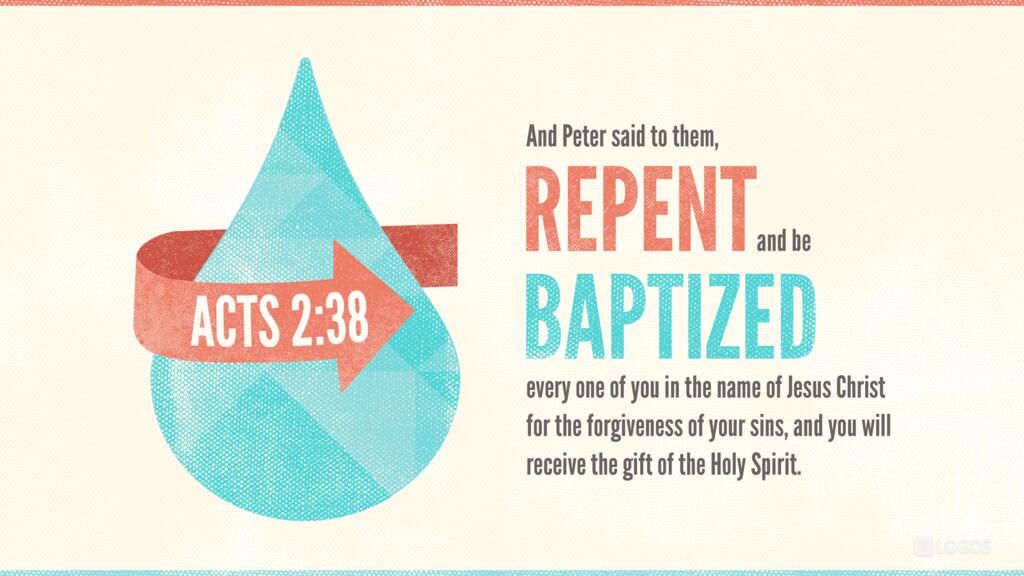
2:37Now when they heard this,80 they were acutely distressed81 and said to Peter and the rest of the apostles, “What should we do, brothers?” 2:38Peter said to them, “Repent, and each one of you be baptized82 in the name of Jesus Christ83 for84 the forgiveness of your sins, and you will receive the gift of the Holy Spirit.852:39For the promise86 is for you and your children, and for all who are far away, as many as the Lord our God will call to himself.” 2:40With many other words he testified87 and exhorted them saying, “Save yourselves from this perverse88 generation!” 2:41So those who accepted89 his message90 were baptized, and that day about three thousand people91 were added.92
The Fellowship of the Early Believers
2:42They were devoting themselves to the apostles’ teaching and to fellowship,93 to the breaking of bread and to prayer.942:43Reverential awe95 came over everyone,96 and many wonders and miraculous signs97 came about by the apostles. 2:44All who believed were together and held98 everything in common, 2:45and they began selling99 their property100 and possessions and distributing the proceeds101 to everyone, as anyone had need. 2:46Every day102 they continued to gather together by common consent in the temple courts,103 breaking bread from104 house to house, sharing their food with glad105 and humble hearts,1062:47praising God and having the good will107 of all the people. And the Lord was adding to their number every day108 those who were being saved.
Footnotes
- 80 The word “this” is not in the Greek text. Direct objects were often omitted in Greek, but must be supplied for the modern English reader.
- 81 Grk “they were pierced to the heart” (an idiom for acute emotional distress).
- 82 The verb is a third person imperative, but the common translation “let each of you be baptized” obscures the imperative force in English, since it sounds more like a permissive (“each of you may be baptized”) to the average English reader.
- 83 Or “Messiah”; both “Christ” (Greek) and “Messiah” (Hebrew and Aramaic) mean “one who has been anointed.” In the name of Jesus Christ. Baptism in Messiah Jesus’ name shows how much authority he possesses.
- 84 There is debate over the meaning of εἰς in the prepositional phrase εἰς ἄφεσιν τῶν ἁμαρτιῶν ὑμῶν (eis aphesin tōn hamartiōn humōn, “for/because of/with reference to the forgiveness of your sins”). Although a causal sense has been argued, it is difficult to maintain here. discusses at least four other ways of dealing with the passage: (1) The baptism referred to here is physical only, and εἰς has the meaning of “for” or “unto.” Such a view suggests that salvation is based on works—an idea that runs counter to the theology of Acts, namely: (a) repentance often precedes baptism (cf. Acts 3:19; 26:20), and (b) salvation is entirely a gift of God, not procured via water baptism (Acts 10:43 [cf. v. 47]; 13:38–39, 48; 15:11; 16:30–31; 20:21; 26:18); (2) The baptism referred to here is spiritual only. Although such a view fits well with the theology of Acts, it does not fit well with the obvious meaning of “baptism” in Acts—especially in this text (cf. 2:41); (3) The text should be repunctuated in light of the shift from second person plural to third person singular back to second person plural again. The idea then would be, “Repent for/with reference to your sins, and let each one of you be baptized …” Such a view is an acceptable way of handling εἰς, but its subtlety and awkwardness count against it; (4) Finally, it is possible that to a first-century Jewish audience (as well as to Peter), the idea of baptism might incorporate both the spiritual reality and the physical symbol. That Peter connects both closely in his thinking is clear from other passages such as Acts 10:47 and 11:15–16. If this interpretation is correct, then Acts 2:38 is saying very little about the specific theological relationship between the symbol and the reality, only that historically they were viewed together. One must look in other places for a theological analysis. For further discussion see R. N. Longenecker, “Acts,” 9:; B. Witherington, Acts, 154–55; F. F. Bruce, The Acts of the Apostles: The Greek Text with Introduction and Commentary, 129–30; εἰς 4.f.
- 85 Here the genitive τοῦ ἁγίου πνεύματος (tou hagiou pneumatos) is a genitive of apposition; the gift consists of the Holy Spirit.
- 86 The promise refers to the promise of the Holy Spirit that Jesus received from the Father in 2:33 and which he now pours out on others. The promise consists of the Holy Spirit (see note in ). Jesus is the active mediator of God’s blessing.
- 87 Or “warned.”
- 88 Or “crooked” (in a moral or ethical sense). See Luke 3:5.
- 89 Or “who acknowledged the truth of.”
- 90 Grk “word.”
- 91 Grk “souls” (here an idiom for the whole person).
- 92 Or “were won over.”
- 93 Fellowship refers here to close association involving mutual involvement and relationships.
- 94 Grk “prayers.” This word was translated as a collective singular in keeping with English style.
- 95 Or “Fear.”
- 96 Grk “on every soul” (here “soul” is an idiom for the whole person).
- 97 In this context the miraculous nature of these signs is implied. Cf. σημεῖον 2.a.
- 98 Grk “had.”
- 99 The imperfect verb has been translated as an ingressive (“began …”). Since in context this is a description of the beginning of the community of believers, it is more likely that these statements refer to the start of various activities and practices that the early church continued for some time.
- 100 It is possible that the first term for property (κτήματα, ktēmata) refers to real estate (as later usage seems to indicate) while the second term (ὑπάρξεις, huparxeis) refers to possessions in general, but it may also be that the two terms are used together for emphasis, simply indicating that all kinds of possessions were being sold. However, if the first term is more specifically a reference to real estate, it foreshadows the incident with Ananias and Sapphira in Acts 5:1–11.
- 101 Grk “distributing them” (αὐτά, auta). The referent (the proceeds of the sales) has been specified in the translation for clarity.
- 102 ἡμέρα 2.c has “every day” for this phrase.
- 103 Grk “in the temple.” This is actually a reference to the courts surrounding the temple proper, and has been translated accordingly.
- 104 Here κατά (kata) is used as a distributive ( B.1.d).
- 105 The term glad (Grk “gladness”) often refers to joy brought about by God’s saving acts (Luke 1:14, 44; also the related verb in 1:47; 10:21).
- 106 Grk “with gladness and humbleness of hearts.” It is best to understand καρδίας (kardias) as an attributed genitive, with the two nouns it modifies actually listing attributes of the genitive noun which is related to them.
- 107 Or “the favor.”
- 108 ἡμέρα 2.c has “every day” for this phrase.
The NET Bible First Edition, Copyright 1996-2005 by Biblical Studies Press