2 Samuel 6:2–11
The NET BibleOther versions
English
- NET The NET Bible
- DARBY 1890 Darby Bible
- ASV American Standard Version
- AV 1873 The Cambridge Paragraph Bible of the Authorized English Version
- CSB Christian Standard Bible
- D-R Douay-Rheims Bible
- ESV English Standard Version
- GW GOD’S WORD Translation
- GNB Good News Translation
- HCSB The Holman Christian Standard Bible
- KJV 1900 King James Version
- LSB Legacy Standard Bible
- LEB The Lexham English Bible
- MSG The Message: The Bible in Contemporary Language
- NASB95 New American Standard Bible (1995)
- NCV New Century Version
- NIrV New International Reader’s Version (1998)
- NIV New International Version (2011)
- NKJV The New King James Version
- NLT New Living Translation
- NRSVue New Revised Standard Version: Updated Edition
- RSV The Revised Standard Version
- RSVCE The Revised Standard Version, Catholic Edition
- TNIV Today’s New International Version
- YLT Young’s Literal Translation
Arabic
Czech
French
German
Hebrew
Hungarian
Italian
Korean
Latin
Portuguese
Russian
Simplified Chinese
Spanish
Traditional Chinese
6:2David and all the men who were with him traveled3 to4 Baalah5 in Judah to bring up from there the ark of God which is called by the name6 of the Lord of hosts, who sits enthroned between the cherubim that are on it. 6:3They loaded the ark of God on a new cart and carried it from the house of Abinadab, which was on the hill. Uzzah and Ahio, the sons of Abinadab, were guiding the new cart. 6:4They brought7 it with the ark of God up from the house of Abinadab on the hill. Ahio was walking in front of the ark, 6:5while David and all Israel8 were energetically celebrating before the Lord, singing9 and playing various stringed instruments,10 tambourines, rattles,11 and cymbals.
6:6When they arrived at the threshing floor of Nacon,12 Uzzah reached out and grabbed hold of13 the ark of God,14 because the oxen stumbled. 6:7The Lord was so furious with Uzzah,15 he16 killed him on the spot17 for his negligence.18 He died right there beside the ark of God.
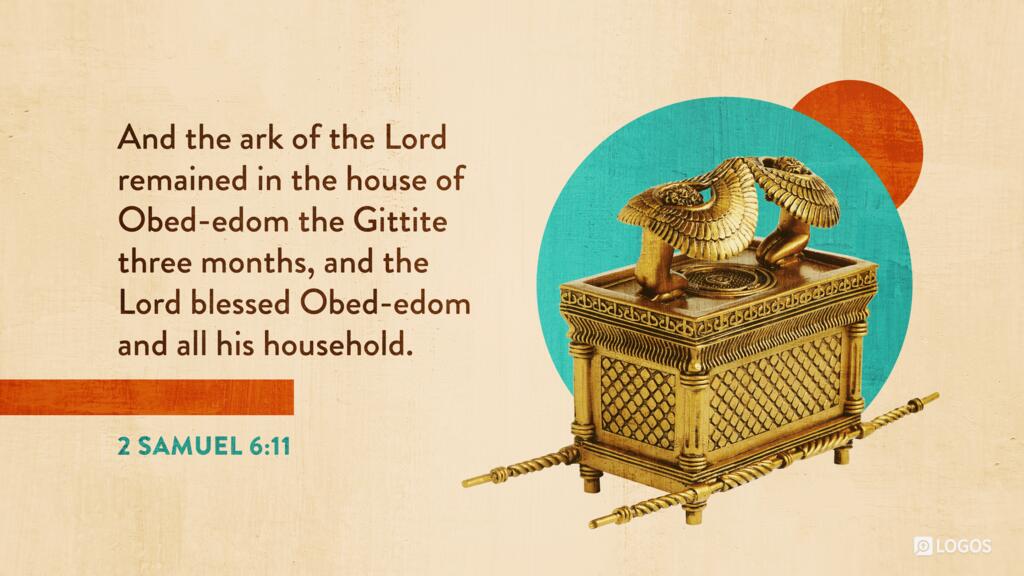
6:8David was angry because the Lord attacked19 Uzzah; so he called that place Perez Uzzah,20 which remains its name to this very day. 6:9David was afraid of the Lord that day and said, “How will the ark of the Lord ever come to me?” 6:10So David was no longer willing to bring the ark of the Lord to be with him in the City of David. David left it in the house of Obed-Edom the Gittite. 6:11The ark of the Lord remained in the house of Obed-Edom the Gittite for three months. The Lord blessed Obed-Edom and all his family.21
Footnotes
- 3 Heb “arose and went.”
- 4 Heb “from,” but the following context indicates they traveled to this location.
- 5 This is another name for Kiriath-jearim (see 1 Chr 13:6).
- 6 The has here a double reference to the name (שֵׁם שֵׁם, shem shem). Many medieval Hebrew in the first occurrence point the word differently and read the adverb שָׁם (sham, “there”). This is also the understanding of the (, taman). While this yields an acceptable understanding to the text, it is more likely that the dittographic here. The present translation therefore reads שֵׁם only once.
- 7 Heb “lifted.”
- 8 Heb “all the house of Israel.”
- 9 Heb “were celebrating before the Lord with all woods of fir” (cf. , , ). If the text is retained, the last expression must be elliptical, referring to musical instruments made from fir wood. But it is preferable to emend the text in light of 1 Chr 13:8, which reads “were celebrating before the Lord with all strength and with songs.”
- 10 Heb “with zithers [?] and with harps.”
- 11 That is, “sistrums” (so , ); , , , , “castanets.”
- 12 1 Chr 13:9 has “Kidon.”
- 13 Or “steadied.”
- 14 Heb “and Uzzah reached out toward the ark of God and grabbed it.”
- 15 Heb “and the anger of the Lord burned against Uzzah.”
- 16 Heb “God.”
- 17 Heb “there.” Since this same term occurs later in the verse it is translated “on the spot” here for stylistic reasons.
- 18 The phrase “his negligence” is absent from the .
- 19 Heb “because the Lord broke out [with] a breaking out [i.e., an outburst] against Uzzah.”
- 20 The name Perez Uzzah means in Hebrew “the outburst [against] Uzzah.”
- 21 Heb “house,” both here and in v. 12.
The NET Bible First Edition, Copyright 1996-2005 by Biblical Studies Press