1 Samuel 16:1–12
The NET BibleOther versions
English
- NET The NET Bible
- DARBY 1890 Darby Bible
- ASV American Standard Version
- AV 1873 The Cambridge Paragraph Bible of the Authorized English Version
- CSB Christian Standard Bible
- D-R Douay-Rheims Bible
- ESV English Standard Version
- GW GOD’S WORD Translation
- GNB Good News Translation
- HCSB The Holman Christian Standard Bible
- KJV 1900 King James Version
- LSB Legacy Standard Bible
- LEB The Lexham English Bible
- MSG The Message: The Bible in Contemporary Language
- NASB95 New American Standard Bible (1995)
- NCV New Century Version
- NIrV New International Reader’s Version (1998)
- NIV New International Version (2011)
- NKJV The New King James Version
- NLT New Living Translation
- NRSVue New Revised Standard Version: Updated Edition
- RSV The Revised Standard Version
- RSVCE The Revised Standard Version, Catholic Edition
- YLT Young’s Literal Translation
Arabic
Czech
French
German
Hebrew
Hungarian
Italian
Korean
Latin
Portuguese
Russian
Simplified Chinese
Spanish
Traditional Chinese
Samuel Anoints David as King
16:1The Lord said to Samuel, “How long do you intend to mourn for Saul? I have rejected him as king over Israel.1 Fill your horn with olive oil and go! I am sending you to Jesse in Bethlehem,2 for I have selected a king for myself from among his sons.”3
16:2Samuel replied, “How can I go? Saul will hear about it and kill me!” But the Lord said, “Take a heifer with you4 and say, ‘I have come to sacrifice to the Lord.’ 16:3Then invite Jesse to the sacrifice, and I will show you what you should do. You will anoint for me the one I point out5 to you.”
16:4Samuel did what the Lord told him.6 When he arrived in Bethlehem,7 the elders of the city were afraid to meet him. They8 said, “Do you come in peace?” 16:5He replied, “Yes, in peace. I have come to sacrifice to the Lord. Consecrate yourselves and come with me to the sacrifice.” So he consecrated Jesse and his sons and invited them to the sacrifice.
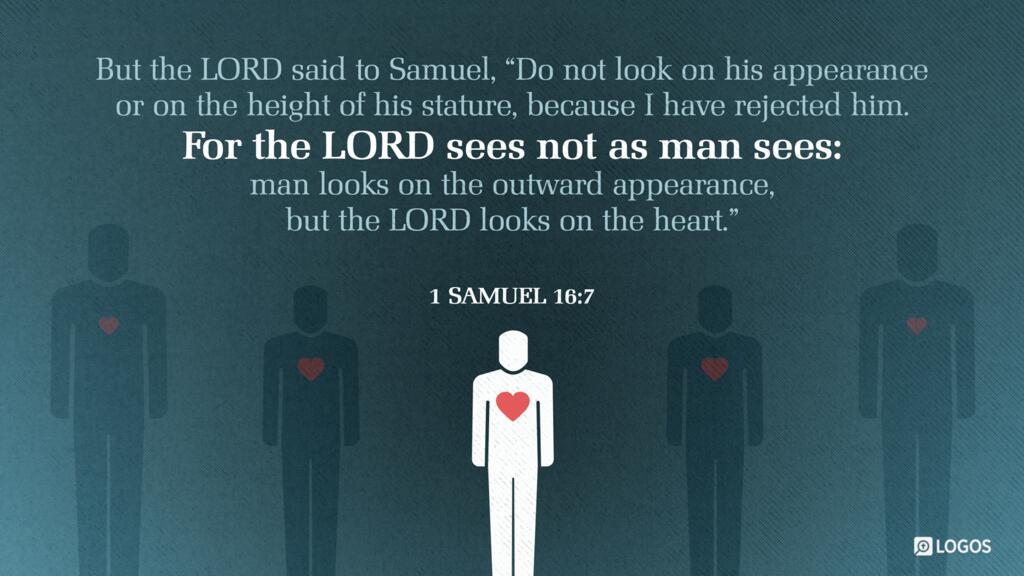
16:6When they arrived, Samuel9 noticed10 Eliab and said to himself,11 “Surely, here before the Lord stands his chosen king!”1216:7But the Lord said to Samuel, “Don’t be impressed by13 his appearance or his height, for I have rejected him. God does not view things the way men do.14 People look on the outward appearance,15 but the Lord looks at the heart.”
16:8Then Jesse called Abinadab and presented him to Samuel.16 But Samuel17 said, “The Lord has not chosen this one, either.” 16:9Then Jesse presented18 Shammah. But Samuel said, “The Lord has not chosen this one either.” 16:10Jesse presented seven of his sons to Samuel.19 But Samuel said to Jesse, “The Lord has not chosen any of these.” 16:11Then Samuel said to Jesse, “Is that all of the young men?” Jesse20 replied, “There is still the youngest one, but he’s taking care of the flock.” Samuel said to Jesse, “Send and get him, for we cannot turn our attention to other things until he comes here.”
16:12So Jesse had him brought in.21 Now he was ruddy, with attractive eyes and a handsome appearance. The Lord said, “Go and anoint him. This is the one!”
Footnotes
- 1 The Lucianic recension of the Old Greek translation includes the following words: “And the Lord said to Samuel.”
- 2 For location see ; ; ; .
- 3 Heb “for I have seen among his sons for me a king.”
- 4 Heb “in your hand.”
- 5 Heb “say”; , “name”; “indicate.”
- 6 Heb “said.”
- 7 For location see ; ; ; .
- 8 In the the verb is singular (“he said”), but the translation follows many medieval Hebrew and ancient versions in reading the plural (“they said”).
- 9 Heb “he”; the referent (Samuel) has been specified in the translation for clarity.
- 10 Heb “saw.”
- 11 Heb “said”; the words “to himself” are implied, given the secrecy surrounding Samuel’s mission to Bethlehem (v. 2).
- 12 Heb “his anointed one.”
- 13 Heb “don’t look toward.”
- 14 Heb “for not that which the man sees.” The translation follows the , which reads, “for not as man sees does God see.” The has suffered from homoioteleuton or homoioarcton. See P. K. McCarter, I Samuel (), .
- 15 Heb “to the eyes.”
- 16 Heb “and caused him to pass before.”
- 17 Heb “he” (also in v. 9); the referent (Samuel) has been specified in the translation for clarity.
- 18 Heb “caused to pass by.”
- 19 Heb “caused seven of his sons to pass before Samuel.” This could be taken as referring to seven sons in addition to the three mentioned before this, but 1 Sam 17:12 says Jesse had eight sons, not eleven. 1 Chr 2:13–15 lists only seven sons, including David. However, 1 Chr 27:18 mentions an additional son, named Elihu.
- 20 Heb “he”; the referent (Jesse) has been specified in the translation both here and in v. 12 for clarity.
- 21 Heb “and he sent and brought him.”
The NET Bible First Edition, Copyright 1996-2005 by Biblical Studies Press