1 Peter 2:16
The NET BibleOther versions
English
- NET The NET Bible
- DARBY 1890 Darby Bible
- ASV American Standard Version
- AV 1873 The Cambridge Paragraph Bible of the Authorized English Version
- CSB Christian Standard Bible
- D-R Douay-Rheims Bible
- ESV English Standard Version
- GW GOD’S WORD Translation
- GNB Good News Translation
- HCSB The Holman Christian Standard Bible
- KJV 1900 King James Version
- LSB Legacy Standard Bible
- LEB The Lexham English Bible
- MSG The Message: The Bible in Contemporary Language
- NASB95 New American Standard Bible (1995)
- NCV New Century Version
- NIrV New International Reader’s Version (1998)
- NIV New International Version (2011)
- NKJV The New King James Version
- NLT New Living Translation
- NRSVue New Revised Standard Version: Updated Edition
- RSV The Revised Standard Version
- RSVCE The Revised Standard Version, Catholic Edition
- TNIV Today’s New International Version
- YLT Young’s Literal Translation
Arabic
Czech
French
German
Greek
Hungarian
Italian
Korean
Latin
Portuguese
Russian
Simplified Chinese
Spanish
Traditional Chinese
Footnotes
- 38 There is no main verb in this verse, but it continues the sense of command from v. 13, “be subject …, as free people … not using … but as slaves of God.”
- 39 Traditionally, “servants” or “bondservants.” Though δοῦλος (doulos) is normally translated “servant,” the word does not bear the connotation of a free individual serving another. notes that “ ‘servant’ for ‘slave’ is largely confined to Biblical transl. and early American times … in normal usage at the present time the two words are carefully distinguished” ( ). The most accurate translation is “bondservant” (sometimes found in the for δοῦλος), in that it often indicates one who sells himself into slavery to another. But as this is archaic, few today understand its force. Undoubtedly the background for the concept of being the Lord’s slave or servant is to be found in the Old Testament scriptures. For a Jew this concept did not connote drudgery, but honor and privilege. It was used of national Israel at times (Isa 43:10), but was especially associated with famous OT personalities, including such great men as Moses (Josh 14:7), David (Ps 89:3; cf. 2 Sam 7:5, 8) and Elijah (2 Kgs 10:10); all these men were “servants (or slaves) of the Lord.”
The NET Bible First Edition, Copyright 1996-2005 by Biblical Studies Press
In other versions
ESVEnglish Standard Version
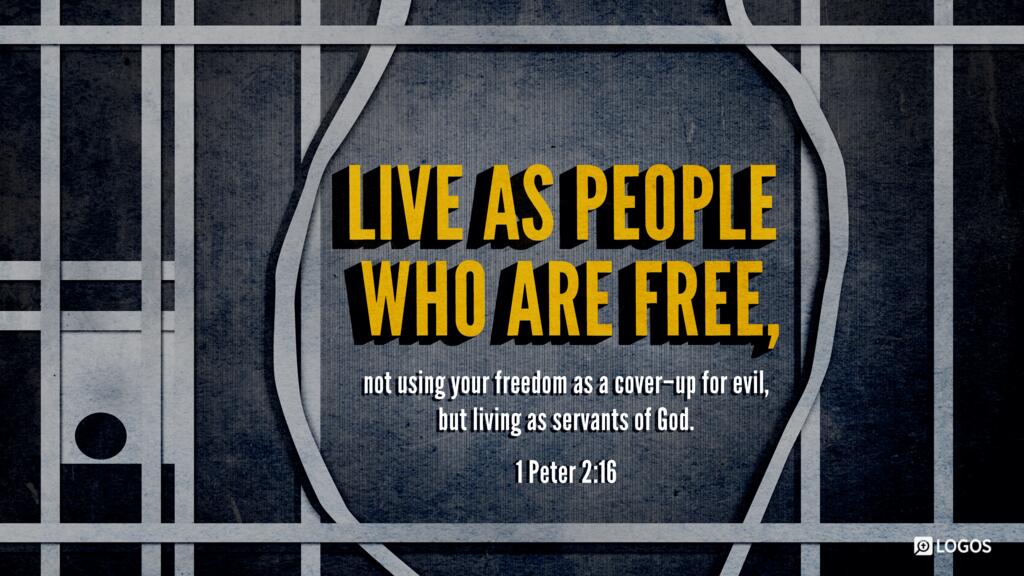
Live as people who are free, not using your freedom as a cover-up for evil, but living as servants of God.
Copyright 2001 Crossway Bibles
NIVNew International Version (2011)
Live as free people, but do not use your freedom as a cover-up for evil; live as God’s slaves.
Copyright 1973, 1978, 1984, 2011 Biblica, Inc.
CSBChristian Standard Bible
Submit as free people, not using your freedom as a cover-up for evil, but as God’s slaves.
Copyright 2017 Holman Bible Publishers
NLTNew Living Translation
For you are free, yet you are God’s slaves, so don’t use your freedom as an excuse to do evil.
Holy Bible, New Living Translation, copyright © 1996, 2004, 2015 by Tyndale House Foundation. Used by permission of Tyndale House Publishers. All rights reserved.
LEBThe Lexham English Bible
Live as free persons, and not using your freedom as a covering for evil, but as slaves of God.
Copyright 2012 Lexham Press
KJV 1900King James Version
As free, and not using your liberty for a cloke of maliciousness, but as the servants of God.
Public Domain