Matthew 22:34–46
The Message: The Bible in Contemporary LanguageOther versions
English
- MSG The Message: The Bible in Contemporary Language
- DARBY 1890 Darby Bible
- ASV American Standard Version
- AV 1873 The Cambridge Paragraph Bible of the Authorized English Version
- CSB Christian Standard Bible
- D-R Douay-Rheims Bible
- ESV English Standard Version
- GW GOD’S WORD Translation
- GNB Good News Translation
- HCSB The Holman Christian Standard Bible
- KJV 1900 King James Version
- LSB Legacy Standard Bible
- LEB The Lexham English Bible
- NET The NET Bible
- NASB95 New American Standard Bible (1995)
- NCV New Century Version
- NIrV New International Reader’s Version (1998)
- NIV New International Version (2011)
- NKJV The New King James Version
- NLT New Living Translation
- NRSVue New Revised Standard Version: Updated Edition
- RSV The Revised Standard Version
- RSVCE The Revised Standard Version, Catholic Edition
- YLT Young’s Literal Translation
Arabic
Czech
French
German
Greek
Hungarian
Italian
Korean
Latin
Portuguese
Russian
Simplified Chinese
Spanish
Traditional Chinese
The Most Important Command
34–36When the Pharisees heard how he had bested the Sadducees, they gathered their forces for an assault. One of their religion scholars spoke for them, posing a question they hoped would show him up: “Teacher, which command in God’s Law is the most important?”
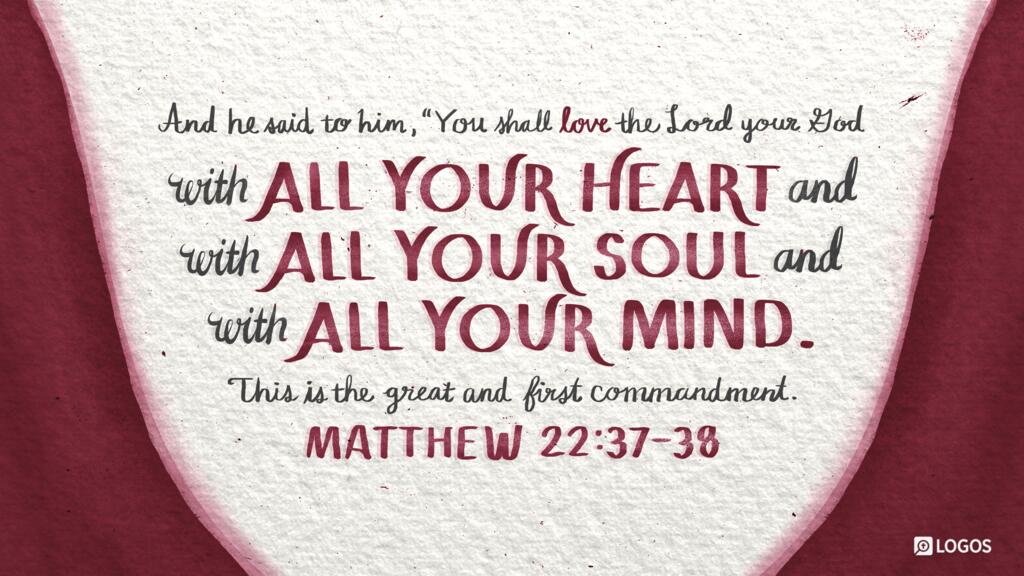
37–40Jesus said, “ ‘Love the Lord your God with all your passion and prayer and intelligence.’ This is the most important, the first on any list. But there is a second to set alongside it: ‘Love others as well as you love yourself.’ These two commands are pegs; everything in God’s Law and the Prophets hangs from them.”
David’s Son and Master
41–42As the Pharisees were regrouping, Jesus caught them off balance with his own test question: “What do you think about the Christ? Whose son is he?” They said, “David’s son.”
43–45Jesus replied, “Well, if the Christ is David’s son, how do you explain that David, under inspiration, named Christ his ‘Master’?
God said to my Master,
“Sit here at my right hand
until I make your enemies your footstool.”
“Now if David calls him ‘Master,’ how can he at the same time be his son?”
46That stumped them, literalists that they were. Unwilling to risk losing face again in one of these public verbal exchanges, they quit asking questions for good.
Copyright 2005 Eugene H. Peterson.