John 9:1–23
The Message: The Bible in Contemporary LanguageOther versions
English
- MSG The Message: The Bible in Contemporary Language
- DARBY 1890 Darby Bible
- ASV American Standard Version
- AV 1873 The Cambridge Paragraph Bible of the Authorized English Version
- CSB Christian Standard Bible
- D-R Douay-Rheims Bible
- ESV English Standard Version
- GW GOD’S WORD Translation
- GNB Good News Translation
- HCSB The Holman Christian Standard Bible
- KJV 1900 King James Version
- LSB Legacy Standard Bible
- LEB The Lexham English Bible
- NET The NET Bible
- NASB95 New American Standard Bible (1995)
- NCV New Century Version
- NIrV New International Reader’s Version (1998)
- NIV New International Version (2011)
- NKJV The New King James Version
- NLT New Living Translation
- NRSVue New Revised Standard Version: Updated Edition
- RSV The Revised Standard Version
- RSVCE The Revised Standard Version, Catholic Edition
- YLT Young’s Literal Translation
Arabic
Czech
French
German
Greek
Hungarian
Italian
Korean
Latin
Portuguese
Russian
Simplified Chinese
Spanish
Traditional Chinese
True Blindness
1–29Walking down the street, Jesus saw a man blind from birth. His disciples asked, “Rabbi, who sinned: this man or his parents, causing him to be born blind?”
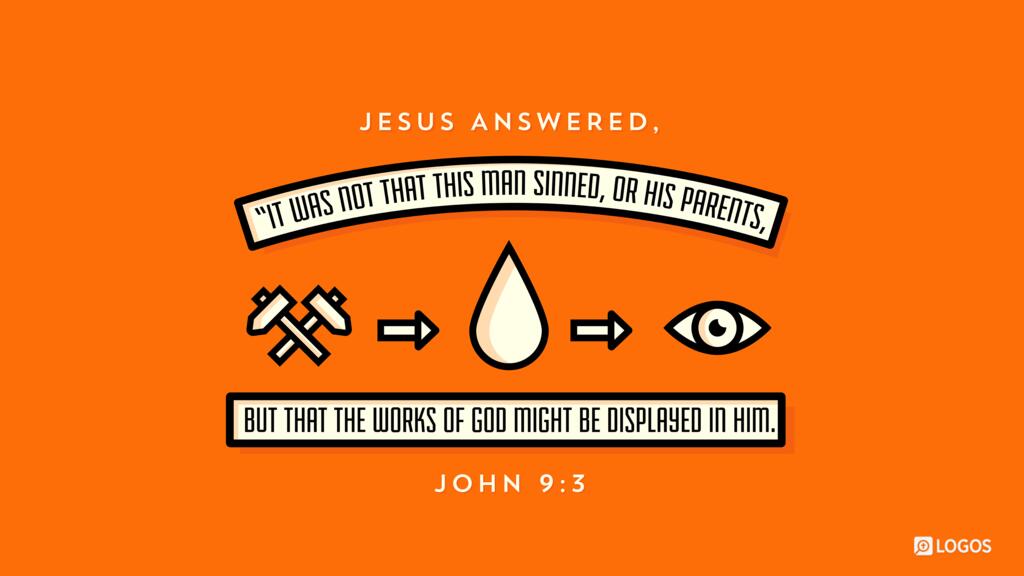
3–5Jesus said, “You’re asking the wrong question. You’re looking for someone to blame. There is no such cause-effect here. Look instead for what God can do. We need to be energetically at work for the One who sent me here, working while the sun shines. When night falls, the workday is over. For as long as I am in the world, there is plenty of light. I am the world’s Light.”
6–7He said this and then spit in the dust, made a clay paste with the saliva, rubbed the paste on the blind man’s eyes, and said, “Go, wash at the Pool of Siloam” (Siloam means “Sent”). The man went and washed—and saw.
8Soon the town was buzzing. His relatives and those who year after year had seen him as a blind man begging were saying, “Why, isn’t this the man we knew, who sat here and begged?”
9Others said, “It’s him all right!”
But others objected, “It’s not the same man at all. It just looks like him.”
He said, “It’s me, the very one.”
10They said, “How did your eyes get opened?”
11“A man named Jesus made a paste and rubbed it on my eyes and told me, ‘Go to Siloam and wash.’ I did what he said. When I washed, I saw.”
12“So where is he?”
“I don’t know.”
13–15They marched the man to the Pharisees. This day when Jesus made the paste and healed his blindness was the Sabbath. The Pharisees grilled him again on how he had come to see. He said, “He put a clay paste on my eyes, and I washed, and now I see.”
16Some of the Pharisees said, “Obviously, this man can’t be from God. He doesn’t keep the Sabbath.”
Others countered, “How can a bad man do miraculous, God-revealing things like this?” There was a split in their ranks.
17They came back at the blind man, “You’re the expert. He opened your eyes. What do you say about him?”
He said, “He is a prophet.”
18–19The Jews didn’t believe it, didn’t believe the man was blind to begin with. So they called the parents of the man now bright-eyed with sight. They asked them, “Is this your son, the one you say was born blind? So how is it that he now sees?”
20–23His parents said, “We know he is our son, and we know he was born blind. But we don’t know how he came to see—haven’t a clue about who opened his eyes. Why don’t you ask him? He’s a grown man and can speak for himself.” (His parents were talking like this because they were intimidated by the Jewish leaders, who had already decided that anyone who took a stand that this was the Messiah would be kicked out of the meeting place. That’s why his parents said, “Ask him. He’s a grown man.”)
Copyright 2005 Eugene H. Peterson.