John 19:23–42
The Message: The Bible in Contemporary LanguageOther versions
English
- MSG The Message: The Bible in Contemporary Language
- DARBY 1890 Darby Bible
- ASV American Standard Version
- AV 1873 The Cambridge Paragraph Bible of the Authorized English Version
- CSB Christian Standard Bible
- D-R Douay-Rheims Bible
- ESV English Standard Version
- GW GOD’S WORD Translation
- GNB Good News Translation
- HCSB The Holman Christian Standard Bible
- KJV 1900 King James Version
- LSB Legacy Standard Bible
- LEB The Lexham English Bible
- NET The NET Bible
- NASB95 New American Standard Bible (1995)
- NCV New Century Version
- NIrV New International Reader’s Version (1998)
- NIV New International Version (2011)
- NKJV The New King James Version
- NLT New Living Translation
- NRSVue New Revised Standard Version: Updated Edition
- RSV The Revised Standard Version
- RSVCE The Revised Standard Version, Catholic Edition
- YLT Young’s Literal Translation
Arabic
Czech
French
German
Greek
Hungarian
Italian
Korean
Latin
Portuguese
Russian
Simplified Chinese
Spanish
Traditional Chinese
23–24When they crucified him, the Roman soldiers took his clothes and divided them up four ways, to each soldier a fourth. But his robe was seamless, a single piece of weaving, so they said to each other, “Let’s not tear it up. Let’s throw dice to see who gets it.” This confirmed the Scripture that said, “They divided up my clothes among them and threw dice for my coat.” (The soldiers validated the Scriptures!)
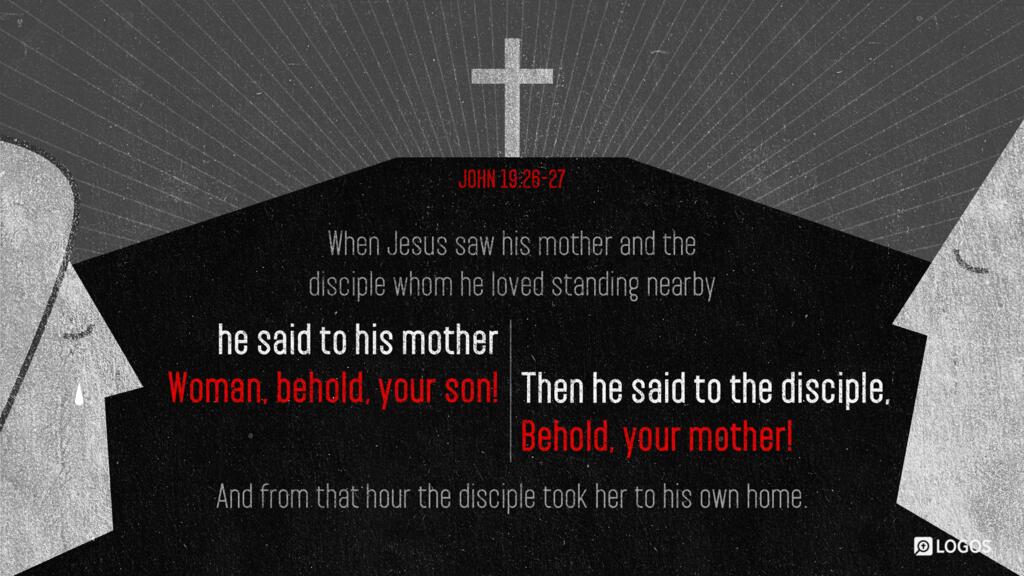
24–27While the soldiers were looking after themselves, Jesus’ mother, his aunt, Mary the wife of Clopas, and Mary Magdalene stood at the foot of the cross. Jesus saw his mother and the disciple he loved standing near her. He said to his mother, “Woman, here is your son.” Then to the disciple, “Here is your mother.” From that moment the disciple accepted her as his own mother.
28Jesus, seeing that everything had been completed so that the Scripture record might also be complete, then said, “I’m thirsty.”
29–30A jug of sour wine was standing by. Someone put a sponge soaked with the wine on a javelin and lifted it to his mouth. After he took the wine, Jesus said, “It’s done … complete.” Bowing his head, he offered up his spirit.
31–34Then the Jews, since it was the day of Sabbath preparation, and so the bodies wouldn’t stay on the crosses over the Sabbath (it was a high holy day that year), petitioned Pilate that their legs be broken to speed death, and the bodies taken down. So the soldiers came and broke the legs of the first man crucified with Jesus, and then the other. When they got to Jesus, they saw that he was already dead, so they didn’t break his legs. One of the soldiers stabbed him in the side with his spear. Blood and water gushed out.
35The eyewitness to these things has presented an accurate report. He saw it himself and is telling the truth so that you, also, will believe.
36–37These things that happened confirmed the Scripture, “Not a bone in his body was broken,” and the other Scripture that reads, “They will stare at the one they pierced.”
38After all this, Joseph of Arimathea (he was a disciple of Jesus, but secretly, because he was intimidated by the Jews) petitioned Pilate to take the body of Jesus. Pilate gave permission. So Joseph came and took the body.
39–42Nicodemus, who had first come to Jesus at night, came now in broad daylight carrying a mixture of myrrh and aloes, about seventy-five pounds. They took Jesus’ body and, following the Jewish burial custom, wrapped it in linen with the spices. There was a garden near the place he was crucified, and in the garden a new tomb in which no one had yet been placed. So, because it was Sabbath preparation for the Jews and the tomb was convenient, they placed Jesus in it.
Copyright 2005 Eugene H. Peterson.