Matthew 11:2–19
The Lexham English BibleOther versions
English
- LEB The Lexham English Bible
- DARBY 1890 Darby Bible
- ASV American Standard Version
- AV 1873 The Cambridge Paragraph Bible of the Authorized English Version
- CSB Christian Standard Bible
- D-R Douay-Rheims Bible
- ESV English Standard Version
- GW GOD’S WORD Translation
- GNB Good News Translation
- HCSB The Holman Christian Standard Bible
- KJV 1900 King James Version
- LSB Legacy Standard Bible
- MSG The Message: The Bible in Contemporary Language
- NET The NET Bible
- NASB95 New American Standard Bible (1995)
- NCV New Century Version
- NIrV New International Reader’s Version (1998)
- NIV New International Version (2011)
- NKJV The New King James Version
- NLT New Living Translation
- NRSVue New Revised Standard Version: Updated Edition
- RSV The Revised Standard Version
- RSVCE The Revised Standard Version, Catholic Edition
- TNIV Today’s New International Version
- YLT Young’s Literal Translation
Arabic
Czech
French
German
Greek
Hungarian
Italian
Korean
Latin
Portuguese
Russian
Simplified Chinese
Spanish
Traditional Chinese
2Now when* Johna heard in prison the deeds of Christ, he sent word* by his disciples 3and* said to him, “Are you the one who is to come, or should we look for another?” 4And Jesus answered and* said to them, “Go and* tell John what you hear and see: 5the blind receive sight and the lame walk, lepers are cleansed and the deaf hear, and the dead are raised, and the poor have good news announced to them.* 6And whoever is not offended by me is blessed.”
7Now as* these were going away, Jesus began to speak to the crowds concerning John: “What did you go out into the wilderness to see? A reed shaken by the wind? 8But what did you go out to see? A man dressed in soft clothing? Behold, those who wear soft clothing are in the houses of kings. 9But why did you go out? To see a prophet?b Yes, I tell you, and even more than a prophet! 10It is this man about whom it is written:
‘Behold, I am sending my messenger before your face,
who will prepare your way before you.’c
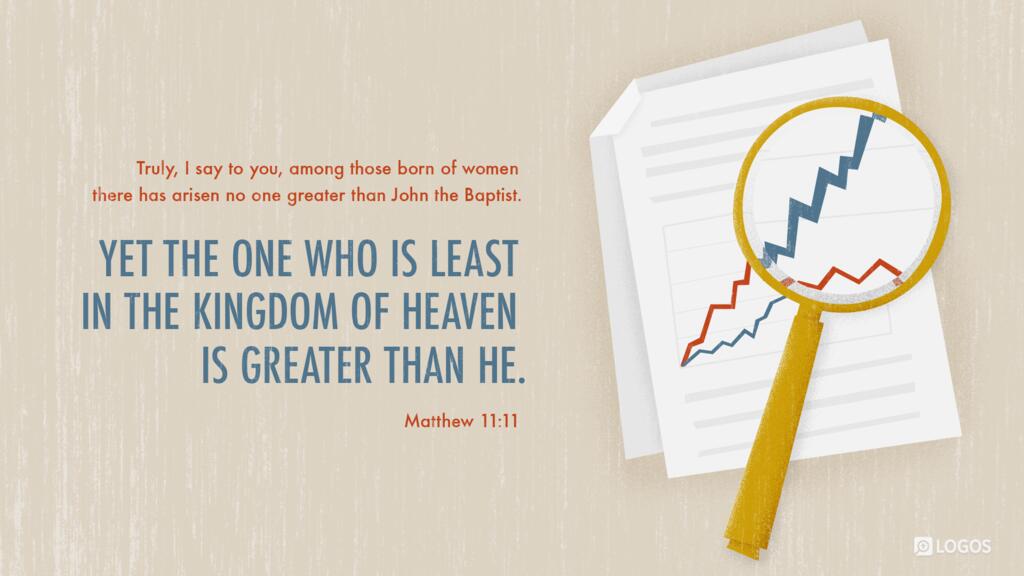
11Truly I say to you, among those born of women there has not arisen one greater than John the Baptist. But the one who is least in the kingdom of heaven is greater than he. 12But from the days of John the Baptist until now, the kingdom of heaven is treated violently, and the violent claimd it. 13For all the prophets and the law prophesied until John, 14and if you are willing to accept it,* he is Elijah, the one who is going to come. 15The one who has ears, let him hear!
16“But to what shall I compare this generation? It is like children sitting in the marketplaces who call out to one another, 17saying,
‘We played the flute for you and you did not dance;
we sang a lament and you did not mourn.’
18For John came neither eating nor drinking, and they say, ‘He has a demon!’ 19The Son of Man came eating and drinking, and they say, ‘Behold, a man who is a glutton and a drunkard, a friend of tax collectors and sinners!’ But wisdom is vindicated by her deeds.”e
Footnotes
- *Here “when” is supplied as a component of the participle (“heard”) which is understood as temporal
- aThat is, John the Baptist
- *Here the direct object is supplied from context in the English translation
- *Here “and” is supplied because the previous participle (“sent” in the previous verse) has been translated as a finite verb
- *Here “and” is supplied because the previous participle (“answered”) has been translated as a finite verb
- *Here “and” is supplied because the previous participle (“go”) has been translated as a finite verb
- *Here the direct object is supplied from context in the English translation
- *Here “as” is supplied as a component of the temporal genitive absolute participle (“were going away”)
- bSome manuscripts have “But what did you go out to see? A prophet?”
- cA quotation from Mal 3:1; cf. Mark 1:2
- dOr “seize”
- *Here the direct object is supplied from context in the English translation
- eMany Greek manuscripts, including most later ones, read “children”
Copyright 2012 Lexham Press