Mark 14:22–31
The Lexham English BibleOther versions
English
- LEB The Lexham English Bible
- DARBY 1890 Darby Bible
- ASV American Standard Version
- AV 1873 The Cambridge Paragraph Bible of the Authorized English Version
- CSB Christian Standard Bible
- D-R Douay-Rheims Bible
- ESV English Standard Version
- GW GOD’S WORD Translation
- GNB Good News Translation
- HCSB The Holman Christian Standard Bible
- KJV 1900 King James Version
- LSB Legacy Standard Bible
- MSG The Message: The Bible in Contemporary Language
- NET The NET Bible
- NASB95 New American Standard Bible (1995)
- NCV New Century Version
- NIrV New International Reader’s Version (1998)
- NIV New International Version (2011)
- NKJV The New King James Version
- NLT New Living Translation
- NRSVue New Revised Standard Version: Updated Edition
- RSV The Revised Standard Version
- RSVCE The Revised Standard Version, Catholic Edition
- TNIV Today’s New International Version
- YLT Young’s Literal Translation
Arabic
Czech
French
German
Greek
Hungarian
Italian
Korean
Latin
Portuguese
Russian
Simplified Chinese
Spanish
Traditional Chinese
The Lord’s Supper
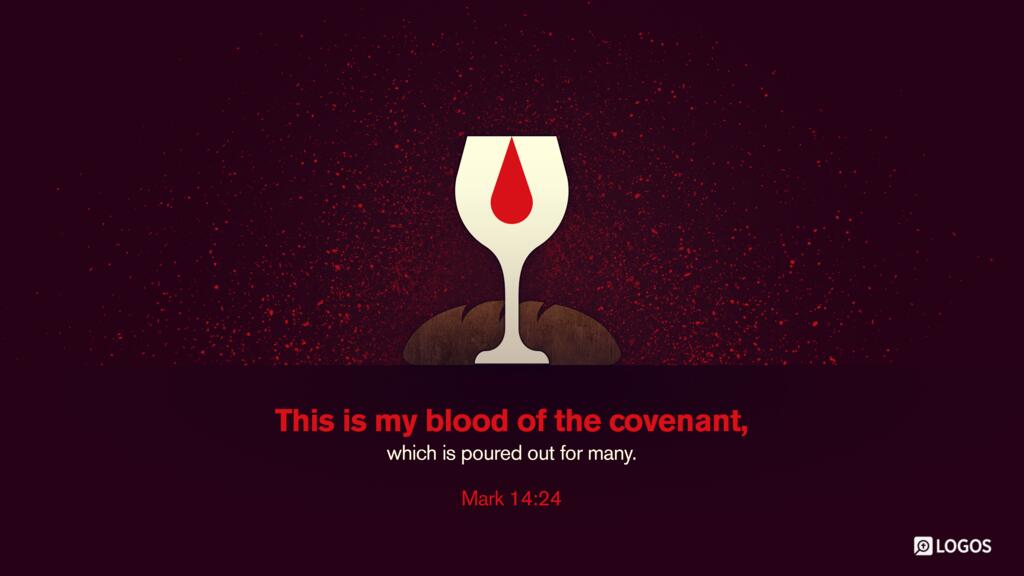
22And while* they were eating, he took bread and,* after* giving thanks, he broke it* and gave it* to them and said, “Take it,* this is my body.” 23And after* taking the cup and* giving thanks, he gave it* to them, and they all drank from it. 24And he said to them, “This is my blood of the covenant which is poured out for many. 25Truly I say to you that I will never drink of the fruit of the vine any longer until that day when I drink it new in the kingdom of God.” 26And after they* had sung the hymn, they went out to the Mount of Olives.
Jesus Predicts Peter’s Denial
27And Jesus said to them, “You will all fall away, because it is written,
‘I will strike the shepherd
and the sheep will be scattered.’g
28But after I am raised, I will go ahead of you into Galilee.” 29But Peter said to him, “Even if they all fall away, certainly I will not!” 30And Jesus said to him, “Truly I say to you that today—this night—before the rooster crows twice, you will deny me three times!” 31But he kept saying emphatically, “If it is necessary for me to die with you, I will never deny you!” And they all were saying the same thing also.
Footnotes
- *Here “while” is supplied as a component of the temporal genitive absolute participle (“were eating”)
- *Here “and” is supplied in the translation because of English style
- *Here “after” is supplied as a component of the participle (“giving thanks”) which is understood as temporal
- *Here the direct object is supplied from context in the English translation
- *Here the direct object is supplied from context in the English translation
- *Here the direct object is supplied from context in the English translation
- *Here “after” is supplied as a component of the participle (“taking”) which is understood as temporal
- *Here “and” is supplied in the translation because of English style
- *Here the direct object is supplied from context in the English translation
- *Here “after” is supplied as a component of the participle (“had sung the hymn”) which is understood as temporal
- gA quotation from Zech 13:7
Copyright 2012 Lexham Press