Mark 13:14–27
The Lexham English BibleOther versions
English
- LEB The Lexham English Bible
- DARBY 1890 Darby Bible
- ASV American Standard Version
- AV 1873 The Cambridge Paragraph Bible of the Authorized English Version
- CSB Christian Standard Bible
- D-R Douay-Rheims Bible
- ESV English Standard Version
- GW GOD’S WORD Translation
- GNB Good News Translation
- HCSB The Holman Christian Standard Bible
- KJV 1900 King James Version
- LSB Legacy Standard Bible
- MSG The Message: The Bible in Contemporary Language
- NET The NET Bible
- NASB95 New American Standard Bible (1995)
- NCV New Century Version
- NIrV New International Reader’s Version (1998)
- NIV New International Version (2011)
- NKJV The New King James Version
- NLT New Living Translation
- NRSVue New Revised Standard Version: Updated Edition
- RSV The Revised Standard Version
- RSVCE The Revised Standard Version, Catholic Edition
- YLT Young’s Literal Translation
Arabic
Czech
French
German
Greek
Hungarian
Italian
Korean
Latin
Portuguese
Russian
Simplified Chinese
Spanish
Traditional Chinese
The Abomination of Desolation
14“But when you see the abomination of desolation standing where it should not be” (let the one who reads understand), “then those in Judea must flee to the mountains! 15The oneb who is on hisc housetop must not come down or go inside to take anything out of his house, 16and the one who is in the field must not turn back to pick up his cloak. 17And woe to those who are pregnantd and to those who are nursing their babies* in those days! 18But pray that it will not happen in winter. 19For in those days there will be tribulation of such a kind as has not happened from the beginning of the creation that God created until now, and never will happen. 20And if the Lord had not shortened the days, no human being would be saved.e But for the sake of the elect, whom he chose, he has shortened the days.
21“And at that time if anyone should say to you, “Behold, here is the Christ,’ ‘Behold, there he is,’ do not believe him!* 22For false messiahs and false prophets will appear, and will produce signs and wonders in order to mislead, if possible, the elect. 23But you, watch out! I have told you everything ahead of time!
The Arrival of the Son of Man
24“But in those days, after that tribulation,
‘the sun will be darkened
and the moon will not give its light,
25and the stars will be falling from heaven,
and the powers in the heavens will be shaken.’f
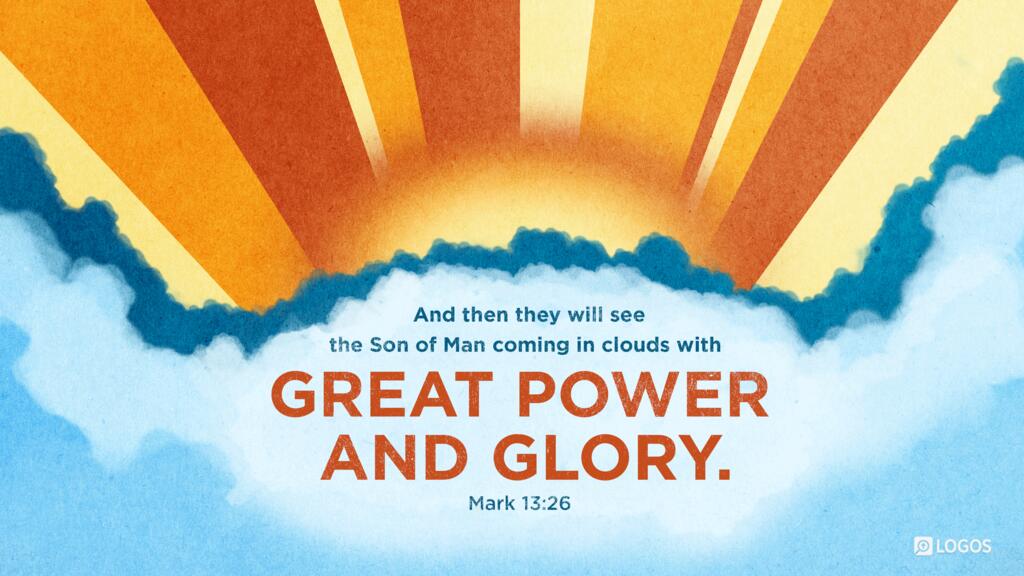
26And then they will see the Son of Man arriving in the clouds with great power and glory. 27And then he will send out the angels, and will gather theg elect together from the four winds, from the end of the earth to the end of heaven.
Footnotes
- bSome manuscripts have “And the one”
- cLiterally “the”; the Greek article is used here as a possessive pronoun
- dLiterally “who have in the womb”
- *The words “their babies” are not in the Greek text but are supplied as a necessary clarification
- eLiterally “every flesh would not be saved”
- *Here the direct object is supplied from context in the English translation
- fA quotation from Isa 13:10; 34:4
- gSome manuscripts have “his”
Copyright 2012 Lexham Press