Luke 14:1–24
The Lexham English BibleOther versions
English
- LEB The Lexham English Bible
- DARBY 1890 Darby Bible
- ASV American Standard Version
- AV 1873 The Cambridge Paragraph Bible of the Authorized English Version
- CSB Christian Standard Bible
- D-R Douay-Rheims Bible
- ESV English Standard Version
- GW GOD’S WORD Translation
- GNB Good News Translation
- HCSB The Holman Christian Standard Bible
- KJV 1900 King James Version
- LSB Legacy Standard Bible
- MSG The Message: The Bible in Contemporary Language
- NET The NET Bible
- NASB95 New American Standard Bible (1995)
- NCV New Century Version
- NIrV New International Reader’s Version (1998)
- NIV New International Version (2011)
- NKJV The New King James Version
- NLT New Living Translation
- NRSVue New Revised Standard Version: Updated Edition
- RSV The Revised Standard Version
- RSVCE The Revised Standard Version, Catholic Edition
- TNIV Today’s New International Version
- YLT Young’s Literal Translation
Arabic
Czech
French
German
Greek
Hungarian
Italian
Korean
Latin
Portuguese
Russian
Simplified Chinese
Spanish
Traditional Chinese
A Man Suffering from Edema Healed
14And it happened that when he came to the house of a certain one of the leaders of the Pharisees on a Sabbath to eat a meal,a they were watching him closely. 2And behold, a certain man was in front of him, suffering from edema. 3And Jesus answered and* said to the legal experts and Pharisees, saying, “Is it permitted to heal on the Sabbath, or not?” 4But they remained silent. And he took hold of him* and* healed him, and sent him* away. 5And he said to them, “Who among you, if your* son or your ox falls into a wellb on the day of the Sabbath, will not immediately pull him out?” 6And they were not able to make a reply to these things.
The Parable of the Guests at the Wedding Feast
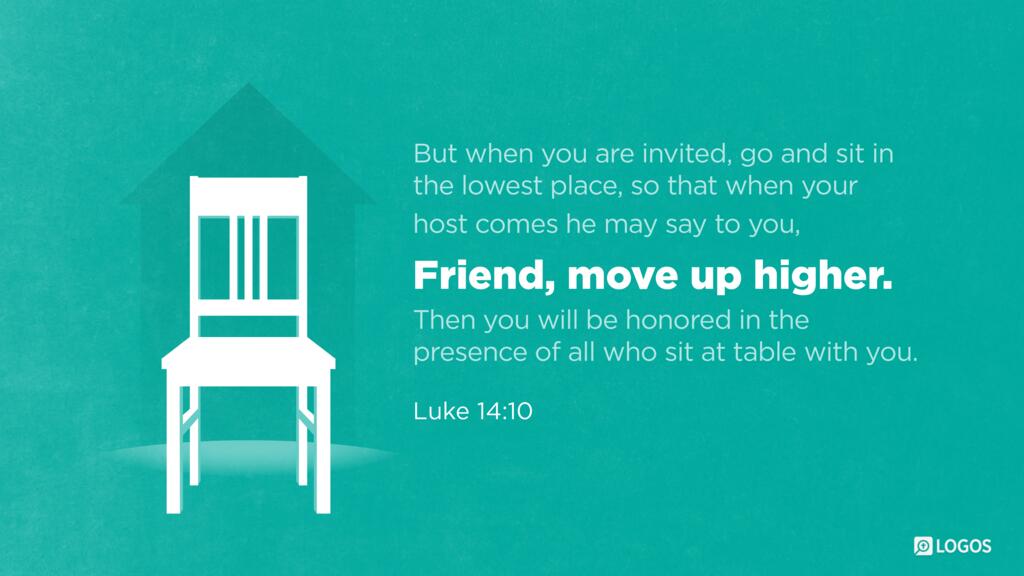
7Now he told a parable to those who had been invited when he* noticed how they were choosing for themselves the places of honor, saying to them, 8“When you are invited by someone to a wedding feast,c do not recline at the table in the place of honor, lest someone more distinguished than you has been invited by him, 9and the one who invited you bothd will come and* say to you, ‘Give the place to this person,’ and then with shame you will begin to take the last place. 10But when you are invited, go and* recline at the table in the last place, so that when the one who invited you comes, he will say to you, ‘Friend, move up higher.’ Then it will be an honor to you in the presence of all those who are reclining at the table with you. 11For everyone who exalts himself will be humbled, and the one who humbles himself will be exalted.”
The Parable of the Great Banquet
12And he also said to the one who had invited him, “When you give a dinner or a banquet, do not invite your friends or your brothers or your relatives or wealthy neighbors, lest they also invite you in return, and repayment come to you. 13But whenever you give a banquet, invite the poor, the crippled, the lame, the blind, 14and you will be blessed, because they are not able to repay you. For it will be paid back to you at the resurrection of the righteous.”
15Now when* one of those reclining at the table with him heard these things, he said to him, “Blessed is everyone whoe will eat bread in the kingdom of God!” 16But he said to him, “A certain man was giving a large banquet and invited many. 17And he sent his slave at the hour of the banquet to say to those who have been invited, ‘Come, because now it is ready!’ 18And they all alikef began to excuse themselves. The first said to him, ‘I have purchased a field, and I mustg go out to look at it. I ask you, consider me excused.’ 19And another said, ‘I have purchased five yoke of oxen, and I am going to examine them. I ask you, consider me excused.’ 20And another said, ‘I have married a wife, and for this reason I am not able to come.’ 21And the slave came and* reported these things to his master. Then the master of the house became angry and* said to his slave, ‘Go out quickly into the streets and alleys of the city and bring in here the poor and crippled and blind and lame!’ 22And the slave said, ‘Sir, what you ordered has been done, and there is still room.’ 23And the master said to the slave, ‘Go out into the highways and hedges and press them* to come in, so that my house will be filled! 24For I say to you that none of those persons who were invited will taste my banquet!’ ”
Footnotes
- aLiterally “bread”
- *Here “and” is supplied because the previous participle (“answered”) has been translated as a finite verb
- *Here the direct object is supplied from context in the English translation
- *Here “and” is supplied because the previous participle (“took hold of”) has been translated as a finite verb
- *Here the direct object is supplied from context in the English translation
- *The words “if your” are not in the Greek text but are implied
- bOr “cistern”
- *Here “when” is supplied as a component of the participle (“noticed”) which is understood as temporal
- cOr perhaps simply “a feast”
- dLiterally “and him”
- *Here “and” is supplied because the previous participle (“will come”) has been translated as a finite verb
- *Here “and” is supplied because the previous participle (“go”) has been translated as a finite verb
- *Here “when” is supplied as a component of the participle (“heard”) which is understood as temporal
- eLiterally “whoever”
- fLiterally “by one”
- gLiterally “I have necessity”
- *Here “and” is supplied because the previous participle (“came”) has been translated as a finite verb
- *Here “and” is supplied because the previous participle (“became angry”) has been translated as a finite verb
- *Here the direct object is supplied from context in the English translation
Copyright 2012 Lexham Press