Luke 1:26–38
The Lexham English BibleOther versions
English
- LEB The Lexham English Bible
- DARBY 1890 Darby Bible
- ASV American Standard Version
- AV 1873 The Cambridge Paragraph Bible of the Authorized English Version
- CSB Christian Standard Bible
- D-R Douay-Rheims Bible
- ESV English Standard Version
- GW GOD’S WORD Translation
- GNB Good News Translation
- HCSB The Holman Christian Standard Bible
- KJV 1900 King James Version
- LSB Legacy Standard Bible
- MSG The Message: The Bible in Contemporary Language
- NET The NET Bible
- NASB95 New American Standard Bible (1995)
- NCV New Century Version
- NIrV New International Reader’s Version (1998)
- NIV New International Version (2011)
- NKJV The New King James Version
- NLT New Living Translation
- NRSVue New Revised Standard Version: Updated Edition
- RSV The Revised Standard Version
- RSVCE The Revised Standard Version, Catholic Edition
- TNIV Today’s New International Version
- YLT Young’s Literal Translation
Arabic
Czech
French
German
Greek
Hungarian
Italian
Korean
Latin
Portuguese
Russian
Simplified Chinese
Spanish
Traditional Chinese
The Prediction of Jesus’ Birth
26Now in the sixth month, the angel Gabriel was sent from God to a town of Galilee namedg Nazareth, 27to a virgin legally promised in marriage to a man namedh Joseph of the house of David. And the name of the virgin was Mary. 28And he came to her and* said, “Greetings, favored one! The Lord is with you.” 29But she was greatly perplexed at the statement, and was pondering what sort of greeting this might be. 30And the angel said to her,
“Do not be afraid, Mary, for you have found favor with God.
31And behold, you will conceive in the womb and will give birth to a son,
and you will call his name Jesus.
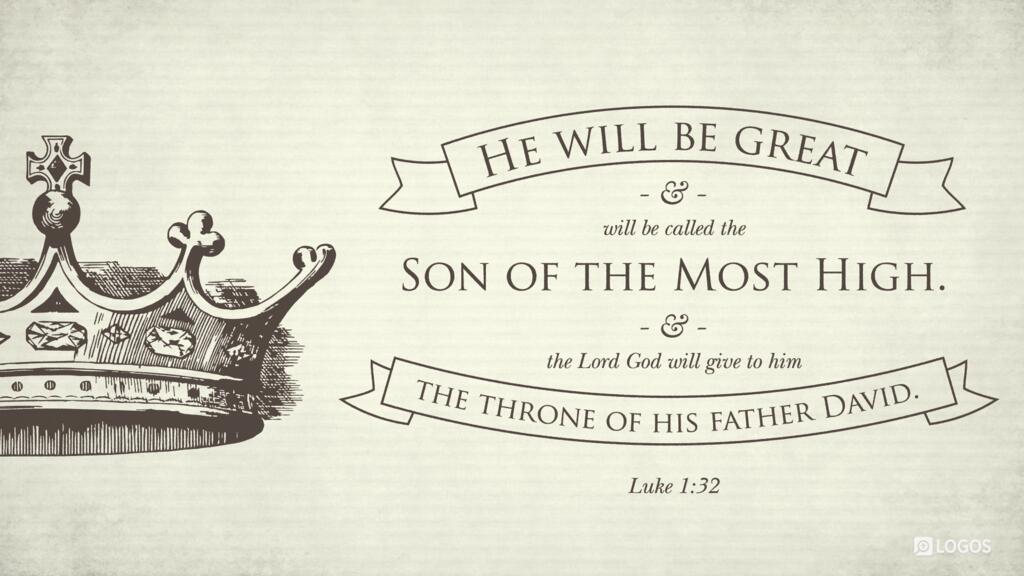
32This one will be great, and he will be called the Son of the Most High,
and the Lord God will give him the throne of his father David.
33And he will reign over the house of Jacob forever,i
and of his kingdom there will be no end.
34And Mary said to the angel, “How will this be, since I have not had sexual relations with a man?” 35And the angel answered and* said to her,
“The Holy Spirit will come upon you,
and the power of the Most High will overshadow you.
Therefore also the one to be born will be called holy, the Son of God.
36And behold, your relative Elizabeth—she also has conceived a son in her old age, and this is the sixth month for her who was called barren. 37For nothing will be impossible with God.”j
38So Mary said, “Behold, the Lord’s female slave! May it happen to me according to your word.” And the angel departed from her.
Footnotes
- gLiterally “to which the name”
- hLiterally “to whom the name”
- *Here “and” is supplied because the previous participle (“came”) has been translated as a finite verb
- iLiterally “for the ages”
- *Here “and” is supplied because the previous participle (“answered”) has been translated as a finite verb
- jLiterally “every thing will not be impossible with God”
Copyright 2012 Lexham Press