Luke 9:51–19:44
The Lexham English BibleOther versions
English
- LEB The Lexham English Bible
- DARBY 1890 Darby Bible
- ASV American Standard Version
- AV 1873 The Cambridge Paragraph Bible of the Authorized English Version
- CSB Christian Standard Bible
- D-R Douay-Rheims Bible
- ESV English Standard Version
- GW GOD’S WORD Translation
- GNB Good News Translation
- HCSB The Holman Christian Standard Bible
- KJV 1900 King James Version
- LSB Legacy Standard Bible
- MSG The Message: The Bible in Contemporary Language
- NET The NET Bible
- NASB95 New American Standard Bible (1995)
- NCV New Century Version
- NIrV New International Reader’s Version (1998)
- NIV New International Version (2011)
- NKJV The New King James Version
- NLT New Living Translation
- NRSVue New Revised Standard Version: Updated Edition
- RSV The Revised Standard Version
- RSVCE The Revised Standard Version, Catholic Edition
- YLT Young’s Literal Translation
Arabic
Czech
French
German
Greek
Hungarian
Italian
Korean
Latin
Portuguese
Russian
Simplified Chinese
Spanish
Traditional Chinese
Jesus Rejected in a Samaritan Village
51Now it happened that when the days were approaching for him to be taken up,g he set his* face to go to Jerusalem. 52And he sent messengers before him,h and they went and* entered into a village of the Samaritans in order to prepare for him. 53And they did not welcome him because he was determined to goi to Jerusalem. 54Now when* the disciples James and John saw it,* they said, “Lord, do you want us to call fire to come down from heaven and consume them?” 55But he turned around and* rebuked them, 56and they proceeded to another village.
Would-be Followers
57And as* they were traveling on the road, someone said to him, “I will follow you wherever you go!” 58And Jesus said to him, “Foxes have dens and birds of the sky have nests, but the Son of Man has no place to lay his* head.” 59And he said to another, “Follow me!” But he said, “Lord, first allow me to go and* bury my father.” 60But he said to him, “Leave the dead to bury their own dead! But you go and* proclaim the kingdom of God.” 61And another person also said, “I will follow you, Lord, but first allow me to say farewell to those in my house.” 62But Jesus said,j “No one who puts his* hand on the plow and looks back is fit for the kingdom of God!”
The Seventy-Two Appointed and Sent Out
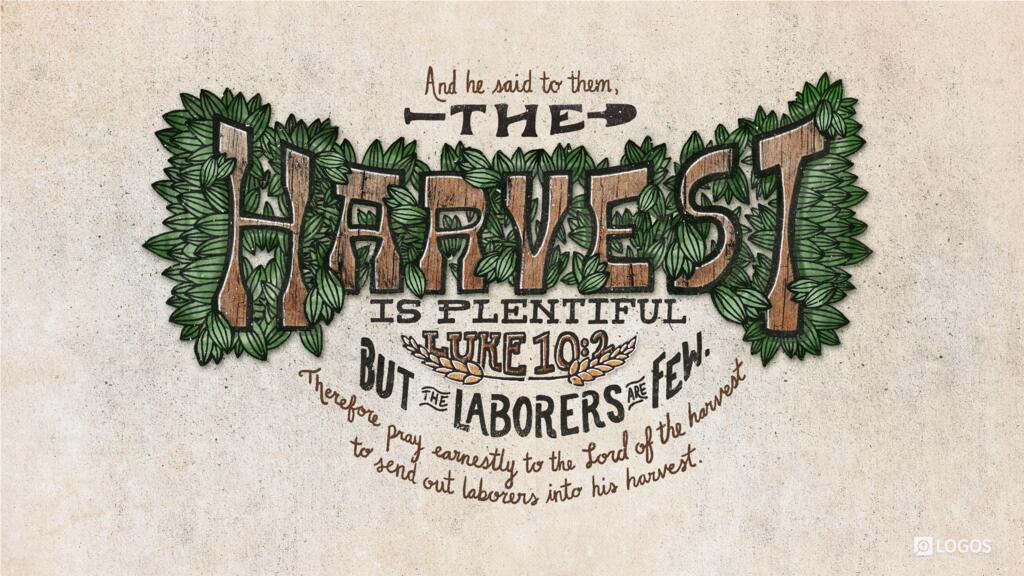
10And after these things, the Lord alsoa appointed seventy-two others and sent them out two by two before himb into every town and place where he was about to go. 2And he said to them, “The harvest is plentiful, but the workers are few. Therefore ask the Lord of the harvest that he send out workers into his harvest. 3Go! Behold, I am sending you out like lambs in the midst of wolves! 4Do not carry a money bag or a traveler’s bag or sandals, and greet no one along the road. 5And into whatever house you enter, first say, “Peace be to this household!” 6And if a son of peace is there, your peace will rest on him. But if not, it will return to you. 7And remain in the same house, eating and drinking whatever they provide,c for the worker is worthy of his pay. Do not move from house to house. 8And into whatever town you enter and they welcome you, eat whatever isd set before you, 9and heal the sick in it, and say to them, “The kingdom of God has come near to you.” 10But into whatever town you enter and they do not welcome you, go out into its streets and* say, 11“Even the dust of your town that clings to our feet we wipe off against you! Nevertheless know this: that the kingdom of God has come near!”e 12I tell you that it will be more bearable on that day for Sodom than for that town!
13Woe to you, Chorazin! Woe to you, Bethsaida! For if the miracles that were done in you had been done in Tyre and Sidon, they would have repented long ago, sitting in sackcloth and ashes! 14But it will be more bearable for Tyre and for Sidon in the judgment than for you! 15And you, Capernaum, will you be exalted to heaven? No! You will be brought down to Hades! 16The one who listens to you listens to me, and the one who rejects you rejects me. But the one who rejects me rejects the one who sent me.”
17And the seventy-two returned with joy, saying, “Lord, even the demons are subject to us in your name!” 18So he said to them, “I saw Satan falling like lightning from heaven. 19Behold, I have given you the authority to tread on snakes and scorpions, and over all the power of the enemy, and nothing will ever harm you. 20Nevertheless, do not rejoice in this, that the spirits are subject to you, but rejoice that your names are inscribed in heaven.”
Jesus Rejoices and Prays
21At that same time he rejoiced in the Holy Spirit and said, “I praise you, Father, Lord of heaven and earth, that you have hidden these things from the wise and intelligent and have revealed them to young children. Yes, Father, for this was pleasing before you. 22All things have been handed over to me by my Father, and no one knows who the Son is except the Father and who the Father is except the Son, and anyone to whom the Son wants to reveal him.”*
23And turning to the disciples, he said privately, “Blessed are the eyes that see the things which you see! 24For I tell you that many prophets and kings desired to see the things which you see, and did not see them,* and to hear the things which you hear, and did not hear them.”*
The Parable of the Good Samaritan
25And behold, a certain legal expert stood up to test him, saying, “Teacher, what must I do so that I will inherit eternal life?” 26And he said to him, “What is written in the law? How do you read it?”* 27And he answered and* said, “You shall love the Lord your God from all your heart, and with all your soul, and with all your strength, and with all your mind,f and your neighbor as yourself.”g 28And he said to him, “You have answered correctly. Do this and you will live.”
29But he, wanting to justify himself, said to Jesus, “And who is my neighbor?” 30Andh Jesus replied and* said, “A certain man was going down from Jerusalem to Jericho, and fell into the hands of robbers, who both stripped him and beat him.* After* inflicting blows on him,* they went away, leaving him* half dead. 31Now by coincidence a certain priest was going down on that road, and when he* saw him, he passed by on the opposite side. 32And in the same way also a Levite, when he* came down to the placei and saw him,* passed by on the opposite side. 33But a certain Samaritan who was traveling came up to him and, when he* saw him,* had compassion. 34And he came up and* bandaged his wounds, pouring on olive oil and wine, and he put him on his own animal and* brought him to an inn and took care of him. 35And on the next day, he took out two denarii and* gave them*j to the innkeeper, and said, “Take care of him, and whatever you spend in addition, I will repay to you when I return. 36Which of these three do you suppose became a neighbor of the man who fell among the robbers?” 37So he said, “The one who showed mercy to him.” And Jesus said to him, “You go and do likewise.”
Martha and Mary
38Now as they traveled along, he entered into a certain village. And a certain woman namedk Martha welcomed him.l 39And she hadm a sister named Mary, who also sat at the feet of Jesusn and* was listening to his teaching. 40But Martha was distracted with much preparation, so she approached and* said, “Lord, is it not a concern to you that my sister has left me alone to make preparations? Then tell her that she should help me!” 41But the Lord answered and* said to her, “Martha, Martha, you are anxious and troubled about many things! 42But few things are necessary, or only one thing,o for Mary has chosen the better part, which will not be taken away from her.”
How to Pray
11And it happened that while he was in a certain place praying, when he stopped a certain one of his disciples said to him, “Lord, teach us to pray, just as John also taught his disciples.” 2And he said to them, “When you pray, say,
“Father,
may your name be treated as holy.
May your kingdom come.
3Give us each day our daily bread.
4And forgive us our sins,
for we ourselves also forgive everyone who is indebted to us.
And do not lead us into temptation.”
Ask, Seek, Knock
5And he said to them, “Who of you will have a friend, and will go to him at midnight and say to him, ‘Friend, lend me three loaves, 6because a friend of mine has come to me on a journey, and I do not have anything to set before him.’ 7And that one will answer from inside and* say, ‘Do not cause me trouble! The door has already been shut and my children are with me in bed! I am not able to get up to give you anything.’* 8I tell you, even if he does not give him anything* after he* gets up because he is his friend, at any rate because of his impudencea he will get up and* give him whatever he needs.
9And I tell you, ask and it will be given to you; seek and you will find; knock and it will be opened for you. 10For everyone who asks receives, and the one who seeks finds, and to the one who knocks it will be opened. 11But what father from among you, if his* son will ask for a fish, instead of a fish will give him a snake? 12Or also, if he will ask for an egg, will give him a scorpion? 13Therefore if you, although you* are evil, know how to give good gifts to your children, how much more will the Father from heaven give the Holy Spirit to those who ask him?”
A House Divided Cannot Stand
14And he was expelling a mute demon.b Now it happened that when* the demon came out, the man who had been mute spoke, and the crowds were astonished. 15But some of them said, “By Beelzebul the ruler of demons he expels demons!” 16And others, in order to* test him,* were demanding from him a sign from heaven. 17But he, knowing their thoughts, said to them, “Every kingdom divided against itself is laid waste, and a divided householdc falls. 18So if Satan also is divided against himself, how will his kingdom stand? For you say that I expel demons by Beelzebul. 19But if I expel demons by Beelzebul, by whom do your sons expel them?* For this reason they will be your judges! 20But if I expel demons by the finger of God, then the kingdom of God has come upon you! 21When a strong man, fully armed, guards his own palace, his possessions are safe.d 22But when a stronger man attacks him and* conquers him, he takes away his full armor in which he trusted and distributes his plunder. 23The one who is not with me is against me, and the one who does not gather with me scatters.
An Unclean Spirit Returns
24“Whenever an unclean spirit has gone out of a person, it travels through waterless places searching for rest, and does not find it.* It says,e ‘I will return to my house from which I came out.’ 25And when it* arrives it finds the house* swept and put in order. 26Then it goes and brings along seven other spirits more evil than itself, and they go in and* live there. And the last state of that person becomes worse than the first!”
27Now…
This passage has been shortened. Keep reading Luke 9:51–19:44 in Logos
Footnotes
- gLiterally “of his taking up”
- *Literally “the”; the Greek article is used here as a possessive pronoun
- hLiterally “his face”
- *Here “and” is supplied because the previous participle (“went”) has been translated as a finite verb
- iLiterally “his face was going”
- *Here “when” is supplied as a component of the participle (“saw”) which is understood as temporal
- *Here the direct object is supplied from context in the English translation
- *Here “and” is supplied because the previous participle (“turned around”) has been translated as a finite verb
- *Here “as” is supplied as a component of the temporal genitive absolute participle (“were going”)
- *Literally “the”; the Greek article is used here as a possessive pronoun
- *Here “and” is supplied because the previous participle (“go”) has been translated as an infinitive
- *Here “and” is supplied because the previous participle (“go”) has been translated as a finite verb
- jSome manuscripts have “said to him”
- *Literally “the”; the Greek article is used here as a possessive pronoun
- aSome manuscripts omit “also”
- bLiterally “his presence”
- cLiterally “the things from them”
- dLiterally “the things”
- *Here “and” is supplied because the previous participle (“go out”) has been translated as a finite verb
- eOr “has come”
- *Here the direct object is supplied from context in the English translation
- *Here the direct object is supplied from context in the English translation
- *Here the direct object is supplied from context in the English translation
- *Here the direct object is supplied from context in the English translation
- *Here “and” is supplied because the previous participle (“answered”) has been translated as a finite verb
- fA quotation from Deut 6:5
- gA quotation from Lev 19:18
- hSome manuscripts omit “and”
- *Here “and” is supplied because the previous participle (“replied”) has been translated as a finite verb
- *Here the direct object is supplied from context in the English translation
- *Here “after” is supplied as a component of the participle (“inflicting blows on”) which is understood as temporal
- *Here the direct object is supplied from context in the English translation
- *Here the direct object is supplied from context in the English translation
- *Here “when” is supplied as a component of the participle (“saw”) which is understood as temporal
- *Here “when” is supplied as a component of the participle (“came”) which is understood as temporal
- iSome manuscripts have “who happened by the place, when he came up to him”
- *Here the direct object is supplied from context in the English translation
- *Here “when” is supplied as a component of the participle (“saw”) which is understood as temporal
- *Here the direct object is supplied from context in the English translation
- *Here “and” is supplied because the previous participle (“came up”) has been translated as a finite verb
- *Here “and” is supplied because the previous participle (“put”) has been translated as a finite verb
- *Here “and” is supplied because the previous participle (“took out”) has been translated as a finite verb
- *Here the direct object is supplied from context in the English translation
- jSome manuscripts have “he took out and gave two denarii”
- kLiterally “by name”
- lMost manuscripts add some form of the location such as “into her house” but there is considerable variation in the exact wording, so the shorter reading is preferred
- mLiterally “this was”
- nSome manuscripts have “of the Lord”
- *Here “and” is supplied because the previous participle (“sat”) has been translated as a finite verb
- *Here “and” is supplied because the previous participle (“approached”) has been translated as a finite verb
- *Here “and” is supplied because the previous participle (“answered”) has been translated as a finite verb
- oSome manuscripts have “But one thing is necessary”
- *Here “and” is supplied because the previous participle (“will answer”) has been translated as a finite verb
- *Here the direct object is supplied from context in the English translation
- *Here the direct object is supplied from context in the English translation
- *Here “after” is supplied as a component of the participle (“gets up”) which is understood as temporal
- aOr “shamelessness”; some translate as “persistence” based on the context, though this is not the normal meaning of the word
- *Here “and” is supplied because the previous participle (“will get up”) has been translated as a finite verb
- *Literally “the”; the Greek article is used here as a possessive pronoun
- *Here “although” is supplied as a component of the participle (“are”) which is understood as concessive
- bSome manuscripts have “a demon, and it was mute”
- *Here “when” is supplied as a component of the temporal genitive absolute participle (“came out”)
- *Here “in order to” is supplied as a component of the participle (“test”) which is understood as purpose
- *Here the direct object is supplied from context in the English translation
- cLiterally “house against house”
- *Here the direct object is supplied from context in the English translation
- dLiterally “in peace”
- *Here “and” is supplied because the previous participle (“attacks”) has been translated as a finite verb
- *Here the direct object is supplied from context in the English translation
- eSome manuscripts have “Then it says”
- *Here “when” is supplied as a component of the participle (“arrives”) which is understood as temporal
- *Here the direct object is supplied from context in the English translation
- *Here “and” is supplied because the previous participle (“go in”) has been translated as a finite verb
Copyright 2012 Lexham Press