John 6:60–71
The Lexham English BibleOther versions
English
- LEB The Lexham English Bible
- DARBY 1890 Darby Bible
- ASV American Standard Version
- AV 1873 The Cambridge Paragraph Bible of the Authorized English Version
- CSB Christian Standard Bible
- D-R Douay-Rheims Bible
- ESV English Standard Version
- GW GOD’S WORD Translation
- GNB Good News Translation
- HCSB The Holman Christian Standard Bible
- KJV 1900 King James Version
- LSB Legacy Standard Bible
- MSG The Message: The Bible in Contemporary Language
- NET The NET Bible
- NASB95 New American Standard Bible (1995)
- NCV New Century Version
- NIrV New International Reader’s Version (1998)
- NIV New International Version (2011)
- NKJV The New King James Version
- NLT New Living Translation
- NRSVue New Revised Standard Version: Updated Edition
- RSV The Revised Standard Version
- RSVCE The Revised Standard Version, Catholic Edition
- YLT Young’s Literal Translation
Arabic
Czech
French
German
Greek
Hungarian
Italian
Korean
Latin
Portuguese
Russian
Simplified Chinese
Spanish
Traditional Chinese
60Thus many of his disciples, when they* heard it,* said, “This saying is hard! Who can understand it?” 61But Jesus, because he* knew within himself that his disciples were grumbling about this, said to them, “Does this cause you to be offended? 62Then what if you see the Son of Man ascending where he was before? 63The Spirit is the one who gives life; the flesh profits nothing. The words that I have spoken to you are spirit and are life. 64But there are some of you who do not believe.” (For Jesus knew from the beginning who they were who did not believe, and who it was who would betray him.) 65And he said, “Because of this I said to you that no one can come to me unless it has been granted to him by the Father.”
Peter’s Confession
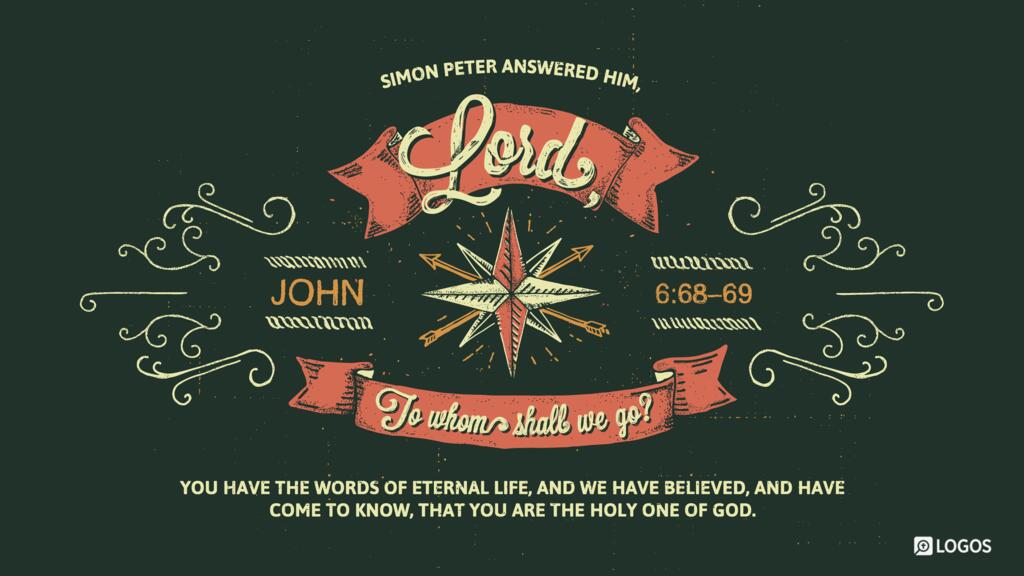
66For this reason many of his disciples drew backl and were not walking with him any longer. 67So Jesus said to the twelve, “You do not want to go away also, do you?”* 68Simon Peter answered him, “Lord, to whom would we go? You have the words of eternal life. 69And we have believed, and have come to know, that you are the Holy One of God.” 70Jesus replied to them, “Did I not choose you, the twelve, and one of you is the devil?” 71(Now he was speaking about Judas son of Simon Iscariot, because this one—one of the twelve—was going to betray him.)
Footnotes
- *Here “when” is supplied as a component of the participle (“heard”) which is understood as temporal
- *Here the direct object is supplied from context in the English translation
- *Here “because” is supplied as a component of the participle (“knew”) which is understood as causal
- lLiterally “went away to the things behind”
- *The negative construction in Greek anticipates a negative answer here, indicated in the translation by the phrase “do you”
Copyright 2012 Lexham Press