John 6:60–71
The NET BibleOther versions
English
- NET The NET Bible
- DARBY 1890 Darby Bible
- ASV American Standard Version
- AV 1873 The Cambridge Paragraph Bible of the Authorized English Version
- CSB Christian Standard Bible
- D-R Douay-Rheims Bible
- ESV English Standard Version
- GW GOD’S WORD Translation
- GNB Good News Translation
- HCSB The Holman Christian Standard Bible
- KJV 1900 King James Version
- LSB Legacy Standard Bible
- LEB The Lexham English Bible
- MSG The Message: The Bible in Contemporary Language
- NASB95 New American Standard Bible (1995)
- NCV New Century Version
- NIrV New International Reader’s Version (1998)
- NIV New International Version (2011)
- NKJV The New King James Version
- NLT New Living Translation
- NRSVue New Revised Standard Version: Updated Edition
- RSV The Revised Standard Version
- RSVCE The Revised Standard Version, Catholic Edition
- YLT Young’s Literal Translation
Arabic
Czech
French
German
Greek
Hungarian
Italian
Korean
Latin
Portuguese
Russian
Simplified Chinese
Spanish
Traditional Chinese
6:60Then many of his disciples, when they heard these things,99 said, “This is a difficult100 saying!101 Who can understand it?”1026:61When Jesus was aware103 that his disciples were complaining104 about this, he said to them, “Does this cause you to be offended?1056:62Then what if you see the Son of Man ascending where he was before?1066:63The Spirit is the one who gives life; human nature is of no help!107 The words that I have spoken to you are spirit and are life.1086:64But there are some of you who do not believe.” (For Jesus had already known from the beginning who those were who did not believe, and who it was who would betray him.)1096:65So Jesus added,110 “Because of this I told you that no one can come to me unless the Father has allowed him to come.”111
Peter’s Confession
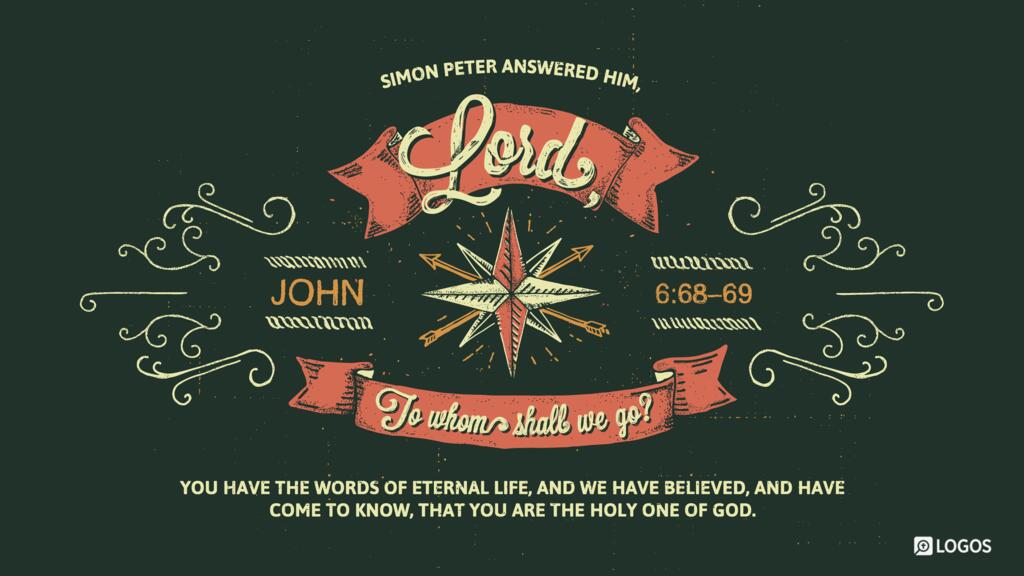
6:66After this many of his disciples quit following him112 and did not accompany him113 any longer. 6:67So Jesus said to the twelve, “You don’t want to go away too, do you?”1146:68Simon Peter answered him, “Lord, to whom would we go? You have the words of eternal life. 6:69We115 have come to believe and to know116 that you are the Holy One of God!”1176:70Jesus replied,118 “Didn’t I choose you, the twelve, and yet one of you is the devil?”1196:71(Now he said this about Judas son of Simon Iscariot,120 for Judas,121 one of the twelve, was going to betray him.)122
Footnotes
- 99 The words “these things” are not present in the Greek text but are implied. Direct objects in Greek were often omitted when clear from the context, and must be supplied for the English reader.
- 100 Or “hard,” “demanding.”
- 101 Or “teaching”; Grk “word.”
- 102 Or “obey it”; Grk “hear it.” The Greek word ἀκούω (akouō) could imply hearing with obedience here, in the sense of “obey.” It could also point to the acceptance of what Jesus had just said, (i.e., “who can accept what he said?” However, since the context contains several replies by those in the crowd of hearers that suggest uncertainty or confusion over the meaning of what Jesus had said (6:42; 6:52), the meaning “understand” is preferred here.
- 103 Grk “When Jesus knew within himself.”
- 104 Or “were grumbling.”
- 105 Or “Does this cause you to no longer believe?” (Grk “cause you to stumble?”) Does this cause you to be offended? It became apparent to some of Jesus’ followers at this point that there would be a cost involved in following him. They had taken offense at some of Jesus’ teaching (perhaps the graphic imagery of “eating his flesh” and “drinking his blood,” and Jesus now warned them that if they thought this was a problem, there was an even worse cause for stumbling in store: his upcoming crucifixion (John 6:61b–62). Jesus asked, in effect, “Has what I just taught caused you to stumble? What will you do, then, if you see the Son of Man ascending where he was before?” This ascent is to be accomplished through the cross; for John, Jesus’ departure from this world and his return to the Father form one continual movement from cross to resurrection to ascension.
- 106 Or “he was formerly?”
- 107 Grk “the flesh counts for nothing.”
- 108 Or “are spirit-giving and life-producing.”
- 109 This is a parenthetical comment by the author.
- 110 Grk “And he said”; the referent (Jesus) has been specified in the translation for clarity.
- 111 Grk “unless it has been permitted to him by the Father.”
- 112 Grk “many of his disciples went back to what lay behind.”
- 113 Grk “were not walking with him.”
- 114 Questions prefaced with μή (mē) in Greek anticipate a negative answer. This can sometimes be indicated by using a “tag” at the end in English (here it is “do you?”).
- 115 Grk “And we.”
- 117 The witnesses display a bewildering array of variants here. Instead of “the Holy One of God” (ὁ ἅγιος τοῦ θεοῦ, ho hagios tou theou), Tertullian has ὁ Χριστός (ho Christos, “the Christ”); C3 Θ* f1 33 565 lat read ὁ Χριστὸς ὁ υἱὸς τοῦ θεοῦ (ho Christos ho huios tou theou, “the Christ, the Son of God”); two versional witnesses (b syc) have ὁ υἱὸς τοῦ θεοῦ (“the Son of God”); the Byzantine text as well as many others (Ψ 0250 f13 33 𝔐) read ὁ Χριστὸς ὁ υἱὸς τοῦ θεοῦ τοῦ ζῶντος (ho Christos ho huios tou theou tou zōntos, “the Christ, the Son of the living God”); and 𝔓66 as well as a few versions have ὁ Χριστὸς ὁ ἅγιος τοῦ θεοῦ (“the Christ, the Holy One of God”). The reading ὁ ἅγιος τοῦ θεοῦ is, however, well supported by 𝔓75 א B C* D L W as well as versional witnesses. It appears that Peter’s confession in the Synoptic Gospels (especially Matt 16:16) supplied the motivation for the variations. Although the witnesses in Matt 16:16; Mark 8:29; and Luke 9:20 vary considerably, the readings are all intra-synoptic, that is, they do not pull in “the Holy One of God” but reflect various permutations of “Christ“/“Christ of God“/“Christ, the Son of God“/“Christ, the Son of the living God.” The wording “the Holy One of God” (without “Christ”) in important witnesses here is thus unique among Peter’s confessions, and best explains the rise of the other readings. You have the words of eternal life … you are the Holy One of God! In contrast to the response of some of his disciples, here is the response of the twelve, whom Jesus then questioned concerning their loyalty to him. This was the big test, and the twelve, with Peter as spokesman, passed with flying colors. The confession here differs considerably from the synoptic accounts (Matt 16:16, Mark 8:29, and Luke 9:20) and concerns directly the disciples’ personal loyalty to Jesus, in contrast to those other disciples who had deserted him (John 6:66).
- 118 Grk “Jesus answered them.”
- 119 Although most translations render this last phrase as “one of you is a devil,” such a translation presupposes that there is more than one devil. This finds roots in the in which the Greek word for demon was often translated “devil.” In fact, the never uses the word “demon.” (Sixty-two of the 63 NT instances of δαιμόνιον [daimonion] are translated “devil” [in Acts 17:18 the plural has been translated “gods“]. This can get confusing in places where the singular “devil” is used: Is Satan or one of the demons in view [cf. Matt 9:33 (demon); 13:39 (devil); 17:18 (demon); Mark 7:26 (demon); Luke 4:2 (devil); etc.]?) Now regarding John 6:70, both the construction in Greek and the technical use of διάβολος (diabolos) indicate that the one devil is in view. To object to the translation “the devil” because it thus equates Judas with Satan does not take into consideration that Jesus often spoke figuratively (e.g., “destroy this temple” [John 2:19]; “he [John the Baptist] is Elijah” [Matt 11:14]), even equating Peter with the devil on one occasion (Mark 8:33). According to , “A curious phenomenon has occurred in the English Bible with reference to one particular monadic noun, διάβολος. The translates both διάβολος and δαιμόνιον as ‘devil.’ Thus in the translators’ minds, ‘devil’ was not a monadic noun. Modern translations have correctly rendered δαιμόνιον as ‘demon’ and have, for the most part, recognized that διάβολος is monadic (cf., e.g., 1 Pet 5:8; Rev 20:2). But in John 6:70 modern translations have fallen into the error of the King James translators. The has ‘one of you is a devil.’ So does the , , , , , and the [Jerusalem Bible]. Yet there is only one devil … The legacy of the still lives on, then, even in places where it ought not.”
- 120 At least six explanations for the name Iscariot have been proposed, but it is probably transliterated Hebrew with the meaning “man of Kerioth” (there are at least two villages that had that name). See D. A. Carson, John, 304.
- 121 Grk “this one”; the referent (Judas) has been specified in the translation for clarity.
- 122 This parenthetical statement by the author helps the reader understand Jesus’ statement one of you is the devil in the previous verse. This is the first mention of Judas in the Fourth Gospel, and he is immediately identified (as he is in the synoptic gospels, Matt 10:4, Mark 3:19, Luke 6:16) as the one who would betray Jesus.
Cross references
- 116 See 1 John 4:16.
The NET Bible First Edition, Copyright 1996-2005 by Biblical Studies Press