Genesis 4:1–12
The Lexham English BibleOther versions
English
- LEB The Lexham English Bible
- DARBY 1890 Darby Bible
- ASV American Standard Version
- AV 1873 The Cambridge Paragraph Bible of the Authorized English Version
- CSB Christian Standard Bible
- D-R Douay-Rheims Bible
- ESV English Standard Version
- GW GOD’S WORD Translation
- GNB Good News Translation
- HCSB The Holman Christian Standard Bible
- KJV 1900 King James Version
- LSB Legacy Standard Bible
- MSG The Message: The Bible in Contemporary Language
- NET The NET Bible
- NASB95 New American Standard Bible (1995)
- NCV New Century Version
- NIrV New International Reader’s Version (1998)
- NIV New International Version (2011)
- NKJV The New King James Version
- NLT New Living Translation
- NRSVue New Revised Standard Version: Updated Edition
- RSV The Revised Standard Version
- RSVCE The Revised Standard Version, Catholic Edition
- YLT Young’s Literal Translation
Arabic
Czech
French
German
Hebrew
Hungarian
Italian
Korean
Latin
Portuguese
Russian
Simplified Chinese
Spanish
Traditional Chinese
Cain and Abel
4Now Adam knewa Eve his wife, and she conceived and bore Cain. And she said, “I have given birth to a man with the help of Yahweh.” 2Then she boreb his brother Abel. And Abel became a keeper of sheep, and Cain became a tiller of the ground. 3And in the course of timec Cain brought an offering from the fruit of the ground to Yahweh, 4and Abel also brought an offering from the choicest firstlings of his flock.d And Yahweh looked with favor to Abel and to his offering, 5but to Cain and to his offering he did not look with favor. And Cain became very angry, and his face fell. 6And Yahweh said to Cain, “Why are you angry, and why is your face fallen? 7If you do well will I not accept you?e But if you do not do well, sin is crouching at the door. And its desire is for you, but you must rule over it.”
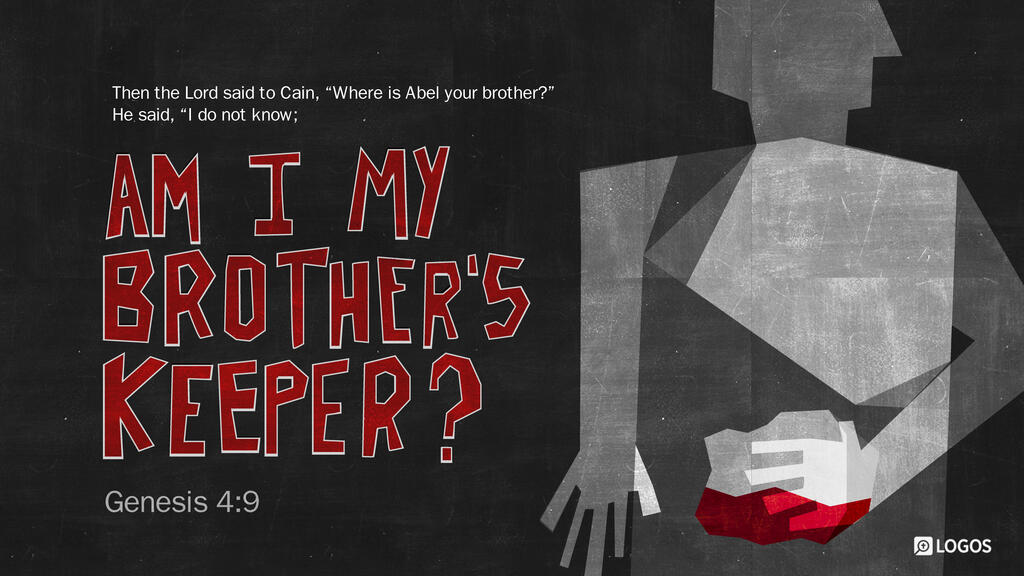
8Thenf Cain said to his brother Abel, “Let us go out into the field.”g And when they were in the field, Cain rose up against his brother Abel and killed him. 9Thenh Yahweh said to Cain, “Where is Abel your brother?” And he said, “I do not know; am I my brother’s keeper?” 10And he said, “What have you done? The voice of your brother’s blood is crying out to me from the ground. 11So now you are cursed from the ground, which has opened its mouth to receive the blood of your brother from your hand. 12When you till the ground it shall no longer yield its strength to you.i You shall be a wanderer and a fugitive on the earth.”
Footnotes
- aOr “had intercourse with”
- bLiterally “And she added to bear”
- cLiterally “it came to pass at the end of days”
- dLiterally “from the firstlings of his flock and from their fat”
- eLiterally “a lifting up”; this is an abbreviation of the Hebrew idiom “to lift up the face,” which means “to accept or regard with favor”
- fOr “And”
- gThis phrase is not present in the Hebrew; it is supplied in other versions Samaritan, Septuagint, Syriac, Vulgate
- hOr “And”
- iLiterally “it shall not add to give its strength to you”
Copyright 2012 Lexham Press