Galatians 4:8–20
The Lexham English BibleOther versions
English
- LEB The Lexham English Bible
- DARBY 1890 Darby Bible
- ASV American Standard Version
- AV 1873 The Cambridge Paragraph Bible of the Authorized English Version
- CSB Christian Standard Bible
- D-R Douay-Rheims Bible
- ESV English Standard Version
- GW GOD’S WORD Translation
- GNB Good News Translation
- HCSB The Holman Christian Standard Bible
- KJV 1900 King James Version
- LSB Legacy Standard Bible
- MSG The Message: The Bible in Contemporary Language
- NET The NET Bible
- NASB95 New American Standard Bible (1995)
- NCV New Century Version
- NIrV New International Reader’s Version (1998)
- NIV New International Version (2011)
- NKJV The New King James Version
- NLT New Living Translation
- NRSVue New Revised Standard Version: Updated Edition
- RSV The Revised Standard Version
- RSVCE The Revised Standard Version, Catholic Edition
- YLT Young’s Literal Translation
Arabic
Czech
French
German
Greek
Hungarian
Italian
Korean
Latin
Portuguese
Russian
Simplified Chinese
Spanish
Traditional Chinese
Do Not Be Enslaved Again
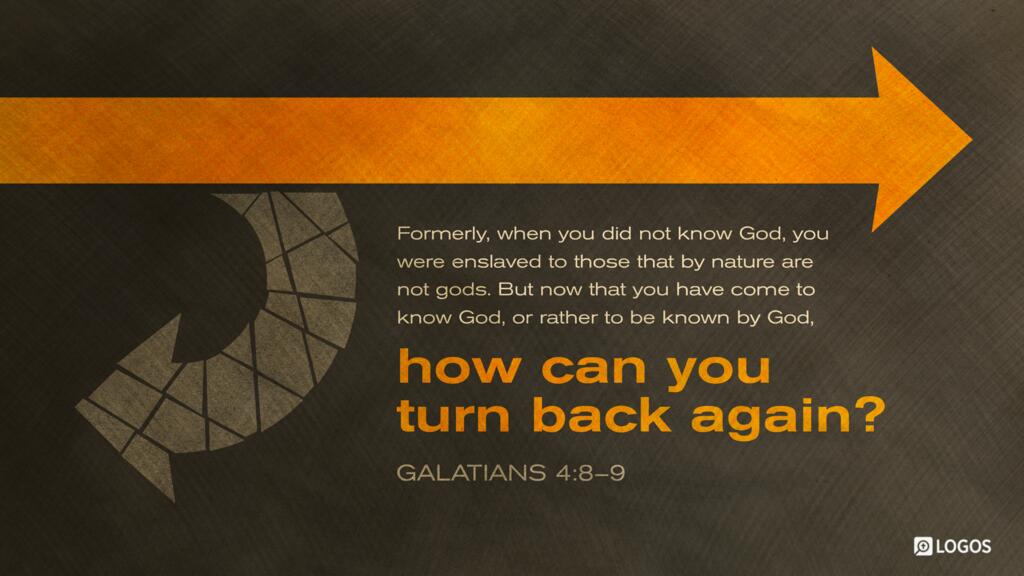
8But at that time when you* did not know God, you were enslaved to the things which by nature are not gods. 9But now, because you have come to know God, or rather have come to be known by God, how can you turn back again to the weak and miserable elemental spirits? Do you want to be enslaved to themb all over again? 10You carefully observe days and months and seasons and years. 11I am afraid for you, lest perhaps I have labored for you in vain! 12I ask you, brothers, become like me, because I also have become like you. You have done me no wrong!
Paul’s Personal Appeal
13But you know that because of an illness of the flesh I proclaimed the gospel to you the first time. 14And you did not despise or disdain what was a trial for you in my flesh, but you welcomed me like an angel of God, like Christ Jesus. 15So where is your blessing? For I testify to you that, if possible, you would have torn out your eyes and given them to me! 16So then, have I become your enemy by* being truthful to you? 17They zealously seek you, not commendably, but they want to exclude you, in order that you may seek them zealously. 18But it is good to be sought zealously in good at all times, and not only when I am present with you. 19My children, for whom I am having birth pains again, until Christ is formed in you! 20But I could wish to be present with you now, and to change my tone because I am perplexed about you.
Footnotes
Copyright 2012 Lexham Press