Colossians 2:13–23
The Lexham English BibleOther versions
English
- LEB The Lexham English Bible
- DARBY 1890 Darby Bible
- ASV American Standard Version
- AV 1873 The Cambridge Paragraph Bible of the Authorized English Version
- CSB Christian Standard Bible
- D-R Douay-Rheims Bible
- ESV English Standard Version
- GW GOD’S WORD Translation
- GNB Good News Translation
- HCSB The Holman Christian Standard Bible
- KJV 1900 King James Version
- LSB Legacy Standard Bible
- MSG The Message: The Bible in Contemporary Language
- NET The NET Bible
- NASB95 New American Standard Bible (1995)
- NCV New Century Version
- NIrV New International Reader’s Version (1998)
- NIV New International Version (2011)
- NKJV The New King James Version
- NLT New Living Translation
- NRSVue New Revised Standard Version: Updated Edition
- RSV The Revised Standard Version
- RSVCE The Revised Standard Version, Catholic Edition
- YLT Young’s Literal Translation
Arabic
Czech
French
German
Greek
Hungarian
Italian
Korean
Latin
Portuguese
Russian
Simplified Chinese
Spanish
Traditional Chinese
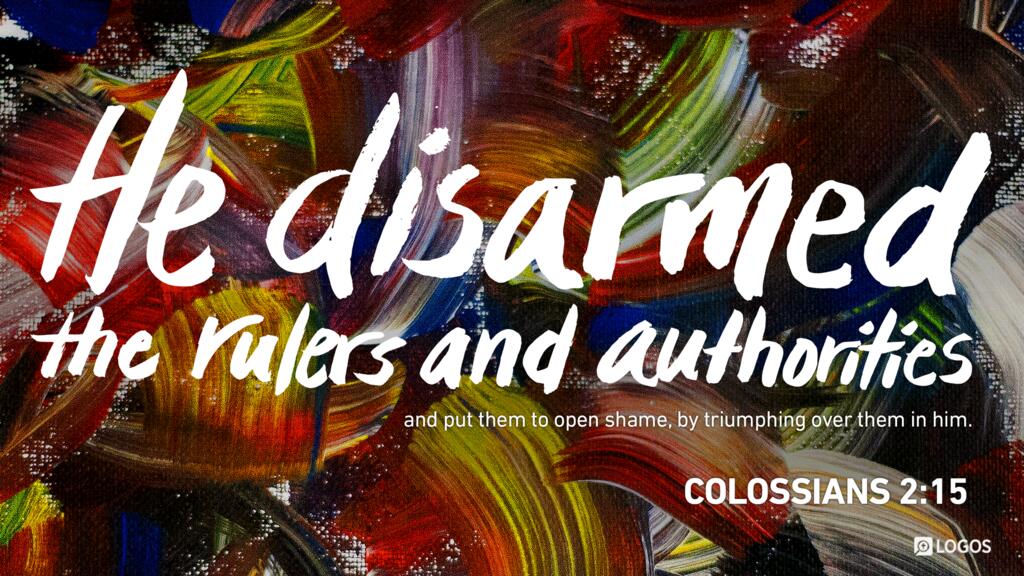
13And although you were deadd* in the trespasses and the uncircumcision of your flesh, he made you alive together with him, having forgiven us all our trespasses, 14having destroyed the certificate of indebtedness in ordinances against us, which was hostile to us, and removed it out of the way by* nailing it to the cross. 15When he* had disarmed the rulers and the authorities, he made a display of them in public, triumphing over them by it.e
Do Not Be Judged by Human Religious Rules
16Therefore do not let anyone judge you with reference to eating orf drinking or participation in a feast or a new moon or a Sabbath, 17which are a shadow of what is to come, but the reality is Christ. 18Let no one condemn you, taking pleasure in humility and the worship of angels, going into detail about the things which he has seen, inflated without cause by his fleshly mind, 19and not holding fast to the head, from whom the whole body, supported and held together by the ligaments and sinews, grows with the growth of God.
20If you have died with Christ to the elemental spirits of the world, why do you submit to them as if living in the world? 21“Do not handle, do not taste, do not touch,” 22which things are all meant for destruction by consuming according to human commandments and teachings, 23which things although they haveg,* to be sure, an appearance of wisdom in self-made religion and humility and unsparing treatment of the body, do not have any valueh against the indulgence of the flesh.
Footnotes
- dLiterally “and you being dead”
- *Here the participle (“being”) is understood as concessive
- *Here “by” is supplied as a component of the participle (“nailing”) which is understood as means
- *Here “when” is supplied as a component of the participle (“had disarmed”) which is understood as temporal
- eOr “in him”
- fSome manuscripts have “and”
- gLiterally “having”
- *Here the participle (“having”) is understood as concessive
- hLiterally “are not with any value”
Copyright 2012 Lexham Press