Acts 9:1–22
The Lexham English BibleOther versions
English
- LEB The Lexham English Bible
- DARBY 1890 Darby Bible
- ASV American Standard Version
- AV 1873 The Cambridge Paragraph Bible of the Authorized English Version
- CSB Christian Standard Bible
- D-R Douay-Rheims Bible
- ESV English Standard Version
- GW GOD’S WORD Translation
- GNB Good News Translation
- HCSB The Holman Christian Standard Bible
- KJV 1900 King James Version
- LSB Legacy Standard Bible
- MSG The Message: The Bible in Contemporary Language
- NET The NET Bible
- NASB95 New American Standard Bible (1995)
- NCV New Century Version
- NIrV New International Reader’s Version (1998)
- NIV New International Version (2011)
- NKJV The New King James Version
- NLT New Living Translation
- NRSVue New Revised Standard Version: Updated Edition
- RSV The Revised Standard Version
- RSVCE The Revised Standard Version, Catholic Edition
- TNIV Today’s New International Version
- YLT Young’s Literal Translation
Arabic
Czech
French
German
Greek
Hungarian
Italian
Korean
Latin
Portuguese
Russian
Simplified Chinese
Spanish
Traditional Chinese
Saul’s Conversion on the Damascus Road
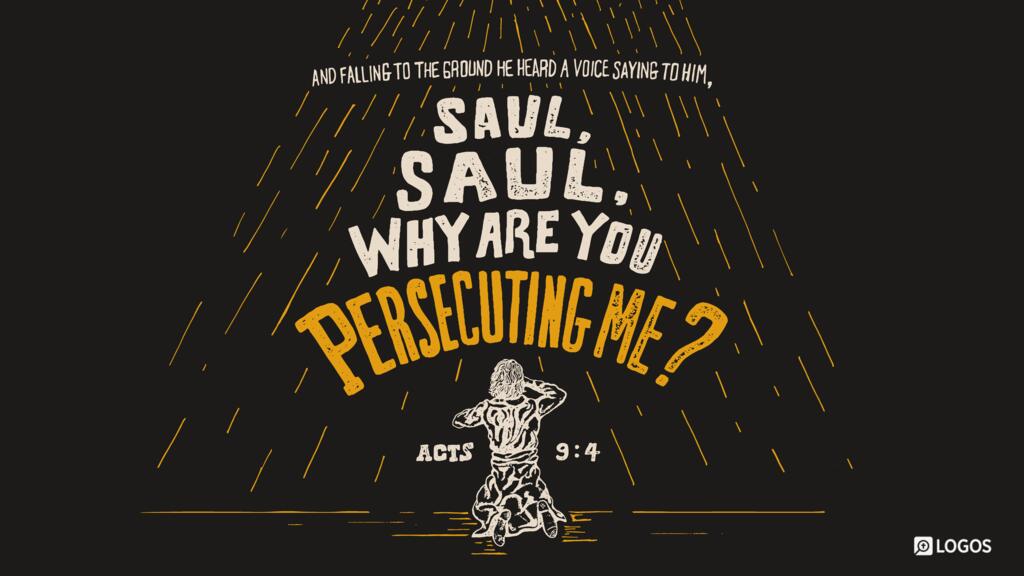
9But Saul, still breathing threats and murder against the disciples of the Lord, went to the high priest 2and* asked for letters from him to the synagogues in Damascus, so that if he found any who were of the Way, both men and women, he could bring them* tied upa to Jerusalem. 3Now as he proceeded, it happened that when he approached Damascus, suddenly a light from heaven flashed around him. 4And falling to the ground, he heard a voice saying to him, “Saul, Saul, why are you persecuting me?” 5So he said, “Who are you, Lord?” And he said, “I am Jesus, whom you are persecuting! 6But get up and enter into the city, and it will be told to you what you must do.”b 7(Now the men who were traveling together with him stood speechless, because they* heard the voice but saw no one.) 8So Saul got up from the ground, but although* his eyes were open he could see nothing. And leading him by the hand, they brought him into Damascus. 9And he was unable to seec for three days, and he did not eat or drink.
Ananias Sent to Saul
10Now there was a certain disciple in Damascus namedd Ananias, and the Lord said to him in a vision, “Ananias!” And he said, “Behold, here I am, Lord!” 11And the Lord said to him, “Get up, go to the street called ‘Straight’ and in the house of Judas look for a man named Saul from Tarsus.e For behold, he is praying, 12and he has seen in a vision a man namedf Ananias coming in and placing handsg on him so that he may regain his sight.” 13But Ananias replied, “Lord, I have heard from many people about this man, how much harm he has done to your saints in Jerusalem, 14and here he has authority from the chief priests to tie uph all who call upon your name!” 15But the Lord said to him, “Go, because this man is my chosen instrument to carry my name before Gentilesi and kings and the sons of Israel. 16For I will show him how much he must suffer for the sake of my name.” 17So Ananias departed and entered into the house, and placing his* hands on him, he said, “Brother Saul, the Lord Jesus, who appeared to you on the road by which you came, has sent me so that you may regain your sight and be filled with the Holy Spirit.” 18And immediately something like scales fell from his eyes and he regained his sight and got up and* was baptized, 19and after* taking food, he regained his strength. And he was with the disciples in Damascus several days.
Saul Proclaims Christ in Damascus
20And immediately he began proclaiming* Jesus in the synagogues: “This one is the Son of God!” 21And all who heard him* were amazed, and were saying, “Is this not the one who was wreaking havoc in Jerusalem on those who call upon this name, and had come here for this reason, that he could bring them tied upj to the chief priests?” 22But Saul was increasing in strength even more, and was confounding the Jews who lived in Damascus by* proving that this one is the Christ.k
Footnotes
- *Here “and” is supplied because the participle in the previous verse (“went to”) has been translated as a finite verb
- *Here the direct object is supplied from context in the English translation
- aOr figuratively “bring them under arrest”
- bLiterally “what thing it is necessary that you do”
- *Here “because” is supplied as a component of the participle (“heard”) which is understood as causal
- *Here “although” is supplied as a component of the genitive absolute participle (“were open”) which is understood as concessive
- cLiterally “not seeing”
- dLiterally “by name”
- eLiterally “Saul by name of Tarsus”
- fLiterally “by name”
- gSome manuscripts have “placing his hands”
- hOr figuratively “to arrest” or “to imprison”
- iThe same Greek word can be translated “nations” or “Gentiles” depending on the context
- *Literally “the”; the Greek article is used here as a possessive pronoun
- *Here “and” is supplied because the previous participle (“got up”) has been translated as a finite verb
- *Here “after” is supplied as a component of the participle (“taking”) which is understood as temporal
- *The imperfect tense has been translated as ingressive here (“began proclaiming”)
- *Here the direct object is supplied from context in the English translation
- jOr figuratively “bring them under arrest”
- *Here “by” is supplied as a component of the participle (“proving”) which is understood as means
- kOr “Messiah”
Copyright 2012 Lexham Press