John 9:1–12
The NET BibleOther versions
English
- NET The NET Bible
- DARBY 1890 Darby Bible
- ASV American Standard Version
- AV 1873 The Cambridge Paragraph Bible of the Authorized English Version
- CSB Christian Standard Bible
- D-R Douay-Rheims Bible
- ESV English Standard Version
- GW GOD’S WORD Translation
- GNB Good News Translation
- HCSB The Holman Christian Standard Bible
- KJV 1900 King James Version
- LSB Legacy Standard Bible
- LEB The Lexham English Bible
- MSG The Message: The Bible in Contemporary Language
- NASB95 New American Standard Bible (1995)
- NCV New Century Version
- NIrV New International Reader’s Version (1998)
- NIV New International Version (2011)
- NKJV The New King James Version
- NLT New Living Translation
- NRSVue New Revised Standard Version: Updated Edition
- RSV The Revised Standard Version
- RSVCE The Revised Standard Version, Catholic Edition
- YLT Young’s Literal Translation
Arabic
Czech
French
German
Greek
Hungarian
Italian
Korean
Latin
Portuguese
Russian
Simplified Chinese
Spanish
Traditional Chinese
Healing a Man Born Blind
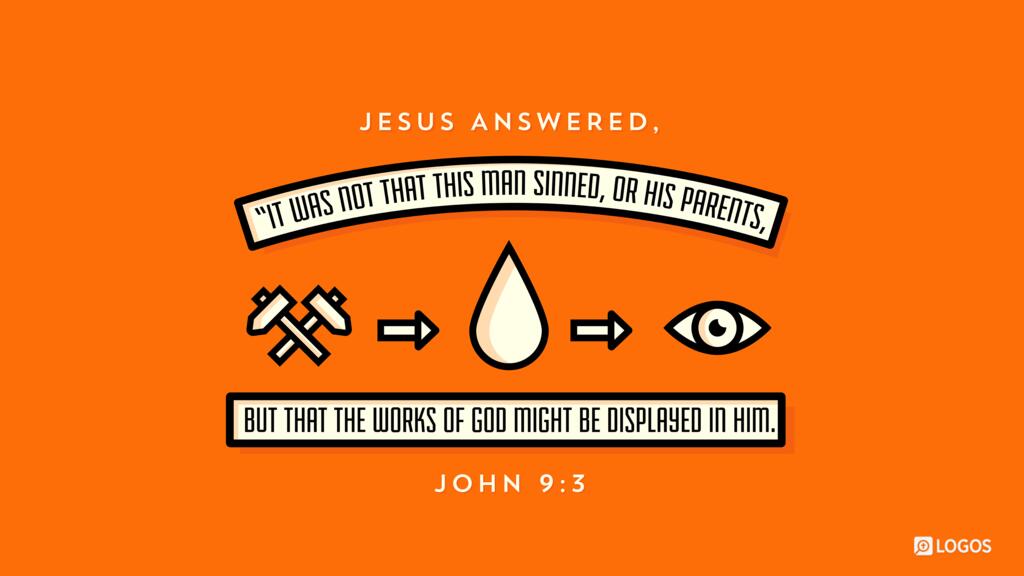
9:1Now as Jesus was passing by,1 he saw a man who had been blind from birth. 9:2His disciples asked him,2 “Rabbi, who committed the sin that caused him to be born blind, this man3 or his parents?”49:3Jesus answered, “Neither this man5 nor his parents sinned, but he was born blind so that6 the acts7 of God may be revealed8 through what happens to him.99:4We must perform the deeds10 of the one who sent me11 as long as12 it is daytime. Night is coming when no one can work. 9:5As long as I am in the world, I am the light of the world.”139:6Having said this,14 he spat on the ground and made some mud15 with the saliva. He16 smeared the mud on the blind man’s17 eyes 9:7and said to him, “Go wash in the pool of Siloam”18 (which is translated “sent”).19 So the blind man20 went away and washed, and came back seeing.
9:8Then the neighbors and the people who had seen him previously21 as a beggar began saying,22 “Is this not the man23 who used to sit and beg?” 9:9Some people said,24 “This is the man!”25 while others said, “No, but he looks like him.”26 The man himself27 kept insisting, “I am the one!”289:10So they asked him,29 “How then were you made to see?”309:11He replied,31 “The man called Jesus made mud,32 smeared it33 on my eyes and told me,34 ‘Go to Siloam and wash.’ So I went and washed, and was able to see.”359:12They said36 to him, “Where is that man?”37 He replied,38 “I don’t know.”
Footnotes
- 1 Or “going along.” The opening words of chap. 9, καὶ παράγων (kai paragōn), convey only the vaguest indication of the circumstances. Since there is no break with chap. 8, Jesus is presumably still in Jerusalem, and presumably not still in the temple area. The events of chap. 9 fall somewhere between the feast of Tabernacles (John 7:2) and the feast of the Dedication (John 10:22). But in the author’s narrative the connection exists—the incident recorded in chap. 9 (along with the ensuing debates with the Pharisees) serves as a real-life illustration of the claim Jesus made in 8:12, I am the light of the world. This is in fact the probable theological motivation behind the juxtaposition of these two incidents in the narrative. The second serves as an illustration of the first, and as a concrete example of the victory of light over darkness. One other thing which should be pointed out about the miracle recorded in chap. 9 is its messianic significance. In the OT it is God himself who is associated with the giving of sight to the blind (Exod 4:11, Ps 146:8). In a number of passages in Isa (29:18, 35:5, 42:7) it is considered to be a messianic activity.
- 2 Grk “asked him, saying.”
- 3 Grk “this one.”
- 4 Grk “in order that he should be born blind.” The disciples assumed that sin (regardless of who committed it) was the cause of the man’s blindness. This was a common belief in Judaism; the rabbis used Ezek 18:20 to prove there was no death without sin, and Ps 89:33 to prove there was no punishment without guilt (the Babylonian Talmud, Shabbat 55a, although later than the NT, illustrates this). Thus in this case the sin must have been on the part of the man’s parents, or during his own prenatal existence. Song Rabbah 1:41 (another later rabbinic work) stated that when a pregnant woman worshiped in a heathen temple the unborn child also committed idolatry. This is only one example of how, in rabbinic Jewish thought, an unborn child was capable of sinning.
- 5 Grk “this one.”
- 6 Grk “but so that.” There is an ellipsis that must be supplied: “but [he was born blind] so that” or “but [it happened to him] so that.”
- 7 Or “deeds”; Grk “works.”
- 8 Or “manifested,” “brought to light.”
- 9 Grk “in him.”
- 10 Grk “We must work the works.”
- 11 Or “of him who sent me” (God).
- 12 Or “while.”
- 13 Jesus’ statement I am the light of the world connects the present account with 8:12. Here (seen more clearly than at 8:12) it is obvious what the author sees as the significance of Jesus’ statement. “Light” is not a metaphysical definition of the person of Jesus but a description of his effect on the world, forcing everyone in the world to ‘choose up sides’ for or against him (cf. 3:19–21).
- 14 Grk “said these things.”
- 15 Or “clay” (moistened earth of a clay-like consistency). The textual variant preserved in the text of Ephraem’s commentary on the Diatessaron (“he made eyes from his clay”) probably arose from the interpretation given by Irenaeus in Against Heresies: “that which the Artificer, the Word, had omitted to form in the womb, he then supplied in public.” This involves taking the clay as an allusion to Gen 2:7, which is very unlikely.
- 16 Because of the length and complexity of the Greek sentence, the conjunction καί (kai) was replaced by a third person pronoun and a new sentence started here in the translation.
- 17 Grk “on his.”
- 18 The pool’s name in Hebrew is shiloah from the Hebrew verb “to send.” In Gen 49:10 the somewhat obscure shiloh was interpreted messianically by later Jewish tradition, and some have seen a lexical connection between the two names (although this is somewhat dubious). It is known, however, that it was from the pool of Siloam that the water which was poured out at the altar during the feast of Tabernacles was drawn.
- 19 This is a parenthetical note by the author. Why does he comment on the meaning of the name of the pool? Here, the significance is that the Father sent the Son, and the Son sent the man born blind. The name of the pool is applicable to the man, but also to Jesus himself, who was sent from heaven.
- 20 Grk “So he”; the referent (the blind man) is specified in the translation for clarity.
- 21 Or “formerly.”
- 22 An ingressive force (“began saying”) is present here because the change in status of the blind person provokes this new response from those who knew him.
- 23 Grk “the one.”
- 24 Grk “Others were saying.”
- 25 Grk “This is the one.”
- 26 Grk “No, but he is like him.”
- 27 Grk “That one”; the referent (the man himself) is specified in the translation for clarity.
- 28 Grk “I am he.”
- 29 Grk “So they were saying to him.”
- 30 Grk “How then were your eyes opened” (an idiom referring to restoration of sight).
- 31 Grk “That one answered.”
- 32 Or “clay” (moistened earth of a clay-like consistency).
- 33 Grk “and smeared.” Direct objects in Greek were often omitted when obvious from the context.
- 34 Grk “said to me.”
- 35 Or “and I gained my sight.”
- 36 Grk “And they said.”
- 37 Grk “that one.” “Man” is more normal English style for the referent.
- 38 Grk “He said.”
The NET Bible First Edition, Copyright 1996-2005 by Biblical Studies Press