John 9:1–12
The Lexham English BibleOther versions
English
- LEB The Lexham English Bible
- DARBY 1890 Darby Bible
- ASV American Standard Version
- AV 1873 The Cambridge Paragraph Bible of the Authorized English Version
- CSB Christian Standard Bible
- D-R Douay-Rheims Bible
- ESV English Standard Version
- GW GOD’S WORD Translation
- GNB Good News Translation
- HCSB The Holman Christian Standard Bible
- KJV 1900 King James Version
- LSB Legacy Standard Bible
- MSG The Message: The Bible in Contemporary Language
- NET The NET Bible
- NASB95 New American Standard Bible (1995)
- NCV New Century Version
- NIrV New International Reader’s Version (1998)
- NIV New International Version (2011)
- NKJV The New King James Version
- NLT New Living Translation
- NRSVue New Revised Standard Version: Updated Edition
- RSV The Revised Standard Version
- RSVCE The Revised Standard Version, Catholic Edition
- YLT Young’s Literal Translation
Arabic
Czech
French
German
Greek
Hungarian
Italian
Korean
Latin
Portuguese
Russian
Simplified Chinese
Spanish
Traditional Chinese
A Man Born Blind Is Given Sight
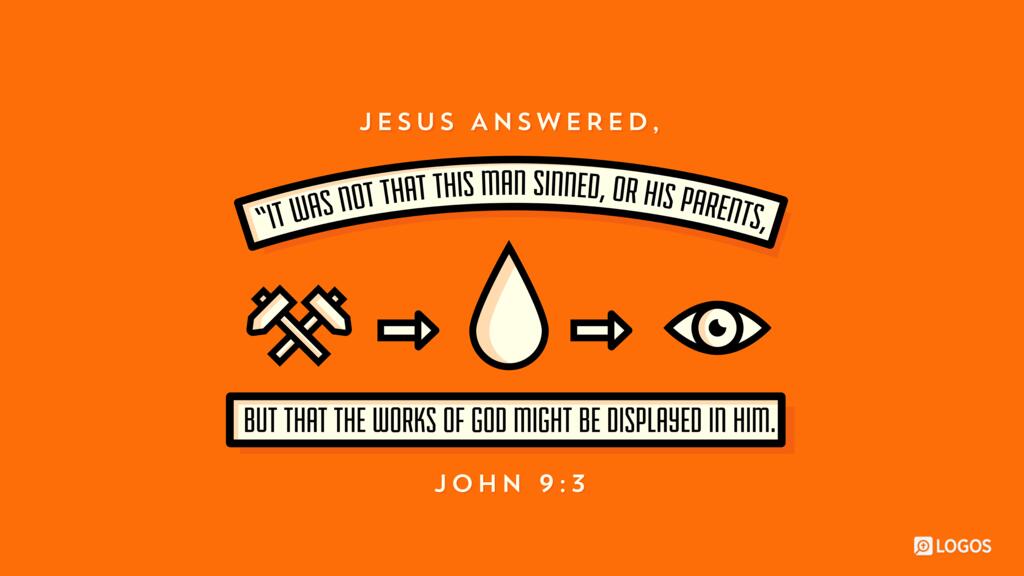
9And as he* went away, he saw a man blind from birth. 2And his disciples asked him, saying, “Rabbi, who sinned, this man or his parents, that he should be born blind?” 3Jesus replied, “Neither this man sinned nor his parents, but it happened* so that the works of God could be revealed in him. 4It is necessary for us to do the deeds of the one who sent me while it is day; night is coming, when no one can work! 5While I am in the world, I am the light of the world.” 6When he* had said these things, he spat on the ground and made clay with the saliva, and smeared the clay on his eyes. 7And he said to him, “Go, wash in the pool of Siloam” (which is translated “sent”). So he went and washed and came back seeing.
8Then the neighbors and those who saw him previously (because he was a beggar) began to say,* “Is this man not the one who used to sit and beg?” 9Others were saying, “It is this man”; others were saying, “No, but he is like him.” That one was saying, “I am he!” 10So they began to say* to him, “Howa were your eyes opened?” 11He replied, “The man who is called Jesus made clay and smeared it* on my eyes and said to me, ‘Go to Siloam and wash!’ So I went, and I washed, and* I received sight.” 12And they said to him, “Where is that man?” He said, “I do not know.”
Footnotes
- *Here “as” is supplied as a component of the participle (“went away”) which is understood as temporal
- *The words “it happened” are not in the Greek text but are implied
- *Here “when” is supplied as a component of the participle (“had said”) which is understood as temporal
- *The imperfect tense has been translated as ingressive here (“began to say”)
- *The imperfect tense has been translated as ingressive here (“began to say”)
- aSome manuscripts have “Then how”
- *Here the direct object is supplied from context in the English translation
- *Here “and” is supplied because the two previous participles (“went” and “washed”) have been translated as finite verbs
Copyright 2012 Lexham Press