John 6:25–35
The NET BibleOther versions
English
- NET The NET Bible
- DARBY 1890 Darby Bible
- ASV American Standard Version
- AV 1873 The Cambridge Paragraph Bible of the Authorized English Version
- CSB Christian Standard Bible
- D-R Douay-Rheims Bible
- ESV English Standard Version
- GW GOD’S WORD Translation
- GNB Good News Translation
- HCSB The Holman Christian Standard Bible
- KJV 1900 King James Version
- LSB Legacy Standard Bible
- LEB The Lexham English Bible
- MSG The Message: The Bible in Contemporary Language
- NASB95 New American Standard Bible (1995)
- NCV New Century Version
- NIrV New International Reader’s Version (1998)
- NIV New International Version (2011)
- NKJV The New King James Version
- NLT New Living Translation
- NRSVue New Revised Standard Version: Updated Edition
- RSV The Revised Standard Version
- RSVCE The Revised Standard Version, Catholic Edition
- YLT Young’s Literal Translation
Arabic
Czech
French
German
Greek
Hungarian
Italian
Korean
Latin
Portuguese
Russian
Simplified Chinese
Spanish
Traditional Chinese
Jesus’ Discourse About the Bread of Life
6:25When they found him on the other side of the lake,37 they said to him, “Rabbi, when did you get here?”386:26Jesus replied,39 “I tell you the solemn truth,40 you are looking for me not because you saw miraculous signs, but because you ate all the loaves of bread you wanted.416:27Do not work for the food that disappears,42 but for the food that remains to eternal life—the food43 which the Son of Man will give to you. For God the Father has put his seal of approval on him.”44
6:28So then they said to him, “What must we do to accomplish the deeds45 God requires?”466:29Jesus replied,47 “This is the deed48 God requires49—to believe in the one whom he50 sent.” 6:30So they said to him, “Then what miraculous sign will you perform, so that we may see it and believe you? What will you do? 6:31Our ancestors51 ate the manna in the wilderness, just as it is written, ‘He gave them bread from heaven to eat.’ ”52
6:32Then Jesus told them, “I tell you the solemn truth,53 it is not Moses who has given you the bread from heaven, but my Father is giving you the true bread from heaven. 6:33For the bread of God is the one who54 comes down from heaven and gives life to the world.” 6:34So they said to him, “Sir,55 give us this bread all the time!”
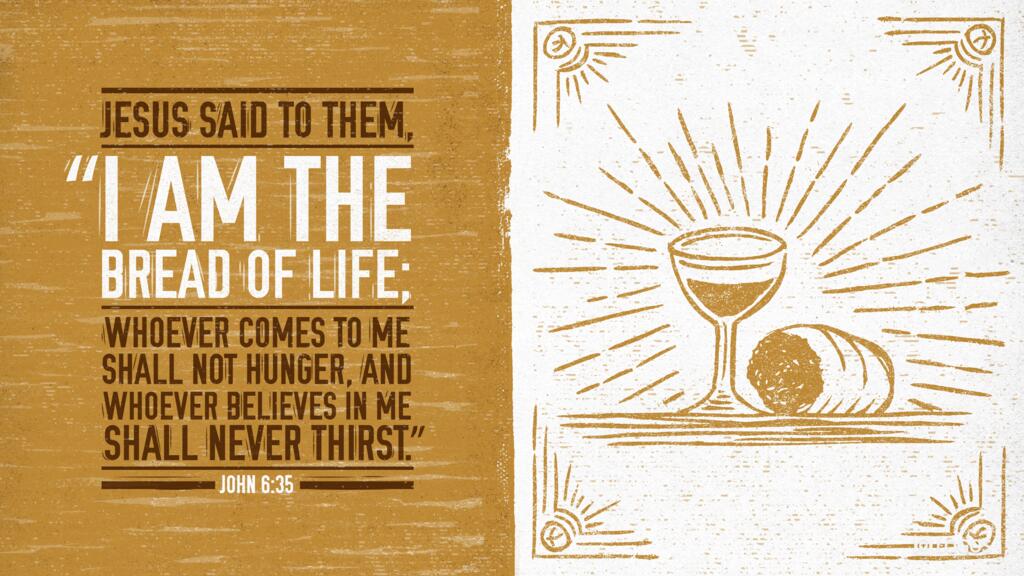
6:35Jesus said to them, “I am the bread of life. The one who comes to me will never go hungry, and the one who believes in me will never be thirsty.56
Footnotes
- 37 Or “sea.” See the note on “lake” in v. .
- 38 John 6:25–31. The previous miracle of the multiplication of the bread had taken place near the town of Tiberias (cf. John 6:23). Jesus’ disciples set sail for Capernaum (6:17) and were joined by the Lord in the middle of the sea. The next day boats from Tiberias picked up a few of those who had seen the multiplication (certainly not the whole 5,000) and brought them to Capernaum. It was to this group that Jesus spoke in 6:26–27. But there were also people from Capernaum who had gathered to see Jesus, who had not witnessed the multiplication, and it was this group that asked Jesus for a miraculous sign like the manna (6:30–31). This would have seemed superfluous if it were the same crowd that had already seen the multiplication of the bread. But some from Capernaum had heard about it and wanted to see a similar miracle repeated.
- 39 Grk “answered and said to them.”
- 40 Grk “Truly, truly, I say to you.”
- 41 Grk “because you ate of the loaves of bread and were filled.”
- 42 Or “perishes” (this might refer to spoiling, but is more focused on the temporary nature of this kind of food). Do not work for the food that disappears. Note the wordplay on “work” here. This does not imply “working” for salvation, since the “work” is later explained (in John 6:29) as “to believe in the one whom he (the Father) sent.”
- 43 The referent (the food) has been specified for clarity by repeating the word “food” from the previous clause.
- 44 Grk “on this one.”
- 45 Grk “the works.”
- 46 Grk “What must we do to work the works of God?”
- 47 Grk “answered and said to them.”
- 48 Grk “the work.”
- 49 Grk “This is the work of God.”
- 50 Grk “that one” (i.e., God).
- 51 Or “forefathers”; Grk “fathers.”
- 52 A quotation from Ps 78:24 (referring to the events of Exod 16:4–36).
- 53 Grk “Truly, truly, I say to you.”
- 54 Or “he who.”
- 55 Or “Lord.” The Greek κύριος (kurios) means both “Sir” and “Lord.” In this passage it is not at all clear at this point that the crowd is acknowledging Jesus as Lord. More likely this is simply a form of polite address (“sir”).
- 56 Grk “the one who believes in me will not possibly thirst, ever.” The one who believes in me will never be thirsty. Note the parallelism between “coming to Jesus” in the first part of v. 35 and “believing in Jesus” in the second part of v. 35. For the author of the Gospel of John these terms are virtually equivalent, both referring to a positive response to Jesus (see John 3:17–21).
The NET Bible First Edition, Copyright 1996-2005 by Biblical Studies Press