John 15:5–8
The NET BibleOther versions
English
- NET The NET Bible
- DARBY 1890 Darby Bible
- ASV American Standard Version
- AV 1873 The Cambridge Paragraph Bible of the Authorized English Version
- CSB Christian Standard Bible
- D-R Douay-Rheims Bible
- ESV English Standard Version
- GW GOD’S WORD Translation
- GNB Good News Translation
- HCSB The Holman Christian Standard Bible
- KJV 1900 King James Version
- LSB Legacy Standard Bible
- LEB The Lexham English Bible
- MSG The Message: The Bible in Contemporary Language
- NASB95 New American Standard Bible (1995)
- NCV New Century Version
- NIrV New International Reader’s Version (1998)
- NIV New International Version (2011)
- NKJV The New King James Version
- NLT New Living Translation
- NRSVue New Revised Standard Version: Updated Edition
- RSV The Revised Standard Version
- RSVCE The Revised Standard Version, Catholic Edition
- YLT Young’s Literal Translation
Arabic
Czech
French
German
Greek
Hungarian
Italian
Korean
Latin
Portuguese
Russian
Simplified Chinese
Spanish
Traditional Chinese
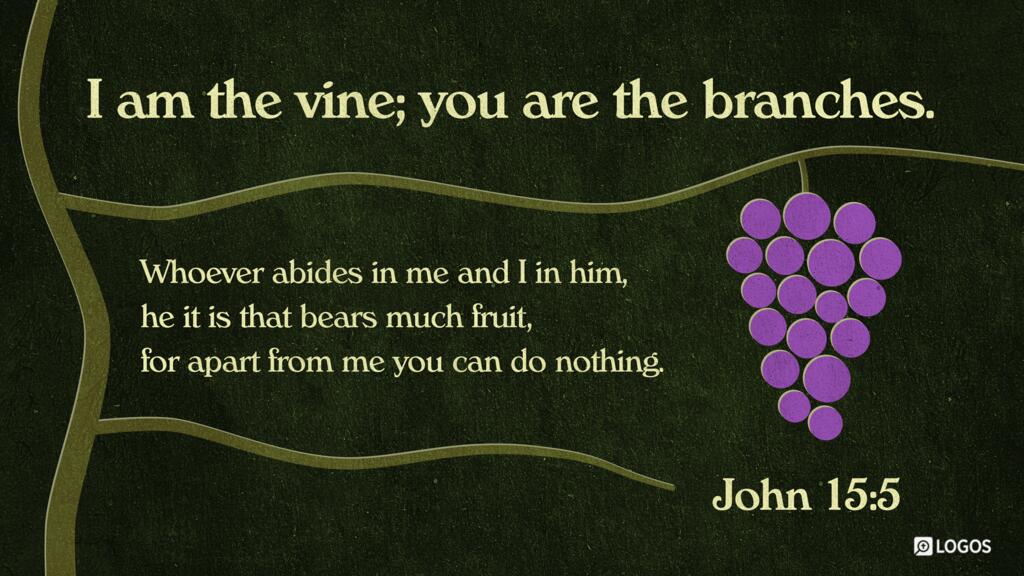
15:5“I am the vine; you are the branches. The one who remains15 in me—and I in him—bears16 much fruit,17 because apart from me you can accomplish18 nothing. 15:6If anyone does not remain19 in me, he is thrown out like a branch, and dries up; and such branches are gathered up and thrown into the fire,20 and are burned up.2115:7If you remain22 in me and my words remain23 in you, ask whatever you want, and it will be done for you.2415:8My Father is honored25 by this, that26 you bear27 much fruit and show that you are28 my disciples.
Footnotes
- 15 Or “resides.”
- 16 Or “yields.”
- 17 Grk “in him, this one bears much fruit.” The pronoun “this one” has been omitted from the translation because it is redundant according to contemporary English style. Many interpret the imagery of fruit here and in 15:2, 4 in terms of good deeds or character qualities, relating it to passages elsewhere in the NT like Matt 3:8 and 7:20, Rom 6:22, Gal 5:22, etc. This is not necessarily inaccurate, but one must remember that for John, to have life at all is to bear fruit, while one who does not bear fruit shows that he does not have the life (once again, conduct is the clue to paternity, as in John 8:41; compare also 1 John 4:20).
- 18 Or “do.”
- 19 Or “reside.”
- 20 Such branches are gathered up and thrown into the fire. The author does not tell who it is who does the gathering and throwing into the fire. Although some claim that realized eschatology is so prevalent in the Fourth Gospel that no references to final eschatology appear at all, the fate of these branches seems to point to the opposite. The imagery is almost certainly that of eschatological judgment, and recalls some of the OT vine imagery which involves divine rejection and judgment of disobedient Israel (Ezek 15:4–6, 19:12).
- 21 Grk “they gather them up and throw them into the fire, and they are burned.”
- 22 Or “reside.”
- 23 Or “reside.”
- 24 Once again Jesus promises the disciples ask whatever you want, and it will be done for you. This recalls 14:13–14, where the disciples were promised that if they asked anything in Jesus’ name it would be done for them. The two thoughts are really quite similar, since here it is conditioned on the disciples’ remaining in Jesus and his words remaining in them. The first phrase relates to the genuineness of their relationship with Jesus. The second phrase relates to their obedience. When both of these qualifications are met, the disciples would in fact be asking in Jesus’ name and therefore according to his will.
- 25 Grk “glorified.”
- 26 The ἵνα (hina) clause is best taken as substantival in apposition to ἐν τούτῳ (en toutō) at the beginning of the verse. The Father is glorified when the disciples bring forth abundant fruit. Just as Jesus has done the works which he has seen his Father doing (5:19–29) so also will his disciples.
- 27 Or “yield.”
- 28 Most (א A Ψ f13 33 𝔐) read the future indicative γενήσεσθε (genēsesthe; perhaps best rendered as “[and show that] you will become”), while some early and good witnesses (𝔓66vid B D L Θ 0250 1 565 ) have the aorist subjunctive γένησθε (genēsthe; “[and show that] you are”). The original reading is difficult to determine because the external evidence is fairly evenly divided. On the basis of the external evidence alone the first reading has some credibility because of א and 33, but it is not enough to overthrow the Alexandrian and Western witnesses for the aorist. Some who accept the future indicative see a consecutive (or resultative) sequence between φέρητε (pherēte) in the ἵνα (hina) clause and γενήσεσθε, so that the disciples’ bearing much fruit results in their becoming disciples. This alleviates the problem of reading a future indicative within a ἵνα clause (a grammatical solecism that is virtually unattested in Attic Greek), although such infrequently occurs in the NT, particularly in the Apocalypse (cf. Gal 2:4; Rev 3:9; 6:4, 11; 8:3; 9:4, 5, 20; 13:12; 14:13; 22:14; even here, however, the Byzantine , with א occasionally by their side, almost always change the future indicative to an aorist subjunctive). It seems more likely, however, that the second verb (regardless of whether it is read as aorist or future) is to be understood as coordinate in meaning with the previous verb φέρητε (So M. Zerwick, §342). Thus the two actions are really one and the same: Bearing fruit and being Jesus’ disciple are not two different actions, but a single action. The first is the outward sign or proof of the second—in bearing fruit the disciples show themselves to be disciples indeed (cf. 15:5). Thus the translation followed here is, “that you bear much fruit and show that you are my disciples.” As far as the textual reading is concerned, it appears somewhat preferable to accept the aorist subjunctive reading (γένησθε) on the basis of better external testimony.
The NET Bible First Edition, Copyright 1996-2005 by Biblical Studies Press
In other versions
ESVEnglish Standard Version
I am the vine; you are the branches. Whoever abides in me and I in him, he it is that bears much fruit, for apart from me you can do nothing. If anyone does not abide in me, he is thrown away like a branch and withers; and the branches are gathered, thrown into the fire, and burned. If you abide in me, and my words abide in you, ask whatever you wish, and it will be done for you. By this my Father is glorified, that you bear much fruit and so prove to be my disciples.
Copyright 2001 Crossway Bibles
NIVNew International Version (2011)
“I am the vine; you are the branches. If you remain in me and I in you, you will bear much fruit; apart from me you can do nothing. If you do not remain in me, you are like a branch that is thrown away and withers; such branches are picked up, thrown into the fire and burned. If you remain in me and my words remain in you, ask whatever you wish, and it will be done for you. This is to my Father’s glory, that you bear much fruit, showing yourselves to be my disciples.
Copyright 1973, 1978, 1984, 2011 Biblica, Inc.
CSBChristian Standard Bible
I am the vine; you are the branches. The one who remains in me and I in him produces much fruit, because you can do nothing without me. If anyone does not remain in me, he is thrown aside like a branch and he withers. They gather them, throw them into the fire, and they are burned. If you remain in me and my words remain in you, ask whatever you want and it will be done for you. My Father is glorified by this: that you produce much fruit and prove to be my disciples.
Copyright 2017 Holman Bible Publishers
NLTNew Living Translation
“Yes, I am the vine; you are the branches. Those who remain in me, and I in them, will produce much fruit. For apart from me you can do nothing. Anyone who does not remain in me is thrown away like a useless branch and withers. Such branches are gathered into a pile to be burned. But if you remain in me and my words remain in you, you may ask for anything you want, and it will be granted! When you produce much fruit, you are my true disciples. This brings great glory to my Father.
Holy Bible, New Living Translation, copyright © 1996, 2004, 2015 by Tyndale House Foundation. Used by permission of Tyndale House Publishers. All rights reserved.
LEBThe Lexham English Bible
“I am the vine; you are the branches. The one who remains in me and I in him—this one bears much fruit, for apart from me you are not able to do anything. If anyone does not remain in me, he is thrown out as a branch, and dries up, and they gather them and throw them into the fire, and they are burned. If you remain in me and my words remain in you, ask whatever you want and it will be done for you. My Father is glorified by this: that you bear much fruit, and prove to be my disciples.
Copyright 2012 Lexham Press
KJV 1900King James Version
I am the vine, ye are the branches: He that abideth in me, and I in him, the same bringeth forth much fruit: for without me ye can do nothing. If a man abide not in me, he is cast forth as a branch, and is withered; and men gather them, and cast them into the fire, and they are burned. If ye abide in me, and my words abide in you, ye shall ask what ye will, and it shall be done unto you. Herein is my Father glorified, that ye bear much fruit; so shall ye be my disciples.
Public Domain