Genesis 15:5–12
The NET BibleOther versions
English
- NET The NET Bible
- DARBY 1890 Darby Bible
- ASV American Standard Version
- AV 1873 The Cambridge Paragraph Bible of the Authorized English Version
- CSB Christian Standard Bible
- D-R Douay-Rheims Bible
- ESV English Standard Version
- GW GOD’S WORD Translation
- GNB Good News Translation
- HCSB The Holman Christian Standard Bible
- KJV 1900 King James Version
- LSB Legacy Standard Bible
- LEB The Lexham English Bible
- MSG The Message: The Bible in Contemporary Language
- NASB95 New American Standard Bible (1995)
- NCV New Century Version
- NIrV New International Reader’s Version (1998)
- NIV New International Version (2011)
- NKJV The New King James Version
- NLT New Living Translation
- NRSVue New Revised Standard Version: Updated Edition
- RSV The Revised Standard Version
- RSVCE The Revised Standard Version, Catholic Edition
- YLT Young’s Literal Translation
Arabic
Czech
French
German
Hebrew
Hungarian
Italian
Korean
Latin
Portuguese
Russian
Simplified Chinese
Spanish
Traditional Chinese
15:5The Lord19 took him outside and said, “Gaze into the sky and count the stars—if you are able to count them!” Then he said to him, “So will your descendants be.”
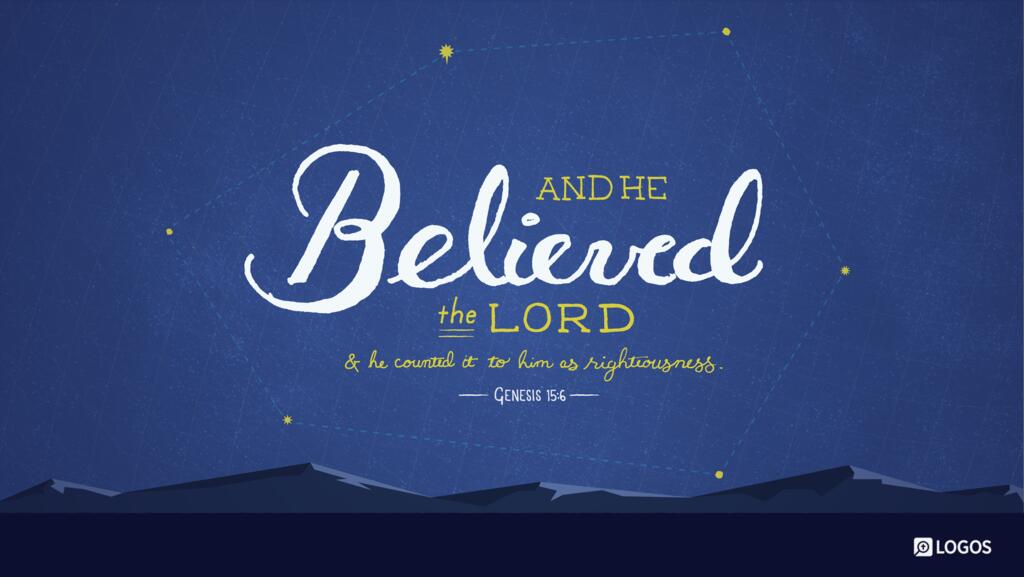
15:6Abram believed20 the Lord, and the Lord21 considered his response of faith22 as proof of genuine loyalty.23
15:7The Lord said24 to him, “I am the Lord25 who brought you out from Ur of the Chaldeans26 to give you this land to possess.” 15:8But27 Abram28 said, “O sovereign Lord,29 by what30 can I know that I am to possess it?”
15:9The Lord31 said to him, “Take for me a heifer, a goat, and a ram, each three years old, along with a dove and a young pigeon.” 15:10So Abram32 took all these for him and then cut them in two33 and placed each half opposite the other,34 but he did not cut the birds in half. 15:11When birds of prey came down on the carcasses, Abram drove them away.
15:12When the sun went down, Abram fell sound asleep,35 and great terror overwhelmed him.36
Footnotes
- 19 Heb “he”; the referent (the Lord) has been specified in the translation for clarity.
- 20 The nonconsecutive vav (ו) is on a perfect verbal form. If the composer of the narrative had wanted to show simple sequence, he would have used the vav consecutive with the preterite. The perfect with vav conjunctive (where one expects the preterite with vav consecutive) in narrative contexts can have a variety of discourse functions, but here it probably serves to highlight Abram’s response to God’s promise. For a detailed discussion of the vav + perfect construction in Hebrew narrative, see R. Longacre, “Weqatal Forms in Biblical Hebrew Prose: A Discourse-modular Approach,” Biblical Hebrew and Discourse Linguistics, 50–98. The Hebrew verb אָמַן (’aman) means “to confirm, to support” in the Qal verbal stem. Its derivative nouns refer to something or someone that/who provides support, such as a “pillar,” “nurse,” or “guardian, trustee.” In the Niphal stem it comes to mean “to be faithful, to be reliable, to be dependable,” or “to be firm, to be sure.” In the Hiphil, the form used here, it takes on a declarative sense: “to consider something reliable [or “dependable”].” Abram regarded the God who made this promise as reliable and fully capable of making it a reality.
- 21 Heb “and he”; the referent (the Lord) has been specified in the translation for clarity.
- 22 Heb “and he reckoned it to him.” The third feminine singular pronominal suffix refers back to Abram’s act of faith, mentioned in the preceding clause. On third feminine singular pronouns referring back to verbal ideas see §135.p. Some propose taking the suffix as proleptic, anticipating the following feminine noun (“righteousness”). In this case one might translate: “and he reckoned it to him—[namely] righteousness.” See O. P. Robertson, “Genesis 15:6: A New Covenant Exposition of an Old Covenant Text,” 42 (1980): .
- 23 Or “righteousness”; or “evidence of steadfast commitment.” The noun is an adverbial accusative. The verb translated “considered” (Heb “reckoned”) also appears with צְדָקָה (tsédaqah, “righteousness”) in Ps 106:31. Alluding to the events recorded in Numbers 25, the psalmist notes that Phinehas’ actions were “credited to him as righteousness for endless generations to come.” Reference is made to the unconditional, eternal covenant with which God rewarded Phinehas’ loyalty (Num 25:12–13). So צְדָקָה seems to carry by metonymy the meaning “loyal, rewardable behavior” here, a nuance that fits nicely in Genesis 15, where God responds to Abram’s faith by formally ratifying his promise to give Abram and his descendants the land. (See R. B. Chisholm, “Evidence from Genesis,” A Case for Premillennialism, 40.) In Phoenician and Old Aramaic inscriptions cognate nouns glossed as “correct, justifiable conduct” sometimes carry this same semantic nuance ( 2:962). This episode is basic to the NT teaching of Paul on justification (Romans 4). Paul weaves this passage and Psalm 32 together, for both use this word. Paul explains that for the one who believes in the Lord, like Abram, God credits him with righteousness but does not credit his sins against him because he is forgiven. Justification does not mean that the believer is righteous; it means that God credits him with righteousness, so that in the records of heaven (as it were) he is declared righteous. See M. G. Kline, “Abram’s Amen,” 31 (1968): .
- 24 Heb “And he said.”
- 25 I am the Lord. The Lord initiates the covenant-making ceremony with a declaration of who he is and what he has done for Abram. The same form appears at the beginning of the covenant made at Sinai (see Exod 20:1).
- 26 The phrase of the Chaldeans is a later editorial clarification for the readers, designating the location of Ur. From all evidence there would have been no Chaldeans in existence at this early date; they are known in the time of the neo-Babylonian empire in the first millennium b.c.
- 27 Here the vav carries adversative force and is translated “but.”
- 28 Heb “he”; the referent (Abram) has been specified in the translation for clarity.
- 29 See note on the phrase “sovereign Lord” in .
- 30 Or “how.”
- 31 Heb “He”; the referent (the Lord) has been specified in the translation for clarity.
- 32 Heb “he”; the referent (Abram) has been specified in the translation for clarity.
- 33 Heb “in the middle.”
- 34 Heb “to meet its neighbor.” For discussion of this ritual see G. F. Hasel, “The Meaning of the Animal Rite in Genesis 15,” 19 (1981): 61–78.
- 35 Heb “a deep sleep fell on Abram.”
- 36 Heb “and look, terror, a great darkness was falling on him.”
The NET Bible First Edition, Copyright 1996-2005 by Biblical Studies Press
In other versions
ESVEnglish Standard Version
And he brought him outside and said, “Look toward heaven, and number the stars, if you are able to number them.” Then he said to him, “So shall your offspring be.” And he believed the Lord, and he counted it to him as righteousness.
And he said to him, “I am the Lord who brought you out from Ur of the Chaldeans to give you this land to possess.” But he said, “O Lord God, how am I to know that I shall possess it?” He said to him, “Bring me a heifer three years old, a female goat three years old, a ram three years old, a turtledove, and a young pigeon.” And he brought him all these, cut them in half, and laid each half over against the other. But he did not cut the birds in half. And when birds of prey came down on the carcasses, Abram drove them away.
As the sun was going down, a deep sleep fell on Abram. And behold, dreadful and great darkness fell upon him.
Copyright 2001 Crossway Bibles
NIVNew International Version (2011)
He took him outside and said, “Look up at the sky and count the stars—if indeed you can count them.” Then he said to him, “So shall your offspring be.”
Abram believed the Lord, and he credited it to him as righteousness.
He also said to him, “I am the Lord, who brought you out of Ur of the Chaldeans to give you this land to take possession of it.”
But Abram said, “Sovereign Lord, how can I know that I will gain possession of it?”
So the Lord said to him, “Bring me a heifer, a goat and a ram, each three years old, along with a dove and a young pigeon.”
Abram brought all these to him, cut them in two and arranged the halves opposite each other; the birds, however, he did not cut in half. Then birds of prey came down on the carcasses, but Abram drove them away.
As the sun was setting, Abram fell into a deep sleep, and a thick and dreadful darkness came over him.
Copyright 1973, 1978, 1984, 2011 Biblica, Inc.
CSBChristian Standard Bible
He took him outside and said, “Look at the sky and count the stars, if you are able to count them.” Then he said to him, “Your offspring will be that numerous.”
Abram believed the Lord, and he credited it to him as righteousness.
He also said to him, “I am the Lord who brought you from Ur of the Chaldeans to give you this land to possess.”
But he said, “Lord God, how can I know that I will possess it?”
He said to him, “Bring me a three-year-old cow, a three-year-old female goat, a three-year-old ram, a turtledove, and a young pigeon.”
So he brought all these to him, cut them in half, and laid the pieces opposite each other, but he did not cut the birds in half. Birds of prey came down on the carcasses, but Abram drove them away. As the sun was setting, a deep sleep came over Abram, and suddenly great terror and darkness descended on him.
Copyright 2017 Holman Bible Publishers
NLTNew Living Translation
Then the Lord took Abram outside and said to him, “Look up into the sky and count the stars if you can. That’s how many descendants you will have!”
And Abram believed the Lord, and the Lord counted him as righteous because of his faith.
Then the Lord told him, “I am the Lord who brought you out of Ur of the Chaldeans to give you this land as your possession.”
But Abram replied, “O Sovereign Lord, how can I be sure that I will actually possess it?”
The Lord told him, “Bring me a three-year-old heifer, a three-year-old female goat, a three-year-old ram, a turtledove, and a young pigeon.” So Abram presented all these to him and killed them. Then he cut each animal down the middle and laid the halves side by side; he did not, however, cut the birds in half. Some vultures swooped down to eat the carcasses, but Abram chased them away.
As the sun was going down, Abram fell into a deep sleep, and a terrifying darkness came down over him.
Holy Bible, New Living Translation, copyright © 1996, 2004, 2015 by Tyndale House Foundation. Used by permission of Tyndale House Publishers. All rights reserved.
LEBThe Lexham English Bible
And he brought him outside and said, “Look toward the heavens and count the stars if you are able to count them.” And he said to him, “So shall your offspring be.” And he believed in Yahweh, and he reckoned it to him as righteousness. And he said to him, “I am Yahweh, who brought you out from Ur of the Chaldeans to give this land to you, to possess it.” And he said, “O Yahweh God, how shall I know that I will possess it?” And he said to him, “Take for me a three-year-old heifer, and a three-year-old female goat, and a three-year-old ram, and a turtledove and a young pigeon.” And he took for him all these and cut them in pieces down the middle. And he put each piece opposite the other, but the birds he did not cut. And the birds of prey came down on the carcasses, but Abram drove them away. And it happened, as the sun went down, then a deep sleep fell upon Abram and, behold, a great terrifying darkness fell upon him.
Copyright 2012 Lexham Press
KJV 1900King James Version
And he brought him forth abroad, and said, Look now toward heaven, and tell the stars, if thou be able to number them: and he said unto him, So shall thy seed be. And he believed in the Lord; and he counted it to him for righteousness. And he said unto him, I am the Lord that brought thee out of Ur of the Chaldees, to give thee this land to inherit it. And he said, Lord God, whereby shall I know that I shall inherit it? And he said unto him, Take me an heifer of three years old, and a she goat of three years old, and a ram of three years old, and a turtledove, and a young pigeon. And he took unto him all these, and divided them in the midst, and laid each piece one against another: but the birds divided he not. And when the fowls came down upon the carcases, Abram drove them away. And when the sun was going down, a deep sleep fell upon Abram; and, lo, an horror of great darkness fell upon him.
Public Domain