Ezekiel 43:13–46:24
The NET BibleOther versions
English
- NET The NET Bible
- DARBY 1890 Darby Bible
- ASV American Standard Version
- AV 1873 The Cambridge Paragraph Bible of the Authorized English Version
- CSB Christian Standard Bible
- D-R Douay-Rheims Bible
- ESV English Standard Version
- GW GOD’S WORD Translation
- GNB Good News Translation
- HCSB The Holman Christian Standard Bible
- KJV 1900 King James Version
- LSB Legacy Standard Bible
- LEB The Lexham English Bible
- MSG The Message: The Bible in Contemporary Language
- NASB95 New American Standard Bible (1995)
- NCV New Century Version
- NIrV New International Reader’s Version (1998)
- NIV New International Version (2011)
- NKJV The New King James Version
- NLT New Living Translation
- NRSVue New Revised Standard Version: Updated Edition
- RSV The Revised Standard Version
- RSVCE The Revised Standard Version, Catholic Edition
- YLT Young’s Literal Translation
Arabic
Czech
French
German
Hebrew
Hungarian
Italian
Korean
Latin
Portuguese
Russian
Simplified Chinese
Spanish
Traditional Chinese
The Altar
43:13“And these are the measurements of the altar:13 Its base14 is 1¾ feet15 high,16 and 1¾ feet17 wide, and its border nine inches18 on its edge. This is to be the height19 of the altar. 43:14From the base of the ground to the lower edge is 3½ feet,20 and the width 1¾ feet;21 and from the smaller ledge to the larger edge, 7 feet,22 and the width 1¾ feet; 43:15and the altar hearth, 7 feet, and from the altar hearth four horns projecting upward. 43:16Now the altar hearth23 is a perfect square, 21 feet24 long and 21 feet wide. 43:17The ledge is 24½ feet25 long and 24½ feet wide on four sides; the border around it is 10½ inches,26 and its surrounding base 1¾ feet.27 Its steps face east.”
43:18Then he said to me: “Son of man, this is what the sovereign Lord says: These are the statutes of the altar: On the day it is built to offer up burnt offerings on it and to sprinkle blood on it,2843:19you will give a young bull for a sin offering to the Levitical priests who are descended from Zadok, who approach me to minister to me, declares the sovereign Lord. 43:20You will take some of its blood, and place it on the four horns of the altar, on the four corners of the ledge, and on the border all around; you will cleanse it and make atonement for it.2943:21You will also take the bull for the sin offering, and it will be burned in the appointed place in the temple, outside the sanctuary.
43:22“On the second day, you will offer a male goat without blemish for a sin offering. They will purify the altar just as they purified it with the bull. 43:23When you have finished purifying it, you will offer an unblemished young bull and an unblemished ram from the flock. 43:24You will present them before the Lord, and the priests will scatter salt on them30 and offer them up as a burnt offering to the Lord.
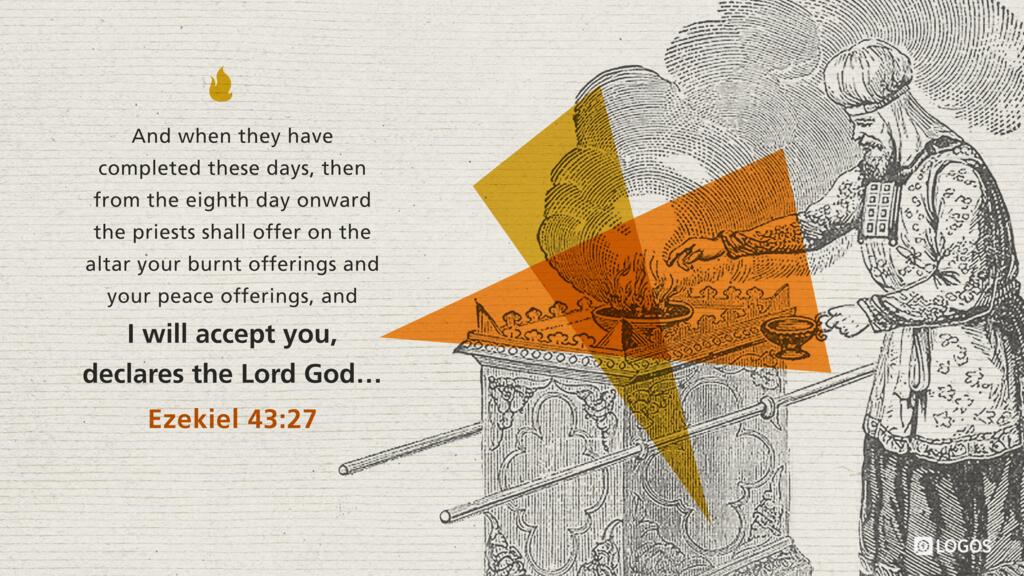
43:25“For seven days you will provide every day a goat for a sin offering; a young bull and a ram from the flock, both without blemish, will be provided. 43:26For seven days they will make atonement for the altar and cleanse it, so they will consecrate it.3143:27When the prescribed period is over,32 on the eighth day and thereafter the priests will offer up on the altar your burnt offerings and your peace offerings;33 I will accept you, declares the sovereign Lord.”
The Closed Gate
44:1Then he brought me back by way of the outer gate of the sanctuary which faces east, but it was shut. 44:2The Lord said to me: “This gate will be shut; it will not be opened, and no one will enter by it. For the Lord, the God of Israel, has entered by it; therefore it will remain shut. 44:3Only the prince may sit in it to eat a sacrificial meal1 before the Lord; he will enter by way of the porch of the gate and will go out by the same way.”
44:4Then he brought me by way of the north gate to the front of the temple. As I watched, I noticed2 the glory of the Lord filling the Lord’s temple, and I threw myself face down. 44:5The Lord said to me: “Son of man, pay attention,3 watch closely and listen carefully to4 everything I tell you concerning all the statutes of the Lord’s house and all its laws. Pay attention to the entrances5 to the temple with all the exits of the sanctuary. 44:6Say to the rebellious,6 to the house of Israel, ‘This is what the sovereign Lord says: Enough of all your abominable practices, O house of Israel! 44:7When you bring foreigners, those uncircumcised in heart and in flesh, into my sanctuary, you desecrate7 it—even my house—when you offer my food, the fat and the blood. You8 have broken my covenant by all your abominable practices. 44:8You have not kept charge of my holy things, but you have assigned foreigners9 to keep charge of my sanctuary for you. 44:9This is what the sovereign Lord says: No foreigner, who is uncircumcised in heart and flesh among all the foreigners who are among the people of Israel, will enter into my sanctuary.10
44:10“ ‘But the Levites who went far from me, straying off from me after their idols when Israel went astray, will be responsible for11 their sin. 44:11Yet they will be ministers in my sanctuary, having oversight at the gates of the temple, and serving the temple. They will slaughter the burnt offerings and the sacrifices for the people, and they will stand before them to minister to them. 44:12Because they used to minister to them before their idols, and became a sinful obstacle12 to the house of Israel, consequently I have made a vow13 concerning them, declares the sovereign Lord, that they will be responsible14 for their sin. 44:13They will not come near me to serve me as priest, nor will they come near any of my holy things, the things which are most sacred. They will bear the shame of the abominable deeds they have committed. 44:14Yet I will appoint them to keep charge of the temple, all of its service and all that will be done in it.
The Levitical Priests
44:15“ ‘But the Levitical priests, the descendants of Zadok15 who kept the charge of my sanctuary when the people of Israel went astray from me, will approach me to minister to me; they will stand before me to offer me the fat and the blood, declares the sovereign Lord. 44:16They will enter my sanctuary, and approach my table to minister to me; they will keep my charge.
44:17“ ‘When they enter the gates of the inner court, they must wear linen garments; they must not have any wool on them when they minister in the inner gates of the court and in the temple. 44:18Linen turbans will be on their heads and linen undergarments will be around their waists; they must not bind themselves with anything that causes sweat. 44:19When they go out to the outer court to the people, they must remove the garments they were ministering in, and place them in the holy chambers; they must put on other garments so that they will not transmit holiness to the people with their garments.16
44:20“ ‘They must not shave their heads17 nor let their hair grow long;18 they must only trim their heads. 44:21No priest may drink wine when he enters the inner court. 44:22They must not marry a widow or a divorcee, but they may marry a virgin from the house of Israel19 or a widow who is a priest’s widow. 44:23Moreover, they will teach my people the difference between the holy and the common, and show them how to distinguish between the ceremonially unclean and the clean.20
44:24“ ‘In a controversy they will act as judges;21 they will judge according to my ordinances. They will keep my laws and my statutes regarding all my appointed festivals and will observe22 my Sabbaths.
44:25“ ‘They must not come near a dead person or they will be defiled;23 however, for father, mother, son, daughter, brother or sister, they may defile themselves. 44:26After a priest24 has become ceremonially clean, they25 must count off a period of seven days for him. 44:27On the day he enters the sanctuary, into the inner court to serve in the sanctuary, he must offer his sin offering, declares the sovereign Lord.
44:28“ ‘This will be their inheritance: I am their inheritance, and you must give them no property in Israel; I am their property.2644:29They may eat the grain offering, the sin offering, and the guilt offering, and every devoted thing in Israel will be theirs. 44:30The first of all the first fruits and all contributions of any kind27 will be for the priests; you will also give to the priest the first portion of your dough, so that a blessing may rest on your house. 44:31The priests will not eat any bird or animal that has died a natural death or was torn to pieces by a wild animal.28
The Lord’s Portion of the Land
45:1“ ‘When you allot the land as an inheritance, you will offer an allotment1 to the Lord, a holy portion from the land; the length will be eight and a quarter miles2 and the width three and one-third miles.3 This entire area will be holy.445:2Of this area a square 875 feet5 by 875 feet will be designated for the sanctuary, with 87½ feet6 set aside for its open space round about. 45:3From this measured area you will measure a length of eight and a quarter miles7 and a width of three and one-third miles;8 in it will be the sanctuary, the most holy place. 45:4It will be a holy portion of the land; it will be for the priests, the ministers of the sanctuary who approach the Lord to minister to him. It will be a place for their houses and a holy place for the sanctuary.945:5An area eight and a quarter miles10 in length and three and one-third miles11 in width will be for the Levites, who minister at the temple, as the place for the cities12 in which they will live.
45:6“ ‘Alongside the portion set apart as the holy allotment, you will allot for the city an area one and two-thirds miles13 wide and eight and a quarter miles14 long; it will be for the whole house of Israel.
45:7“ ‘For the prince there will be land on both sides of the holy allotment and the allotted city, alongside the holy allotment and the allotted city, on the west side and on the east side; it will be comparable in length to one of the portions, from the west border to the east border 45:8of the land. This will be his property in Israel. My princes will no longer oppress my people, but the land will be allotted to the house of Israel according to their tribes.
45:9“ ‘This is what the sovereign Lord says: Enough, you princes of Israel! Put away violence and destruction, and do what is just and right. Put an end to your evictions of my people,15 declares the sovereign Lord. 45:10You must use just balances,16 a just dry measure (an ephah),17 and a just liquid measure (a bath).1845:11The dry and liquid measures will be the same, the bath will contain a tenth of a homer,19 and the ephah a tenth of a homer; the homer will be the standard measure. 45:12The shekel will be twenty gerahs. Sixty shekels20 will be a mina for you.
45:13“ ‘This is the offering you must offer: a sixth of an ephah from a homer of wheat; a sixth of an ephah from a homer of barley, 45:14and…
This passage has been shortened. Keep reading Ezekiel 43:13–46:24 in Logos
Footnotes
- 13 Heb “the measurements of the altar by cubits, the cubit being a cubit and a handbreadth.” The measuring units here and in the remainder of this section are the Hebrew “long” cubit, consisting of a cubit (about 18 inches or 45 cm) and a handbreadth (about 3 inches or 7.5 cm), for a total of 21 inches (52.5 cm). Because modern readers are not familiar with the cubit as a unit of measurement, and due to the additional complication of the “long” cubit as opposed to the regular cubit, all measurements have been converted to American standard feet and inches, with the Hebrew measurements and the metric equivalents given in the notes. On the altar see Ezek 40:47.
- 14 The Hebrew term normally means “bosom.” Here it refers to a hollow in the ground.
- 15 Heb “one cubit” (i.e., 52.5 cm).
- 16 The word “high” is not in the Hebrew text but is supplied in the translation for clarity.
- 17 Heb “one cubit” (i.e., 52.5 cm).
- 18 Heb “one span.” A span was three handbreadths, or about nine inches (i.e., 22.5 cm).
- 19 Heb “bulge, protuberance, mound.” The translation follows the .
- 20 Heb “two cubits” (i.e., 1.05 meters).
- 21 Heb “one cubit” (i.e., 52.5 cm; the phrase occurs again later in this verse).
- 22 Heb “four cubits” (i.e., 2.1 meters; the phrase also occurs in the next verse).
- 23 The precise Hebrew word used here to refer to an “altar hearth” occurs only here in the OT.
- 24 Heb “twelve cubits” (i.e., 6.3 meters; the phrase occurs twice in this verse).
- 25 Heb “fourteen”; the word “cubits” is not in the Hebrew text but is understood from the context; the phrase occurs again later in this verse. Fourteen cubits is about 7.35 meters.
- 26 Heb “half a cubit” (i.e., 26.25 cm).
- 27 Heb “one cubit” (i.e., 52.5 cm).
- 28 For the “sprinkling of blood,” see Lev 1:5, 11; 8:19; 9:12.
- 29 Note the similar language in Lev 16:18.
- 30 It is likely that salt was used with sacrificial meals (Num 18:19; 2 Chr 13:5).
- 31 Heb “fill its hands.”
- 32 Heb “and they will complete the days.”
- 33 The people also could partake of the food of the peace offering (Lev 3).
- 1 Heb “to eat bread.”
- 2 The word הִנֵּה (hinneh, traditionally “behold”) indicates becoming aware of something and has been translated here as a verb.
- 3 Heb “set your heart” (so also in the latter part of the verse).
- 4 Heb “Set your mind, look with your eyes, and with your ears hear.”
- 5 The , , and read the plural. See D. I. Block, Ezekiel (), 2:.
- 6 The reads “house of rebellion.”
- 7 Heb “to desecrate.”
- 8 The Greek, , and Latin versions read “you.” The Masoretic text reads “they.”
- 9 Instead of an energic nun (ן), the text may have read a third masculine plural suffix ם (mem), “them,” which was confused with ן (nun) in the old script. See D. I. Block, Ezekiel (), 2:. This word is not in the Hebrew text but is supplied from the context.
- 10 Tobiah, an Ammonite (Neh 13:8), was dismissed from the temple.
- 11 Heb “will bear.”
- 12 Heb “a stumbling block of iniquity.” This is a unique phrase of the prophet Ezekiel (cf. also Ezek 7:19; 14:3, 4, 7; 18:30).
- 13 Heb “I lifted up my hand.”
- 14 Heb “will bear.”
- 15 Zadok was a descendant of Aaron through Eleazar (1 Chr 6:50–53), who served as a priest during David’s reign (2 Sam 8:17).
- 16 For a similar concept of the transmitting of holiness, see Exod 19:12–14; Lev 10:1–2; 2 Sam 6:7. Similar laws concerning the priest are found in Lev 10 and 21.
- 17 The shaving of the head was associated with mourning (Ezek 7:18).
- 18 Letting the hair grow was associated with the taking of a vow (Num 6:5; Acts 21:23–26).
- 19 Heb “from the offspring of the house of Israel.”
- 20 This task was a fundamental role of the priest (Lev 10:10).
- 21 For a historical illustration of the priest carrying out this function, see 2 Chr 19:9–11.
- 22 Heb “sanctify, set apart.”
- 23 This law was part of the legal code for priests (Lev 21:1–3).
- 24 Heb “he”; the referent (the priest) has been specified in the translation for clarity.
- 25 One medieval Hebrew , the , and the along with Lev 15:13, 28 read the verb as singular.
- 27 Heb has in addition “from your contributions,” a repetition unnecessary in English.
- 28 The words “by a wild animal” are not in the Hebrew text, but have been supplied in the translation as a clarification of the circumstances. For this law, see Lev 7:24; 17:15.
- 1 Heb “a contribution.”
- 2 Heb “twenty-five thousand cubits” (i.e., 13.125 kilometers). The measuring units here are the Hebrew “long” cubit, consisting of a cubit (about 18 inches or 45 cm) and a handbreadth (about 3 inches or 7.5 cm), for a total of 21 inches (52.5 cm). Because modern readers are not familiar with the cubit as a unit of measurement, and due to the additional complication of the “long” cubit as opposed to the regular cubit, all measurements have been converted to American standard miles (one mile = 5,280 feet), with the Hebrew measurements and the metric equivalents given in the notes.
- 3 The reads “twenty thousand cubits.” Heb “ten thousand cubits” (i.e., 5.25 kilometers).
- 4 Heb “holy it is in all its territory round about.”
- 5 Heb “five hundred cubits” (i.e., 262.5 meters); the phrase occurs twice in this verse.
- 6 Heb “fifty cubits” (i.e., 26.25 meters).
- 7 Heb “twenty-five thousand cubits” (i.e., 13.125 kilometers).
- 8 Heb “ten thousand cubits” (i.e., 5.25 kilometers).
- 9 The apparently understood “open land” instead of “sanctuary.”
- 10 Heb “twenty-five thousand cubits” (i.e., 13.125 kilometers).
- 11 Heb “ten thousand cubits” (i.e., 5.25 kilometers).
- 12 The translation follows the here. The reads “twenty.” See L. C. Allen, Ezekiel (), 2:.
- 13 Heb “five thousand cubits” (i.e., 2.625 kilometers).
- 14 Heb “twenty-five thousand cubits” (i.e., 13.125 kilometers).
- 15 Evictions of the less fortunate by the powerful are described in 1 Kgs 21:1–16; Jer 22:1–5, 13–17; Ezek 22:25.
- 16 Previous legislation regarding this practice may be found in Lev 19:35–36; Deut 25:13–16; Mic 6:10–12.
- 17 Heb “ephah,” which was 1/2 bushel.
- 18 Heb “bath,” a liquid measure, was 5 1/2 gallons.
- 19 The homer was about 5 bushels as a dry measure and 55 gallons as a liquid measure.
- 20 Heb “twenty shekels, twenty-five shekels, fifteen shekels.”
Cross references
The NET Bible First Edition, Copyright 1996-2005 by Biblical Studies Press