Daniel 7:1–18
The NET BibleOther versions
English
- NET The NET Bible
- DARBY 1890 Darby Bible
- ASV American Standard Version
- AV 1873 The Cambridge Paragraph Bible of the Authorized English Version
- CSB Christian Standard Bible
- D-R Douay-Rheims Bible
- ESV English Standard Version
- GW GOD’S WORD Translation
- GNB Good News Translation
- HCSB The Holman Christian Standard Bible
- KJV 1900 King James Version
- LSB Legacy Standard Bible
- LEB The Lexham English Bible
- MSG The Message: The Bible in Contemporary Language
- NASB95 New American Standard Bible (1995)
- NCV New Century Version
- NIrV New International Reader’s Version (1998)
- NIV New International Version (2011)
- NKJV The New King James Version
- NLT New Living Translation
- NRSVue New Revised Standard Version: Updated Edition
- RSV The Revised Standard Version
- RSVCE The Revised Standard Version, Catholic Edition
- YLT Young’s Literal Translation
Arabic
Czech
French
German
Hebrew
Hungarian
Italian
Korean
Latin
Portuguese
Russian
Simplified Chinese
Spanish
Traditional Chinese
Daniel has a Vision of Four Animals Coming up from the Sea
7:1In the first1 year of King Belshazzar of Babylon, Daniel had2 a dream filled with visions3 while he was lying on his bed. Then he wrote down the dream in summary fashion.47:2Daniel explained:5 “I was watching in my vision during the night as6 the four winds of the sky7 were stirring up the great sea.87:3Then four large beasts came up from the sea; they were different from one another.
7:4“The first one was like a lion with eagles’ wings. As I watched, its wings were pulled off and it was lifted up from the ground. It was made to stand on two feet like a human being, and a human mind9 was given to it.10
7:5“Then11 a second beast appeared, like a bear. It was raised up on one side, and there were three ribs12 in its mouth between its teeth.13 It was told,14 ‘Get up and devour much flesh!’
7:6“After these things,15 as I was watching, another beast16 like a leopard appeared, with four bird-like wings on its back.17 This beast had four heads,18 and ruling authority was given to it.
7:7“After these things, as I was watching in the night visions19 a fourth beast appeared—one dreadful, terrible, and very strong.20 It had two large rows21 of iron teeth. It devoured and crushed, and anything that was left it trampled with its feet. It was different from all the beasts that came before it, and it had ten horns.
7:8“As I was contemplating the horns, another horn—a small one—came up between them, and three of the former horns were torn out by the roots to make room for it.22 This horn had eyes resembling human eyes and a mouth speaking arrogant23 things.
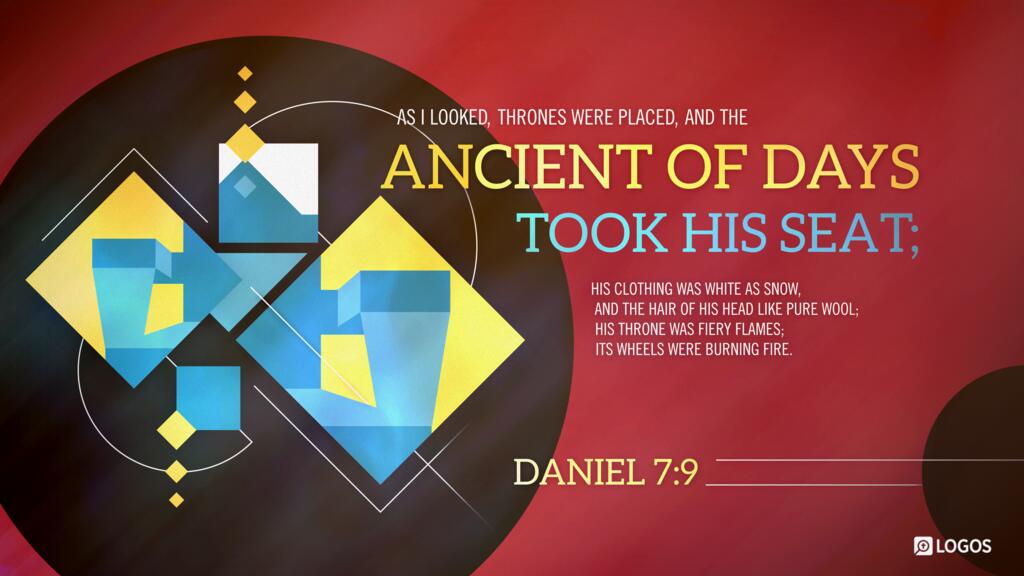
7:9“While I was watching,
thrones were set up,
and the Ancient of Days24 took his seat.
His attire was white like snow;
the hair of his head was like lamb’s25 wool.
His throne was ablaze with fire
and its wheels were all aflame.26
7:10A river of fire was streaming forth
and proceeding from his presence.
Many thousands were ministering to him;
Many tens of thousands stood ready to serve him.27
The court convened28
and the books were opened.
7:11“Then I kept on watching because of the arrogant words of the horn that was speaking. I was watching29 until the beast was killed and its body destroyed and thrown into30 the flaming fire. 7:12As for the rest of the beasts, their ruling authority had already been removed, though they were permitted to go on living31 for a time and a season. 7:13I was watching in the night visions,
“And with32 the clouds of the sky33
one like a son of man34 was approaching.
He went up to the Ancient of Days
and was escorted35 before him.
7:14To him was given ruling authority, honor, and sovereignty.
All peoples, nations, and language groups were serving36 him.
His authority is eternal and will not pass away.37
His kingdom will not be destroyed.38
An Angel Interprets Daniel’s Vision
7:15“As for me, Daniel, my spirit was distressed,39 and the visions of my mind40 were alarming me. 7:16I approached one of those standing nearby and asked him about the meaning41 of all this. So he spoke with me and revealed42 to me the interpretation of the vision:437:17‘These large beasts, which are four in number, represent four kings who will arise from the earth. 7:18The holy ones44 of the Most High will receive the kingdom and will take possession of the kingdom forever and ever.’
Footnotes
- 1 The first year of Belshazzar’s reign would have been 553 B.C. Daniel would have been approximately 67 years old at the time of this vision.
- 2 Aram “saw.”
- 3 Aram “and visions of his head.” The Aramaic is difficult here. Some scholars add a verb thought to be missing (e.g., “the visions of his head [were alarming him]”), but there is no external evidence to support such a decision and the awkwardness of the text at this point may be original.
- 4 Aram “head of words.” The phrase is absent in Theodotion. Cf. “the substance of his dream.”
- 5 Aram “answered and said.”
- 6 Aram “and behold.”
- 7 Or “the heavens.” The Hebrew term שָׁמַיִם (shamayim) may be translated “heavens” or “sky” depending on the context.
- 8 The referent of the great sea is unclear. The common view that the expression refers to the Mediterranean Sea is conjectural.
- 9 Aram “heart of a man.”
- 10 The identity of the first animal, derived from v. 17 and the parallels in chap. 2, is Babylon. The reference to the plucking of its wings is probably a reference to the time of Nebuchadnezzar’s insanity (cf. chap. 4). The latter part of v. 4 then describes the restoration of Nebuchadnezzar. The other animals have traditionally been understood to represent respectively Media-Persia, Greece, and Rome, although most of modern scholarship identifies them as Media, Persia, and Greece. For a biblical parallel to the mention of lion, bear, and leopard together, see Hos 13:7–8.
- 11 Aram “and behold.”
- 12 The three ribs held securely in the mouth of the bear, perhaps representing Media-Persia, apparently symbolize military conquest, but the exact identity of the “ribs” is not clear. Possibly it is a reference to the Persian conquest of Lydia, Egypt, and Babylonia.
- 13 The lacks the phrase “between its teeth.”
- 14 Aram “and thus they were saying to it.”
- 15 Aram “this.” So also in v. 7.
- 16 Aram “and behold, another one.”
- 17 Or “sides.”
- 18 If the third animal is Greece, the most likely identification of these four heads is the four-fold division of the empire of Alexander the Great following his death. See note on .
- 19 The Aramaic text has also “and behold.” So also in vv. 8, 13.
- 20 The fourth animal differs from the others in that it is nondescript. Apparently it was so fearsome that Daniel could find nothing with which to compare it. Attempts to identify this animal as an elephant or other known creature are conjectural.
- 21 The Aramaic word for “teeth” is dual rather than plural, suggesting two rows of teeth.
- 22 Aram “were uprooted from before it.”
- 23 Aram “great.” So also in vv. 11, 20.
- 24 Or “the Ancient One” (, , ), although the traditional expression has been retained in the present translation because it is familiar to many readers. Cf. “One who had been living for ever”; “the Eternal God.”
- 25 Traditionally the Aramaic word נְקֵא (néqe’) has been rendered “pure,” but here it more likely means “of a lamb.” Cf. the neqya’ (“a sheep, ewe”). On this word see further, M. Sokoloff, “’amar neqe’, ‘Lamb’s Wool’ (Dan 7:9),” 95 (1976): 277–79.
- 26 Aram “a flaming fire.”
- 27 Aram “were standing before him.”
- 28 Aram “judgment sat.”
- 29 The and Theodotion lack the words “I was watching” here. It is possible that these words in the are a dittography from the first part of the verse.
- 30 Aram “and given over to” (so ).
- 31 Aram “a prolonging of life was granted to them.”
- 32 The has ἐπί (epi, “upon”) here (cf. Matt 24:30; 26:64). Theodotion has μετά (meta, “with”) here (cf. Mark 14:62; Rev 1:7).
- 33 Or “the heavens.” The Hebrew term שָׁמַיִם (shamayim) may be translated “heavens” or “sky” depending on the context.
- 34 This text is probably the main OT background for Jesus’ use of the term “son of man.” In both Jewish and Christian circles the reference in the book of Daniel has traditionally been understood to refer to an individual, usually in a messianic sense. Many modern scholars, however, understand the reference to have a corporate identity. In this view, the “son of man” is to be equated with the “holy ones” (vv. 18, 21, 22, 25) or the “people of the holy ones” (v. 27) and understood as a reference to the Jewish people. Others understand Daniel’s reference to be to the angel Michael.
- 35 Aram “they brought him near.”
- 36 Some take “serving” here in the sense of “worshiping.”
- 37 Aram “is an eternal authority which will not pass away.”
- 38 Aram “is one which will not be destroyed.”
- 39 The Aramaic text includes the phrase “in its sheath,” apparently viewing the body as a container or receptacle for the spirit somewhat like a sheath or scabbard is for a knife or a sword (cf. “within its sheath of flesh”). For this phrase the and have “in these things.”
- 40 Aram “head.”
- 41 Aram “what is certain.”
- 42 Aram “and made known.”
- 43 Aram “matter,” but the matter at hand is of course the vision.
- 44 The expression holy ones is either a reference to angels or to human beings devoted to God.
The NET Bible First Edition, Copyright 1996-2005 by Biblical Studies Press