1 Corinthians 10:14–28
The NET BibleOther versions
English
- NET The NET Bible
- DARBY 1890 Darby Bible
- ASV American Standard Version
- AV 1873 The Cambridge Paragraph Bible of the Authorized English Version
- CSB Christian Standard Bible
- D-R Douay-Rheims Bible
- ESV English Standard Version
- GW GOD’S WORD Translation
- GNB Good News Translation
- HCSB The Holman Christian Standard Bible
- KJV 1900 King James Version
- LSB Legacy Standard Bible
- LEB The Lexham English Bible
- MSG The Message: The Bible in Contemporary Language
- NASB95 New American Standard Bible (1995)
- NCV New Century Version
- NIrV New International Reader’s Version (1998)
- NIV New International Version (2011)
- NKJV The New King James Version
- NLT New Living Translation
- NRSVue New Revised Standard Version: Updated Edition
- RSV The Revised Standard Version
- RSVCE The Revised Standard Version, Catholic Edition
- YLT Young’s Literal Translation
Arabic
Czech
French
German
Greek
Hungarian
Italian
Korean
Latin
Portuguese
Russian
Simplified Chinese
Spanish
Traditional Chinese
Avoid Idol Feasts
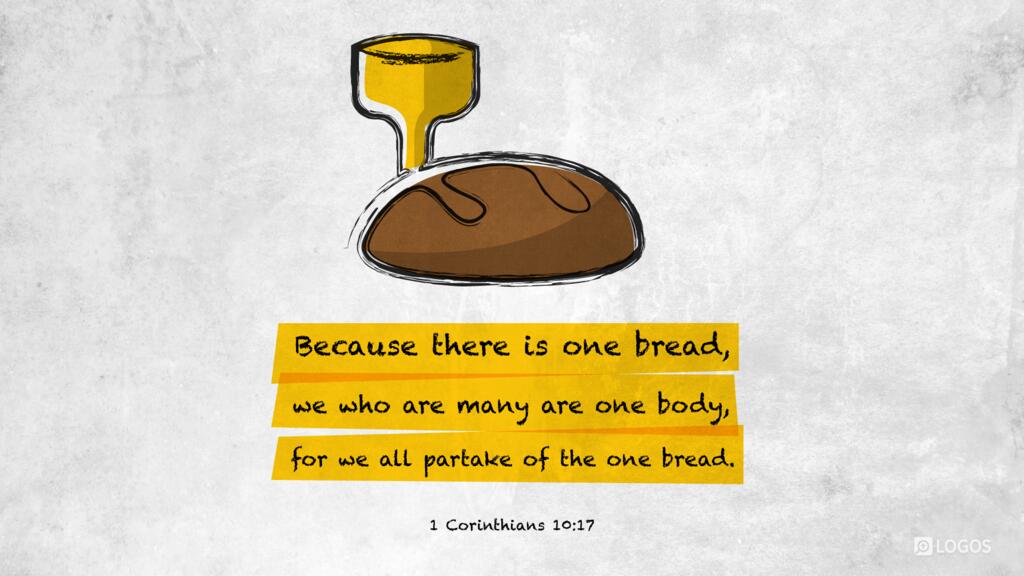
10:14So then, my dear friends, flee from idolatry. 10:15I am speaking to thoughtful people. Consider what I say. 10:16Is not the cup of blessing that we bless a sharing in the blood of Christ? Is not the bread that we break a sharing in the body of Christ? 10:17Because there is one bread, we who are many are one body, for we all share the one bread. 10:18Look at the people of Israel.12 Are not those who eat the sacrifices partners in the altar? 10:19Am I saying that idols or food sacrificed to them amount to anything? 10:20No, I mean that what the pagans sacrifice13 is to demons and not to God. I do not want you to be partners with demons. 10:21You cannot drink the cup of the Lord and the cup of demons. You cannot take part in the table of the Lord and the table of demons. 10:22Or are we trying to provoke the Lord to jealousy? Are we really stronger than he is?14
Live to Glorify God
10:23“Everything is lawful,” but not everything is beneficial. “Everything is lawful,”15 but not everything builds others up.1610:24Do not seek your own good, but the good of the other person. 10:25Eat anything that is sold in the marketplace without questions of conscience, 10:26for the earth and its abundance are the Lord’s.1710:27If an unbeliever invites you to dinner and you want to go, eat whatever is served without asking questions of conscience. 10:28But if someone says to you, “This is from a sacrifice,” do not eat, because of the one who told you and because of conscience18–
Footnotes
- 12 Grk “Israel according to (the) flesh.”
- 13 Grk “what they sacrifice”; the referent (the pagans) is clear from the context and has been specified in the translation for clarity.
- 14 The question in Greek expects a negative answer (“We are not stronger than he is, are we?”).
- 15 “Everything is lawful.” Here again Paul cites certain slogans the Corinthians used to justify their behavior (cf. 6:12–13; 7:1; 8:1, 4). Paul agrees with the slogans in part, but corrects them to show how the Corinthians have misused these ideas.
- 16 Grk “builds up.” The object “others” is not expressed but is implied, as v. 24 shows. Paul picks up a theme he introduced at the start of this section of the letter (8:1).
- 17 A quotation from Ps 24:1; an allusion to Ps 50:12; 89:11.
- 18 The Byzantine texttype and a few other witnesses (Hc Ψ 𝔐) essentially duplicate v. 26 at the end of this verse (with γάρ [gar, “for“] in second instead of third position), which itself is a quotation from Ps 24:1 (23:1 ). Not only is there a vast number of early, important, and diverse witnesses that lack this extra material (א A B C* D F G H* P 33 81 365 630 1175 1739 1881 2464 latt co), but the quotation seems out of place at this point in the discourse for Paul is here discussing reasons not to partake of food that has been sacrificed to idols. Perhaps scribes felt that since food is from the Lord, to eat meat sacrificed to idols contradicts that belief. Either way, the better witnesses lack the clause which, had it been authentic to v. 28, would have not occasioned such a widespread excision. The evidence is thus compelling for the shorter reading.
The NET Bible First Edition, Copyright 1996-2005 by Biblical Studies Press