Get the #1 Bible app for transformative study, preaching, and teaching.
 Loading…
A service of Logos Bible Software
41:1–26 Ezekiel’s tour continues through the interior of the temple. Some of the architectural terms are difficult to define, but the general plan is similar to Solomon’s temple described in 1 Kgs 6:1–37. The combination of detailed measurements with scarce information about furnishings and function for some temple areas suggests that Ezekiel’s primary concern was marking off the sacred space, not providing a building plan for future construction. Throughout his description of the temple and the land, Ezekiel’s overriding concern is maintaining sanctity at all costs.
|
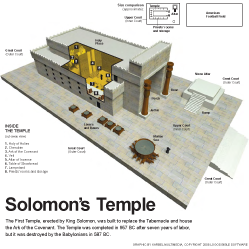
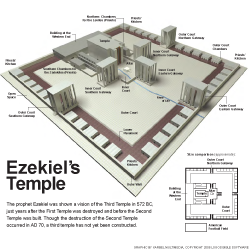
41:1 the temple sanctuary Refers to the second room of the three-room layout (see note on Ezek 40:48).
 Hekal DDD
41:2 the width of the doorway was ten cubits The increasing levels of holiness are signified by the incremental reduction in the size of entryways between rooms as they progress deeper into the temple.
41:3 the inner room The third room of the temple is usually called the devir, which may be translated as “backroom” (see 1 Kgs 6:5 “inner sanctuary”). Ezekiel uses the term penimah from Lev 10:18 that simply refers to the “inside” or “inner part.”
41:4 the most holy place Ezekiel’s guide pauses to confirm his understanding of this inner room as the holy of holies (qodesh haqqodashim)—the most holy place of the temple. Note that only the guide enters the room. Ezekiel was in the second room—which he, as a priest, would have been allowed to enter in the earlier temples. Only the high priest was allowed to enter the most holy place, and then only once a year on the Day of Atonement (see Lev 16).
The most holy place was where the ark of the covenant was kept. Yahweh’s presence there was symbolized by the atonement cover (or mercy seat), where He sat on a throne above the cherubim (Psa 99:1). The atonement cover (mercy seat) was the focus of the Day of Atonement ceremony (Lev 16:13–15).
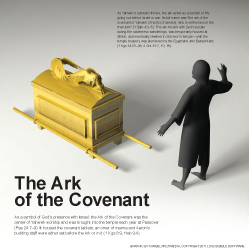
Most Holy Place EDB
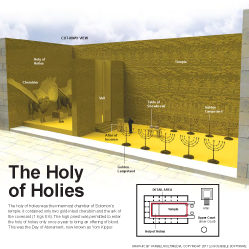
41:6 the side rooms were side by side in three The purpose of these 90 side rooms is not specified.
41:12 the building that faced the courtyard Instead of a western gate, a large building sat directly behind the temple. This location suggests that it was meant to block rear access to the temple. Other than its size, no other details on the building are given.
41:18 it was made of cherubim and palm tree images Refers to the cherubim and palm trees decorating the first temple (see 1 Kgs 6:29–36). The carvings recall when the temple was first built and dedicated to Yahweh, before it was defiled. In Ezek 8:10, the defiled temple is described with idolatrous engravings on the walls.
41:19 the face of a human Each cherub had a human face and the face of a lion. The cherubim that appeared in ch. 10 had four faces, two of which were human and lion (10:14).
41:22 a wooden altar To Ezekiel’s eye, this piece of furniture resembled an altar. His angelic guide clarifies that it is a table.
the table that is before Yahweh Likely represents the table for the bread of the Presence; see Exod 25:23–30. This table has different dimensions from the one in Exod 25, and it is made of wood instead of wood overlaid with gold.

|
About Faithlife Study BibleFaithlife Study Bible (FSB) is your guide to the ancient world of the Old and New Testaments, with study notes and articles that draw from a wide range of academic research. FSB helps you learn how to think about interpretation methods and issues so that you can gain a deeper understanding of the text. |
| Copyright |
Copyright 2012 Logos Bible Software. |
| Support Info | fsb |
Table of Contents