The Future of Bible Study Is Here.
 Loading…
A service of Logos Bible Software
33:1–9 Ezekiel’s role as watchman for God’s people, first assigned in 3:16–21, is revisited here. The role of the watchman is described first, followed by an almost verbatim repetition of 3:17–19 in vv. 7–9. If the watchman sounds a warning and the people fail to act, the people are responsible for their own fate. In the same way, Ezekiel is responsible to sound the warning; he is not responsible for how the people respond.
|
33:2 if I bring over it a sword The literal role of a watchman warning the city of impending attack is first presented as the background for the prophet’s metaphorical role to warn Israel of divine punishment. See 14:17; 21:3 and note on 6:1–14.
a watchman The watchman’s role was to warn the city of coming attack or announce the arrival of a messenger bearing news (see 2 Kgs 9:18–20).
33:6 the people are not warned The watchman who fails at his task is indirectly responsible for the death of the people he was supposed to protect.
33:7 a watchman for the house of Israel See note on Ezek 3:17.
33:10–20 Ezekiel revisits the topic of individual responsibility for sin that was presented in 18:20–32. He emphasizes the need to repent and affirms Yahweh’s just decisions to save or punish depending on the individual’s choice to live righteously or wickedly. |
33:10 and how can we live? Ezekiel first reports the people’s remarks, then refutes them. Their complaint centers on their suffering for sin as in 18:2, but here they take ownership of the sins as their own.
33:11 the death of the wicked Compare 18:23 and 18:32.
why should you die, house of Israel? Echoes 18:31.
33:12 the righteousness of the righteous Compare 18:24.
33:14 he returns from his sin Repentance is the key factor in avoiding divine judgment (see 18:27).
33:15 the wicked returns a pledge for a loan Summarizes the righteous behavior listed in 18:7.
33:17 The way of the Lord is not fair Repeated from 18:25 and 18:29.
33:20 according to his ways Compare 18:30.
33:21–33 Ezekiel has revisited two prominent theological themes in vv. 1–20: his role in warning Israel of judgment, and individual accountability for sin. These reminders are important, considering the immediate need to offer theological justification for Jerusalem’s fall. Here, Ezekiel receives official word of the destruction of Jerusalem (vv. 21–22); gives his prophecy (vv. 23–33), then summarizes the many abominations Israel was condemned for in chs. 5–24. The recounting of Israel’s sins recalls both the ot laws from Leviticus and the earlier condemnations in Ezekiel (e.g., chs. 18; 22). While the earlier parts of his book contained glimmers of a future hope for Israel, judgment was the primary focus. Now attention gradually shifts toward restoration of the land, the people, the kingship, and the temple in chs. 34–48. |
33:21 tenth month, on the fifth day of the month The date is January 19, 585 bc, about five months after the fall of Jerusalem. The journey from Palestine to Babylonia took four to five months (see Ezra 7:9).

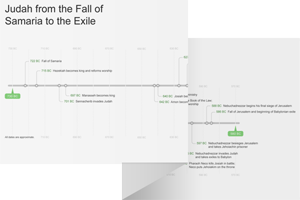
a survivor Also appears in Ezek 24:26. This fugitive probably was not a survivor who escaped the destruction and brought word to the community. He more likely was an exile brought with those deported by Babylon in 586 bc.
For Ezekiel, the Hebrew term palit—which can be translated “fugitive,” “escapee,” or “survivor”—had great theological significance. He reacted strongly in 11:13 when a man named Pelatiah (whose name means “Yahweh rescues”) died during his prophecy. Ezekiel took it as a sign that perhaps Yahweh would decide to not leave any survivors. According to 6:8–9 and 14:22–23, survivors would escape divine judgment only to be scattered among the nations. Ezekiel also uses the term in 7:16 for those who have fled the judgment of the Day of Yahweh and sought refuge in the mountains. The arrival of these survivors would be a sign to the exiled community (see 14:22–23) that divine judgment had been carried out on Jerusalem. The survivor’s behavior also served to demonstrate that Yahweh’s judgment was not unmerited or arbitrary (see 12:16). Ezekiel’s and Isaiah’s views of the remnant are very different. Isaiah focuses on the eventual repentance and righteousness of the remnant that emerges from the judgment of exile (see Isa 26:2; 28:5). Ezekiel emphasizes the survivor’s role as witness to vindicate Yahweh’s judgment.
 Remnant ISBE
Remnant DBI
33:22 the hand of Yahweh A return to Ezekiel’s description of his experience of Yahweh. See note on Ezek 1:3.
my mouth was opened Fulfills the prophecy of 24:25–27 (see note on 24:27).
33:24 Abraham was one Appeals to Yahweh’s promise to Abraham in Gen 15:18 and Ezek 17:8 as a basis for their right to the land. The same sentiment is upheld in Isa 51:2. Possession of the land had been made conditional by the Sinai covenant, whose laws Israel had flagrantly ignored. Their argument from the lesser to the greater is flawed by the unequal comparison of the two covenants. On this type of argument, see note on 15:15.
the land has been given for us as a possession The people of Israel exhibit an excessive sense of entitlement. They expect a right to the land and believe Yahweh is bound to uphold the covenant regardless of their failure to follow His law.
Land DBI
33:25 You eat blood Prohibited in God’s covenant with Noah (see Gen 9:4 and note; compare Lev 3:17; 19:26).
you raise your eyes to your idols Condemned in Ezek 18:6.
you pour out blood See 22:3. The sin of bloodshed was often used as a catch-all condemnation that could apply to both religious impropriety and social injustice.
33:26 you do a detestable thing See note on 5:9. Like the author of Leviticus, Ezekiel is fond of using this word to describe anything that deviates from what Yahweh wants and approves.
each man defiles the wife of his neighbor See 22:11.
33:27 by the sword The sequence of punishments echoes 14:21 with sword, beasts, and pestilence.
33:30–33 Ezekiel’s audience in Babylon easily could have felt far removed from his pronouncements of doom. Here, he describes the people gathering to hear him, apparently to hear the divine word. Their true motivation is later revealed to be mere entertainment. |
33:32 like a sensual song The people come to listen to Ezekiel’s oracles, but they do not take him seriously. Since they did not see God’s words as lessons to be applied to their lives, Ezekiel’s parables and allegories were nothing but entertainment to them (see note on 20:49).
but they are not doing them Compare Isa 29:13 and note.
33:33 a prophet was in the midst of them The fulfillment of Ezekiel’s message vindicates his reputation as true prophet, not entertainer. The statement alludes to his commissioning scene (see Ezek 2:5) and structures the content of chs. 1–33 as a distinct unit of the book.

|
About Faithlife Study BibleFaithlife Study Bible (FSB) is your guide to the ancient world of the Old and New Testaments, with study notes and articles that draw from a wide range of academic research. FSB helps you learn how to think about interpretation methods and issues so that you can gain a deeper understanding of the text. |
| Copyright |
Copyright 2012 Logos Bible Software. |
| Support Info | fsb |
Table of Contents