Get the #1 Bible app for transformative study, preaching, and teaching.
 Loading…
A service of Logos Bible Software
22:1–19 After waiting 25 years to have a son (see note on 21:5), Abraham faces a test of faith. God instructs him to take Isaac, his only son and the heir to God’s promise (17:21), to a mountain and sacrifice him (vv. 1–2). Abraham obeys without question, binding Isaac to the altar (vv. 3–10). God intervenes and provides a ram to offer instead (vv. 11–14). After this resolution, God reiterates His covenant with Abraham (vv. 15–19).
|
22:1 God tested Abraham God is not in favor of human sacrifice, and He later directly prohibits it (Lev 18:21; Deut 12:31)—Abraham is being tested. The text hints that Isaac will not die (Gen 22:5).
 God’s Testing LRC:G1250
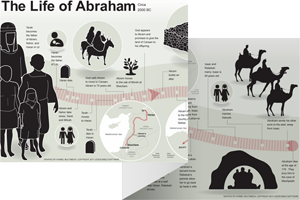
22:2 your only child Since Isaac is not Abraham’s only son (he had Ishmael by Hagar earlier; 16:11–16), the Hebrew text here is referring to value, not number. Isaac is Abraham’s special son—through him the covenant promises with God will be passed on (17:21).
Isaac See Gen 17:17–19.
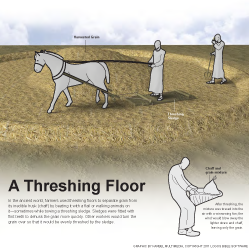
Moriah This term occurs only here and in 2 Chr 3:1, where it is described as a mountain. Second Chronicles 3:1 notes that Mount Moriah is where Yahweh appeared to David on the threshing floor of Ornan (Araunah) the Jebusite—and in turn, where Solomon built the temple.
Moriah LRC:G1250
Moriah (Place) AYBD
The Land of Moriah Genesis (JPS)
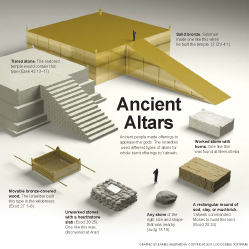
offer him there Abraham is commanded to slay Isaac, the son through whom God promised an abundance of descendants (Gen 12:1–3; 15:1–6). Despite the absurdity of the command, Abraham obeys.
22:4 On the third day Whatever Moriah’s specific location, it was three days’ journey from Beer-sheba (21:33–34).
Three Days LRC:G1250
22:5 I and the boy will go Abraham tells his servants that not only would he and Isaac go and worship (to sacrifice Isaac, unbeknownst to all but Abraham), but both of them would return. This may mean Abraham was concealing the true purpose of the trip from Isaac. However, the nt book of Hebrews takes this as a statement of Abraham’s faith—that God would raise Isaac from the dead (Heb 11:17–19).
“We Will Return to You” LRC:G1250

22:6 placed it on Isaac his son Ironically, Isaac is unaware that he is assisting in his own sacrifice.
22:8 God will provide the lamb This comment and the earlier plural (“we will return”) provides insight into Abraham’s faith. Compare Heb 11:19.
22:9 he bound Isaac his son Genesis 22 is referred to in Judaism as the Akedah, a term derived from the Hebrew verb aqad used here of the binding of Isaac.
The Meaning of the Akedah Genesis (JPS)
The Akedah in Jewish Tradition Genesis (JPS)
The Aqedah LRC:G1250
22:10 slaughter The Hebrew term used here, shachat, occurs elsewhere in the ot of human sacrifices by pagans (Isa 57:5; Ezek 16:21; 23:39). Its use here may serve to heighten the horror of the event.
22:11 the angel of Yahweh See note on Gen 16:7.
22:12 now I know The identity between the angel and God is blurred. The angel speaks in the first person as God, but also refers to God in the third person.
“Now I Know …” LRC:G1250
 Angels in the Bible Table
22:14 the mountain of Yahweh it shall be provided God provides a sacrificial ram as a substitute for Isaac. In response, Abraham names the place yhwy yir'eh in Hebrew (which may be literally rendered “Yahweh will see”). The narrative immediately adds “it shall be provided,” a descriptive reference to the ram. Since the ram was God’s substitute upon “seeing” Abraham’s faith, “provided” is an appropriate translation.
Names of God in the Old Testament Table
22:16 I swear by myself The covenant promises (12:1–3; 15:1–6) are reaffirmed on account of Abraham’s faith. “By myself I have sworn” points to the unilateral nature of the covenant (though, see 17:1–2).
Covenants in the Old Testament Table
22:17 the stars of heaven See 15:5 and note.
22:20–24 Chapter 22 concludes with an account of the offspring of Abraham’s brother, Nahor, who has not been mentioned since Abraham was introduced (11:29). The genealogy provides a transition to the account of Isaac, as it mentions his future wife, Rebekah (v. 23; compare 24:15–16). |
22:20 your brother Nahor Two phrases provide a possible explanation for the genealogy’s placement here after the binding of Isaac: “Kemuel the father of Aram” and “Bethuel fathered Rebekah.” These two details indicate that Rebekah is related to Abraham (and Isaac). This was important for the covenant, as it ensured that the covenant blessings remained within Abraham’s line. The genealogy’s placement here links ch. 22 and Gen 24, which recounts the search for a wife for Isaac.

|
About Faithlife Study BibleFaithlife Study Bible (FSB) is your guide to the ancient world of the Old and New Testaments, with study notes and articles that draw from a wide range of academic research. FSB helps you learn how to think about interpretation methods and issues so that you can gain a deeper understanding of the text. |
| Copyright |
Copyright 2012 Logos Bible Software. |
| Support Info | fsb |
Table of Contents