The Future of Bible Study Is Here.
 Loading…
A service of Logos Bible Software
25:1–21 After about a decade of conflict, Jerusalem and the kingdom of Judah fell to the Babylonian Empire in 586 bc. This final chapter of 2 Kings recounts the siege of Jerusalem, the blinding and binding of Zedekiah, the fiery destruction of the temple, the second wave of deportations to Babylon (compare 2 Kings 24:10–17) and the execution of Jerusalem’s remaining officials. Accounts of Judah’s final collapse also appear in 2 Chr 36:17–21; Jer 39:1–10; and Jer 52:1–30. |
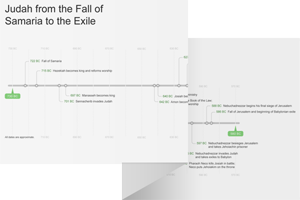
Southern King | Date |
Jehoiakim | 609–597 bc |
Jehoiachin | 597 bc |
Zedekiah | 597–586 bc |
25:1 the ninth year of his reign The Hebrew text does not include the name of the king, reading only “of his reign.” Jeremiah 39:1 makes clear that this refers to Zedekiah’s reign (circa 597–586 BC). See Jer 39:1 and note.
25:2 came under siege According to Ezekiel, the Babylonians laid siege to Jerusalem with siege works and battering rams (see Ezek 4:2 and note).
25:4 the gate between the wall Located in the southeast wall of the city of David. This reference to a double wall suggests that this gate was in the part of the city where Hezekiah built a double wall to protect the Siloam Pool (Isa 22:11; 2 Chr 32:5).
the Arabah Refers to the arid wilderness around the Dead Sea.
 Arabah EBD
25:6 at Riblah See note on 2 Kings 23:33.
25:7 They slaughtered the sons of Zedekiah To eliminate competition to the throne (see Judg 9:5; 2 Kgs 10:1–14).
they blinded the eyes of Zedekiah A brutal but common punishment for rebellious slaves in the ancient Near East.
brought him to Babylon Jeremiah 52:11 indicates that Zedekiah was imprisoned until he died.
25:8 In the fifth month See 2 Kings 24:12 and note.
25:11 the commander of the imperial guard deported Refers to the second wave of deportations in 586 bc (the first was reported in 24:14–16).
25:12 the vineyards and for tilling Fieldworkers were left to supply agricultural goods for the empire.
25:13 The bronze pillars Described in 1 Kgs 7:15–37.
25:14 the vessels of bronze Described in 1 Kgs 7:40–47. Nebuchadnezzar had taken the vessels of gold to Babylon with the first wave of captives (2 Kgs 24:13).
25:18 Zephaniah the second priest Zephaniah was in charge of maintaining the order of the temple (Jer 21:1; 29:25).
25:21 was removed from its land This summary statement suggests that the narrative aims to explain how Judah arrived in exile.
25:22–26 This passage reports that some Jews fled to Egypt in the aftermath of Judah’s collapse. This may help to account for the presence of communities who worship Yahweh in Egypt, including the community at Elephantine. Jewish Diaspora communities would later grow throughout the Greek and Roman periods, producing such thinkers as Philo |

25:22 Gedaliah See note on Jer 39:14. From a prominent Jerusalem family, Gedaliah’s grandfather had been a scribe during Josiah’s reign (2 Kings 22:3). Ahikam, his father, was among those sent to inquire of Yahweh through Huldah (22:12), and he was responsible for saving the life of the prophet Jeremiah (Jer 26:24).
25:23 at Mizpah With the destruction of Jerusalem, Judah’s administrative center shifts roughly seven miles north to the city of Mizpah.
Mizpah, Mizpeh EBD
25:25 the Judeans and with the Chaldeans Ishmael and his men attack those who are assisting Gedaliah and thereby supporting the Babylonian Empire, regardless of nationality.
25:27–30 Jehoiachin’s release from prison concludes the narrative of 1–2 Kings with a sense of hope that David’s royal line will continue and that the kingdom will one day be restored. This hope corresponds with God’s covenant
|
25:27 Evil-Merodach Nebuchadnezzar’s successor.
25:28 the kings who were with him in Babylon Refers to deposed kings of other nations that Babylon had destroyed.

|
About Faithlife Study BibleFaithlife Study Bible (FSB) is your guide to the ancient world of the Old and New Testaments, with study notes and articles that draw from a wide range of academic research. FSB helps you learn how to think about interpretation methods and issues so that you can gain a deeper understanding of the text. |
| Copyright |
Copyright 2012 Logos Bible Software. |
| Support Info | fsb |
Table of Contents