John 9:13–34
The Revised Standard VersionOther versions
English
- RSV The Revised Standard Version
- DARBY 1890 Darby Bible
- ASV American Standard Version
- AV 1873 The Cambridge Paragraph Bible of the Authorized English Version
- CSB Christian Standard Bible
- D-R Douay-Rheims Bible
- ESV English Standard Version
- GW GOD’S WORD Translation
- GNB Good News Translation
- HCSB The Holman Christian Standard Bible
- KJV 1900 King James Version
- LSB Legacy Standard Bible
- LEB The Lexham English Bible
- MSG The Message: The Bible in Contemporary Language
- NET The NET Bible
- NASB95 New American Standard Bible (1995)
- NCV New Century Version
- NIrV New International Reader’s Version (1998)
- NIV New International Version (2011)
- NKJV The New King James Version
- NLT New Living Translation
- NRSVue New Revised Standard Version: Updated Edition
- RSVCE The Revised Standard Version, Catholic Edition
- YLT Young’s Literal Translation
Arabic
Czech
French
German
Greek
Hungarian
Italian
Korean
Latin
Portuguese
Russian
Simplified Chinese
Spanish
Traditional Chinese
13They brought to the Pharisees the man who had formerly been blind. 14Now it was a sabbath day when Jesus made the clay and opened his eyes. 15The Pharisees again asked him how he had received his sight. And he said to them, “He put clay on my eyes, and I washed, and I see.” 16Some of the Pharisees said, “This man is not from God, for he does not keep the sabbath.” But others said, “How can a man who is a sinner do such signs?” There was a division among them. 17So they again said to the blind man, “What do you say about him, since he has opened your eyes?” He said, “He is a prophet.”
18The Jews did not believe that he had been blind and had received his sight, until they called the parents of the man who had received his sight, 19and asked them, “Is this your son, who you say was born blind? How then does he now see?” 20His parents answered, “We know that this is our son, and that he was born blind; 21but how he now sees we do not know, nor do we know who opened his eyes. Ask him; he is of age, he will speak for himself.” 22His parents said this because they feared the Jews, for the Jews had already agreed that if any one should confess him to be Christ, he was to be put out of the synagogue. 23Therefore his parents said, “He is of age, ask him.”
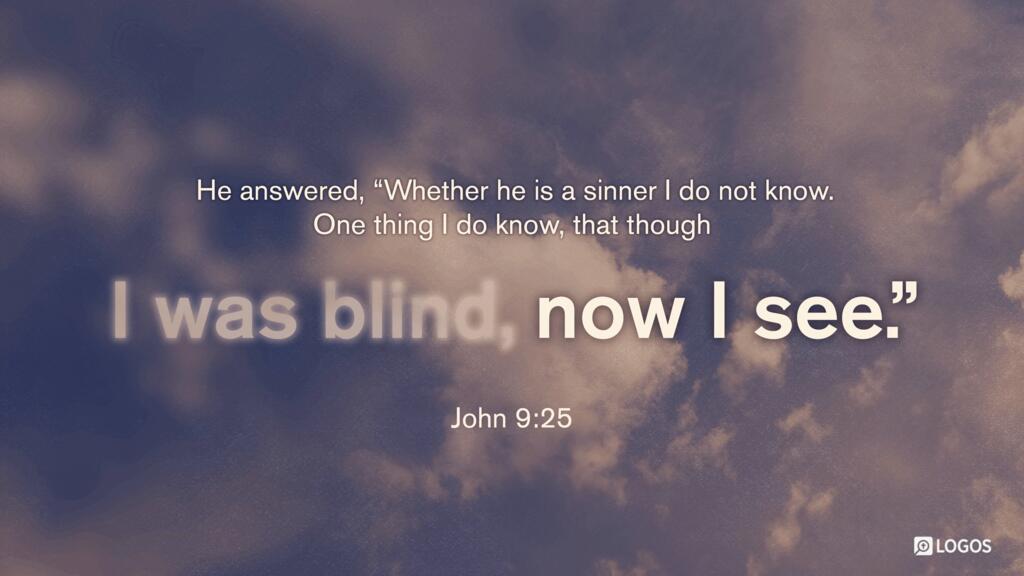
24So for the second time they called the man who had been blind, and said to him, “Give God the praise; we know that this man is a sinner.” 25He answered, “Whether he is a sinner, I do not know; one thing I know, that though I was blind, now I see.” 26They said to him, “What did he do to you? How did he open your eyes?” 27He answered them, “I have told you already, and you would not listen. Why do you want to hear it again? Do you too want to become his disciples?” 28And they reviled him, saying, “You are his disciple, but we are disciples of Moses. 29We know that God has spoken to Moses, but as for this man, we do not know where he comes from.” 30The man answered, “Why, this is a marvel! You do not know where he comes from, and yet he opened my eyes. 31We know that God does not listen to sinners, but if any one is a worshiper of God and does his will, God listens to him. 32Never since the world began has it been heard that any one opened the eyes of a man born blind. 33If this man were not from God, he could do nothing.” 34They answered him, “You were born in utter sin, and would you teach us?” And they cast him out.
Copyright 1952, 1946, 1971, 1957, 1977 Division of Christian Education of the National Council of Churches of Christ in the United States of America.