Revelation 21:14–27
The NET BibleOther versions
English
- NET The NET Bible
- DARBY 1890 Darby Bible
- ASV American Standard Version
- AV 1873 The Cambridge Paragraph Bible of the Authorized English Version
- CSB Christian Standard Bible
- D-R Douay-Rheims Bible
- ESV English Standard Version
- GW GOD’S WORD Translation
- GNB Good News Translation
- HCSB The Holman Christian Standard Bible
- KJV 1900 King James Version
- LSB Legacy Standard Bible
- LEB The Lexham English Bible
- MSG The Message: The Bible in Contemporary Language
- NASB95 New American Standard Bible (1995)
- NCV New Century Version
- NIrV New International Reader’s Version (1998)
- NIV New International Version (2011)
- NKJV The New King James Version
- NLT New Living Translation
- NRSVue New Revised Standard Version: Updated Edition
- RSV The Revised Standard Version
- RSVCE The Revised Standard Version, Catholic Edition
- TNIV Today’s New International Version
- YLT Young’s Literal Translation
Arabic
Czech
French
German
Greek
Hungarian
Italian
Korean
Latin
Portuguese
Russian
Simplified Chinese
Spanish
Traditional Chinese
21:14The35 wall of the city has twelve foundations, and on them are the twelve names of the twelve apostles of the Lamb.
21:15The angel36 who spoke to me had a golden measuring rod with which to measure the city and its foundation stones and wall. 21:16Now37 the city is laid out as a square,38 its length and width the same. He39 measured the city with the measuring rod40 at fourteen hundred miles41 (its length and width and height are equal). 21:17He also measured its wall, one hundred forty-four cubits42 according to human measurement, which is also the angel’s.4321:18The city’s44 wall is made45 of jasper and the city is pure gold, like transparent glass.4621:19The foundations of the city’s wall are decorated47 with every kind of precious stone. The first foundation is jasper, the second sapphire, the third agate,48 the fourth emerald, 21:20the fifth onyx,49 the sixth carnelian,50 the seventh chrysolite,51 the eighth beryl,52 the ninth topaz, the tenth chrysoprase,53 the eleventh jacinth,54 and the twelfth amethyst. 21:21And the twelve gates are twelve pearls—each one of the gates is made from just one pearl! The55 main street56 of the city is pure gold, like transparent glass.
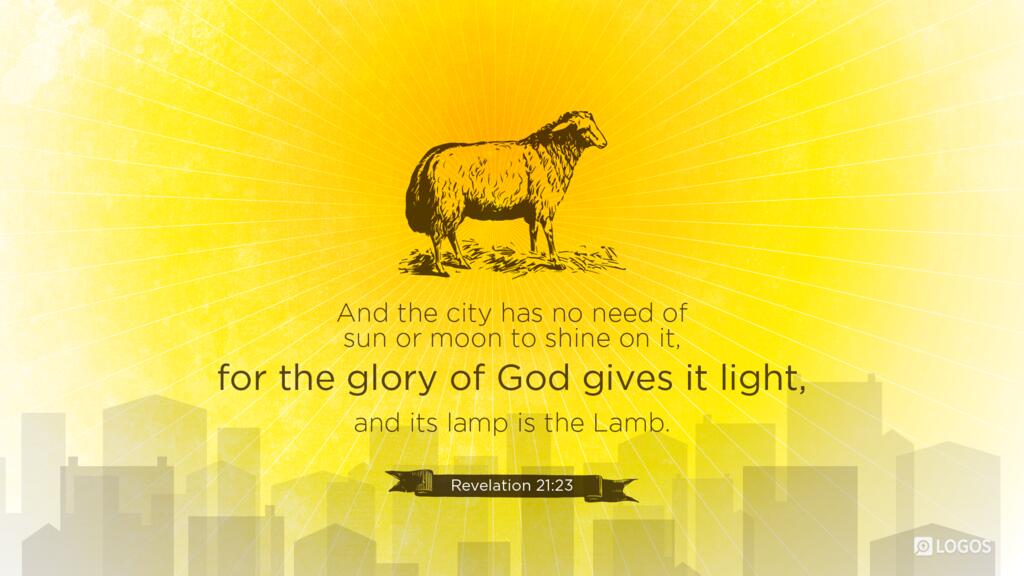
21:22Now57 I saw no temple in the city, because the Lord God—the All-Powerful58—and the Lamb are its temple. 21:23The city does not need the sun or the moon to shine on it, because the glory of God lights it up, and its lamp is the Lamb. 21:24The nations59 will walk by its light and the kings of the earth will bring their grandeur60 into it. 21:25Its gates will never be closed during the day61 (and62 there will be no night there).6321:26They will bring the grandeur and the wealth64 of the nations65 into it, 21:27but66 nothing ritually unclean67 will ever enter into it, nor anyone who does what is detestable68 or practices falsehood,69 but only those whose names70 are written in the Lamb’s book of life.
Footnotes
- 35 Here καί (kai) has not been translated because of differences between Greek and English style.
- 36 Grk “the one”; the referent (the angel of v. 9) has been specified in the translation for clarity.
- 37 Here καί (kai) has been translated as “now” to indicate the somewhat parenthetical nature of the description of the city.
- 38 Or “the city lies square.” On κεῖμαι (keimai) in this context, 2 states, “lie, of things … ἡ πόλις τετράγωνος κεῖται is laid out as a square Rv 21:16.”
- 39 Here καί (kai) has not been translated because of differences between Greek and English style.
- 40 Grk “with the rod”; the word “measuring” is supplied from the description in v. 15.
- 41 Or “two thousand two hundred kilometers,” Grk “12,000 stades.” A stade was a measure of length about 607 ft (185 m).
- 42 Here the measurement was kept in cubits in the translation because of the possible symbolic significance of the number 144 (12 times 12). This is about 216 ft (65 m).
- 43 Here L&N 81.1 translate the phrase μέτρον ἀνθρώπου, ὅ ἐστιν ἀγγέλου (metron anthrōpou, ho estin angelou) “ ‘the unit of measurement used by a person, that is, by an angel’ Re 21:17.” It is more likely that μέτρον is an accusative of respect or reference.
- 44 Grk “and its wall”; the referent of the pronoun (the city) has been specified in the translation for clarity. Here καί (kai) has not been translated because of differences between Greek and English style.
- 45 The phrase ἡ ἐνδώμησις τοῦ τείχους (hē endōmēsis tou teichous) is difficult to translate precisely. ἐνδώμησις states, “primary mng. ‘interior structure’; in our lit. prob.=construction, hence material τοῦ τείχους Rv 21:18.” The phrase could then be translated, “the foundation of the city wall was jasper” or “the material used for the wall of the city was jasper.” The latter alternative has been used in the translation because the text goes on to discuss the foundation in 21:19 (using the term θεμέλιος [themelios]), which is somewhat redundant if the foundation is mentioned here.
- 46 Or “transparent crystal.” See L&N 6.222, which notes the emphasis is on transparency here. The same Greek word, καθαρός (katharos), means both “pure” (referring to the gold) and “transparent” (referring to the glass).
- 47 The perfect participle here has been translated as an intensive (resultative) perfect.
- 48 Agate (also called chalcedony) is a semiprecious stone usually milky or gray in color (L&N 2.32).
- 49 Onyx (also called sardonyx) is a semiprecious stone that comes in various colors (L&N 2.35).
- 50 Carnelian is a semiprecious gemstone, usually red in color (L&N 2.36).
- 51 Chrysolite refers to either quartz or topaz, golden yellow in color (L&N 2.37).
- 52 Beryl is a semiprecious stone, usually blue-green or green in color (L&N 2.38).
- 53 Chrysoprase is a greenish type of quartz (L&N 2.40).
- 54 Jacinth is a semiprecious stone, probably blue in color (also called “hyacinth,” but that translation is not used here because of possible confusion with the flower of the same name). See L&N 2.41.
- 55 Here καί (kai) has not been translated because of differences between Greek and English style.
- 56 The Greek word πλατεῖα (plateia) refers to a major (broad) street (L&N 1.103).
- 57 Here καί (kai) has been translated as “now” to indicate the transition to a new topic. Every verse from here to the end of this chapter begins with καί in Greek, but due to differences between Greek and contemporary English style, these have not been translated.
- 58 On this word παντοκράτωρ states, “the Almighty, All-Powerful, Omnipotent (One) only of God … (ὁ) κύριος ὁ θεὸς ὁ π.… Rv 1:8; 4:8; 11:17; 15:3; 16:7; 21:22.”
- 59 Or “the Gentiles” (the same Greek word may be translated “Gentiles” or “nations”).
- 60 Or “splendor”; Grk “glory.”
- 61 On the translation “during the day” see ἡμέρα 1.a, “But also, as in Thu. et al., of time within which someth. occurs, ἡμέρας during the day Rv 21:25.”
- 62 The Greek connective γάρ (gar) most often expresses some sort of causal connection. However, in this context there is no causal force to the second phrase; γάρ simply expresses continuation or connection. Because of this it has been translated as “and.” See 2.
- 63 The clause has virtually the force of a parenthetical comment.
- 64 Grk “honor,” but τιμή 2.b states, “An outstanding feature of the use of τ., as already shown in several passages, is its combination w. δόξα … of earthly possessions τὴν δόξαν καὶ τὴν τιμὴν τῶν ἐθνῶν Rv 21:26 (τιμή concr.=an object of value: Ezk 22:25).”
- 65 Or “the Gentiles” (the same Greek word may be translated “Gentiles” or “nations”).
- 66 Here καί (kai) has been translated as “but” to indicate the contrast present in this context.
- 67 Here κοινός 2 states, “pert. to being of little value because of being common, common, ordinary, profane … b. specifically, of that which is ceremonially impure: Rv 21:27.”
- 68 Or “what is abhorrent”; Grk “who practices abominations.”
- 69 Grk “practicing abomination or falsehood.” Because of the way βδέλυγμα (bdelugma) has been translated (“does what is detestable”) it was necessary to repeat the idea from the participle ποιῶν (poiōn, “practices”) before the term “falsehood.” On this term, ψεῦδος states, “ποιεῖν ψεῦδος practice (the things that go with) falsehood Rv 21:27; 22:15.” Cf. Rev 3:9.
- 70 Grk “those who are written”; the word “names” is implied.
The NET Bible First Edition, Copyright 1996-2005 by Biblical Studies Press