Psalm 8:4–6
The NET BibleOther versions
English
- NET The NET Bible
- DARBY 1890 Darby Bible
- ASV American Standard Version
- AV 1873 The Cambridge Paragraph Bible of the Authorized English Version
- CSB Christian Standard Bible
- D-R Douay-Rheims Bible
- ESV English Standard Version
- GW GOD’S WORD Translation
- GNB Good News Translation
- HCSB The Holman Christian Standard Bible
- KJV 1900 King James Version
- LSB Legacy Standard Bible
- LEB The Lexham English Bible
- MSG The Message: The Bible in Contemporary Language
- NASB95 New American Standard Bible (1995)
- NCV New Century Version
- NIrV New International Reader’s Version (1998)
- NIV New International Version (2011)
- NKJV The New King James Version
- NLT New Living Translation
- NRSVue New Revised Standard Version: Updated Edition
- RSV The Revised Standard Version
- RSVCE The Revised Standard Version, Catholic Edition
- TNIV Today’s New International Version
- YLT Young’s Literal Translation
Arabic
Czech
French
German
Hebrew
Hungarian
Italian
Korean
Latin
Portuguese
Russian
Simplified Chinese
Spanish
Traditional Chinese
8:4Of what importance is the human race,8 that you should notice9 them?
Of what importance is mankind,10 that you should pay attention to them,11
8:5and make them a little less than the heavenly beings?12
You grant mankind13 honor and majesty;14
8:6you appoint them to rule over your creation;15
Footnotes
- 8 Heb “What is man[kind]?” The singular noun אֱנוֹשׁ (’enosh, “man”) is used here in a collective sense and refers to the human race.
- 9 Heb “remember him.”
- 10 Heb “and the son of man.” The phrase “son of man” is used here in a collective sense and refers to human beings. For other uses of the phrase in a collective or representative manner, see Num 23:19; Ps 146:3; Isa 51:12.
- 11 The two imperfect verbal forms in v. 4 describe God’s characteristic activity.
- 12 Heb “and you make him lack a little from [the] gods [or “God”].” The Piel form of חָסַר (khasar, “to decrease, to be devoid”) is used only here and in Eccl 4:8, where it means “to deprive, to cause to be lacking.” The prefixed verbal form with vav (ו) consecutive either carries on the characteristic nuance of the imperfect in v. 5b or indicates a consequence (“so that you make him …”) of the preceding statement (see §111.m). Some prefer to make this an independent clause and translate it as a new sentence, “You made him.…” In this case the statement might refer specifically to the creation of the first human couple, Adam and Eve (cf. Gen 1:26–27). The psalmist does appear to allude to Gen 1:26–27, where mankind is created in the image of God and his angelic assembly (note “let us make man in our image” in Gen 1:26). However, the psalmist’s statement need not be limited in its focus to that historical event, for all mankind shares the image imparted to the first human couple. Consequently the psalmist can speak in general terms of the exalted nature of mankind. The referent of אֱלֹהִים (’elohim, “God” or “the heavenly beings”) is unclear. Some understand this as a reference to God alone, but the allusion to Gen 1:26–27 suggests a broader referent, including God and the other heavenly beings (known in other texts as “angels”). The term אֱלֹהִים is also used in this way in Gen 3:5, where the serpent says to the woman, “you will be like the heavenly beings who know good and evil.” (Note Gen 3:22, where God says, “the man has become like one of us.”) Also אֱלֹהִים may refer to the members of the heavenly assembly in Ps 82:1, 6. The (the ancient Greek translation of the OT) reads “angels” in Ps 8:5 (this is the source of the quotation of Ps 8:5 in Heb 2:7).
- 13 Heb “you crown him [with].” The imperfect verbal forms in this and the next line describe God’s characteristic activity.
- 14 Honor and majesty. These terms allude to mankind’s royal status as God’s vice-regents (cf. v. 6 and Gen 1:26–30).
- 15 Heb “you cause [i.e., “permit, allow”] him to rule over the works of your hands.”
- 16 The perfect verbal form probably has a present perfect nuance here. It refers to the continuing effects of God’s original mandate (see Gen 1:26–30).
- 17 Heb “under his feet.” Placed everything under their authority. This verse affirms that mankind rules over God’s creation as his vice-regent. See Gen 1:26–30.
The NET Bible First Edition, Copyright 1996-2005 by Biblical Studies Press
In other versions
ESVEnglish Standard Version
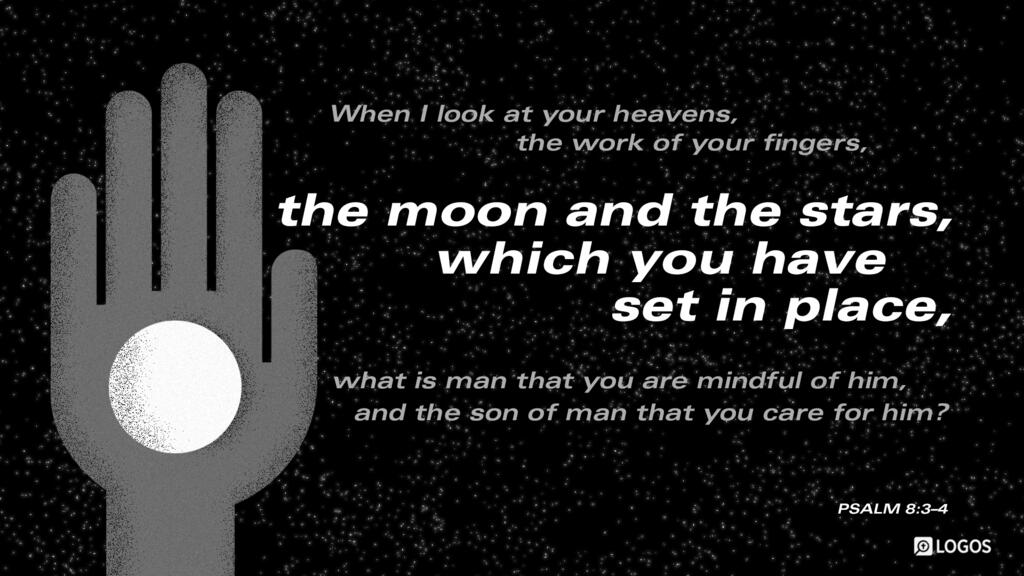
what is man that you are mindful of him,
and the son of man that you care for him?
Yet you have made him a little lower than the heavenly beings
and crowned him with glory and honor.
You have given him dominion over the works of your hands;
you have put all things under his feet,
Copyright 2001 Crossway Bibles
NIVNew International Version (2011)
what is mankind that you are mindful of them,
human beings that you care for them?
You have made them a little lower than the angels
and crowned them with glory and honor.
You made them rulers over the works of your hands;
you put everything under their feet:
Copyright 1973, 1978, 1984, 2011 Biblica, Inc.
CSBChristian Standard Bible
what is a human being that you remember him,
a son of man that you look after him?
You made him little less than God
and crowned him with glory and honor.
You made him ruler over the works of your hands;
you put everything under his feet:
Copyright 2017 Holman Bible Publishers
NLTNew Living Translation
what are mere mortals that you should think about them,
human beings that you should care for them?
Yet you made them only a little lower than God
and crowned them with glory and honor.
You gave them charge of everything you made,
putting all things under their authority—
Holy Bible, New Living Translation, copyright © 1996, 2004, 2015 by Tyndale House Foundation. Used by permission of Tyndale House Publishers. All rights reserved.
LEBThe Lexham English Bible
what is a human being that you think of him?
and a child of humankind that you care for him?
And you made him a little lower than heavenly beings,
and with glory and with majesty you crowned him.
You make him over the works of your hands;
all things you have placed under his feet:
Copyright 2012 Lexham Press
KJV 1900King James Version
What is man, that thou art mindful of him?
And the son of man, that thou visitest him?
For thou hast made him a little lower than the angels,
And hast crowned him with glory and honour.
Thou madest him to have dominion over the works of thy hands;
Thou hast put all things under his feet:
Public Domain