Psalm 49:8–9
The NET BibleOther versions
English
- NET The NET Bible
- DARBY 1890 Darby Bible
- ASV American Standard Version
- AV 1873 The Cambridge Paragraph Bible of the Authorized English Version
- CSB Christian Standard Bible
- D-R Douay-Rheims Bible
- ESV English Standard Version
- GW GOD’S WORD Translation
- GNB Good News Translation
- HCSB The Holman Christian Standard Bible
- KJV 1900 King James Version
- LSB Legacy Standard Bible
- LEB The Lexham English Bible
- MSG The Message: The Bible in Contemporary Language
- NASB95 New American Standard Bible (1995)
- NCV New Century Version
- NIrV New International Reader’s Version (1998)
- NIV New International Version (2011)
- NKJV The New King James Version
- NLT New Living Translation
- NRSVue New Revised Standard Version: Updated Edition
- RSV The Revised Standard Version
- RSVCE The Revised Standard Version, Catholic Edition
- TNIV Today’s New International Version
- YLT Young’s Literal Translation
Arabic
Czech
French
German
Hebrew
Hungarian
Italian
Korean
Latin
Portuguese
Russian
Simplified Chinese
Spanish
Traditional Chinese
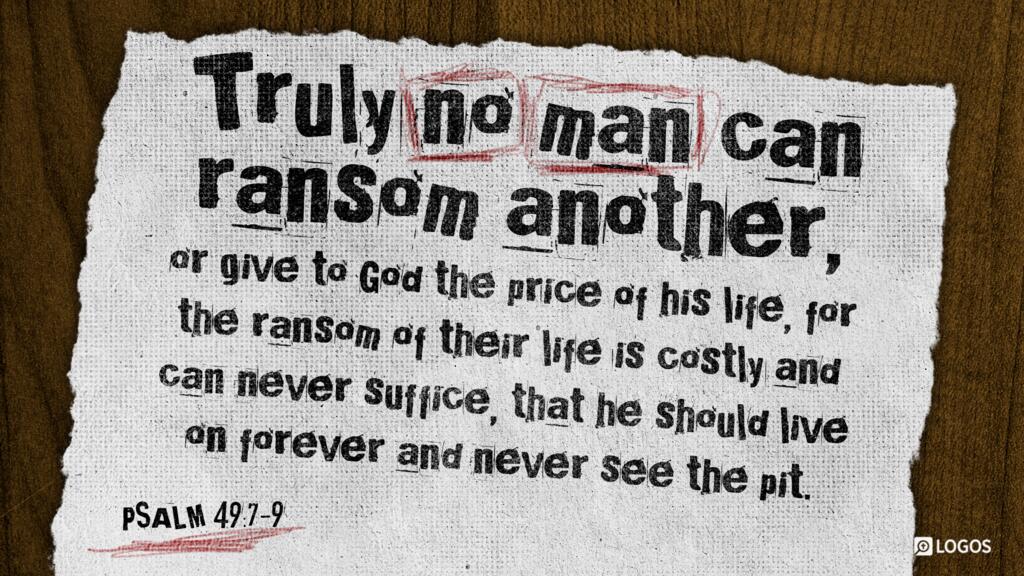
49:8(the ransom price for a human life12 is too high,
and people go to their final destiny),13
49:9so that he might continue to live14 forever
and not experience death.15
Footnotes
- 12 Heb “their life.” Some emend the text to “his life,” understanding the antecedent of the pronoun as “brother” in v. 7. However, the man and brother of v. 7 are representative of the human race in general, perhaps explaining why a plural pronoun appears in v. 8. Of course, the plural pronoun could refer back to “the rich” mentioned in v. 6. Another option (the one assumed in the translation) is that the suffixed mem is enclitic. In this case the “ransom price for human life” is referred to an abstract, general way.
- 13 Heb “and one ceases forever.” The translation assumes an indefinite subject which in turn is representative of the entire human race (“one,” that refers to human beings without exception). The verb חָדַל (khadal, “cease”) is understood in the sense of “come to an end; fail” (i.e., die). Another option is to translate, “and one ceases/refrains forever.” In this case the idea is that the living, convinced of the reality of human mortality, give up all hope of “buying off” God and refrain from trying to do so.
- 14 The jussive verbal form with vav (ו) conjunctive is taken as indicating purpose/result in relation to the statement made in v. 8. (On this use of the jussive after an imperfect, see §109.f.) In this case v. 8 is understood as a parenthetical comment.
- 15 Heb “see the Pit.” The Hebrew term שַׁחַת (shakhat, “pit”) is often used as a title for Sheol (see Pss 16:10; 30:9; 55:24; 103:4).
The NET Bible First Edition, Copyright 1996-2005 by Biblical Studies Press
In other versions
ESVEnglish Standard Version
for the ransom of their life is costly
and can never suffice,
that he should live on forever
and never see the pit.
Copyright 2001 Crossway Bibles
NIVNew International Version (2011)
the ransom for a life is costly,
no payment is ever enough—
so that they should live on forever
and not see decay.
Copyright 1973, 1978, 1984, 2011 Biblica, Inc.
CSBChristian Standard Bible
since the price of redeeming him is too costly,
one should forever stop trying—
so that he may live forever
and not see the Pit.
Copyright 2017 Holman Bible Publishers
NLTNew Living Translation
Redemption does not come so easily,
for no one can ever pay enough
to live forever
and never see the grave.
Holy Bible, New Living Translation, copyright © 1996, 2004, 2015 by Tyndale House Foundation. Used by permission of Tyndale House Publishers. All rights reserved.
LEBThe Lexham English Bible
(since the redemption price for their life is costly
and it always fails),
so that he may stay alive forever
and not see the pit.
Copyright 2012 Lexham Press
KJV 1900King James Version
(For the redemption of their soul is precious,
And it ceaseth for ever:)
That he should still live for ever,
And not see corruption.
Public Domain