Psalm 49:7
The NET BibleOther versions
English
- NET The NET Bible
- DARBY 1890 Darby Bible
- ASV American Standard Version
- AV 1873 The Cambridge Paragraph Bible of the Authorized English Version
- CSB Christian Standard Bible
- D-R Douay-Rheims Bible
- ESV English Standard Version
- GW GOD’S WORD Translation
- GNB Good News Translation
- HCSB The Holman Christian Standard Bible
- KJV 1900 King James Version
- LSB Legacy Standard Bible
- LEB The Lexham English Bible
- MSG The Message: The Bible in Contemporary Language
- NASB95 New American Standard Bible (1995)
- NCV New Century Version
- NIrV New International Reader’s Version (1998)
- NIV New International Version (2011)
- NKJV The New King James Version
- NLT New Living Translation
- NRSVue New Revised Standard Version: Updated Edition
- RSV The Revised Standard Version
- RSVCE The Revised Standard Version, Catholic Edition
- TNIV Today’s New International Version
- YLT Young’s Literal Translation
Arabic
Czech
French
German
Hebrew
Hungarian
Italian
Korean
Latin
Portuguese
Russian
Simplified Chinese
Spanish
Traditional Chinese
Footnotes
- 10 Heb “a brother, he surely does not ransom, a man.” The sequence אִישׁ … אָח (’akh …’ ish, “a brother … a man”) is problematic, for the usual combination is אָח … אָח (“a brother … a brother”) or אִישׁ … אִישׁ (“a man … a man”). When אִישׁ and אָח are combined, the usual order is אָח … אִישׁ (“a man … a brother”), with “brother” having a third masculine singular suffix, “his brother.” This suggests that “brother” is the object of the verb and “man” the subject. (1) Perhaps the altered word order and absence of the suffix can be explained by the text’s poetic character, for ellipsis is a feature of Hebrew poetic style. (2) Another option, supported by a few medieval Hebrew , is to emend “brother” to the similar sounding אַךְ (’akh, “surely; but”) which occurs in v. 15 before the verb פָּדָה (padah, “ransom”). If this reading is accepted the Qal imperfect יִפְדֶּה (yifddeh, “he can [not] ransom”) would need to be emended to a Niphal (passive) form, יִפָּדֶה (yifadeh, “he can[not] be ransomed”) unless one understands the subject of the Qal verb to be indefinite (“one cannot redeem a man”). (A Niphal imperfect can be collocated with a Qal infinitive absolute. See §113.w.) No matter how one decides the textual issues, the imperfect in this case is modal, indicating potential, and the infinitive absolute emphasizes the statement.
- 11 Heb “he cannot pay to God his ransom price.” Num 35:31 may supply the legal background for the metaphorical language used here. The psalmist pictures God as having a claim on the soul of the individual. When God comes to claim the life that ultimately belongs to him, he demands a ransom price that is beyond the capability of anyone to pay. The psalmist’s point is that God has ultimate authority over life and death; all the money in the world cannot buy anyone a single day of life beyond what God has decreed.
The NET Bible First Edition, Copyright 1996-2005 by Biblical Studies Press
In other versions
ESVEnglish Standard Version
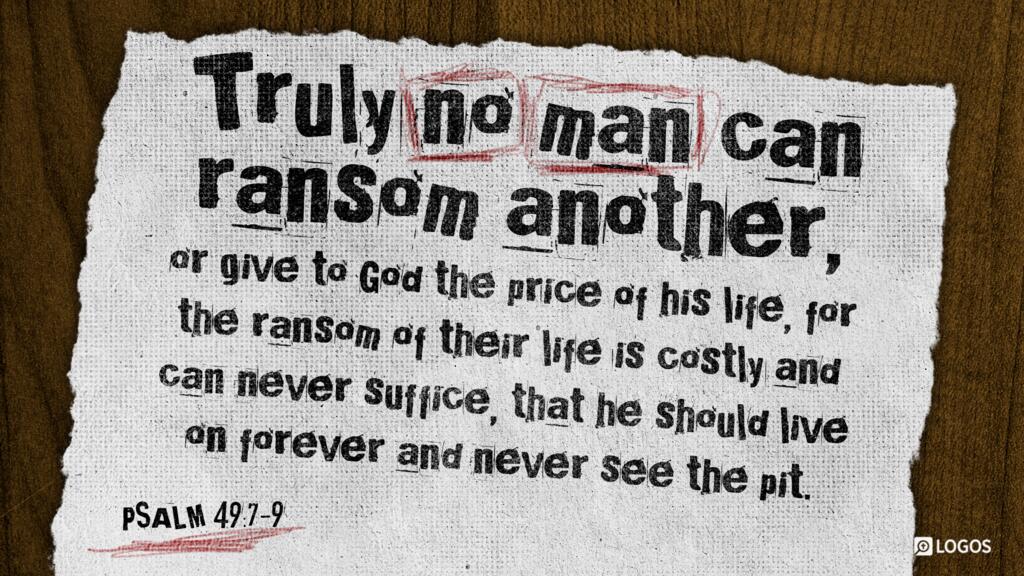
Truly no man can ransom another,
or give to God the price of his life,
Copyright 2001 Crossway Bibles
NIVNew International Version (2011)
No one can redeem the life of another
or give to God a ransom for them—
Copyright 1973, 1978, 1984, 2011 Biblica, Inc.
CSBChristian Standard Bible
Yet these cannot redeem a person
or pay his ransom to God—
Copyright 2017 Holman Bible Publishers
NLTNew Living Translation
Yet they cannot redeem themselves from death
by paying a ransom to God.
Holy Bible, New Living Translation, copyright © 1996, 2004, 2015 by Tyndale House Foundation. Used by permission of Tyndale House Publishers. All rights reserved.
LEBThe Lexham English Bible
Surely a man cannot redeem a brother.
He cannot give to God his ransom
Copyright 2012 Lexham Press
KJV 1900King James Version
None of them can by any means redeem his brother,
Nor give to God a ransom for him:
Public Domain