Psalm 49:7–12
The NET BibleOther versions
English
- NET The NET Bible
- DARBY 1890 Darby Bible
- ASV American Standard Version
- AV 1873 The Cambridge Paragraph Bible of the Authorized English Version
- CSB Christian Standard Bible
- D-R Douay-Rheims Bible
- ESV English Standard Version
- GW GOD’S WORD Translation
- GNB Good News Translation
- HCSB The Holman Christian Standard Bible
- KJV 1900 King James Version
- LSB Legacy Standard Bible
- LEB The Lexham English Bible
- MSG The Message: The Bible in Contemporary Language
- NASB95 New American Standard Bible (1995)
- NCV New Century Version
- NIrV New International Reader’s Version (1998)
- NIV New International Version (2011)
- NKJV The New King James Version
- NLT New Living Translation
- NRSVue New Revised Standard Version: Updated Edition
- RSV The Revised Standard Version
- RSVCE The Revised Standard Version, Catholic Edition
- TNIV Today’s New International Version
- YLT Young’s Literal Translation
Arabic
Czech
French
German
Hebrew
Hungarian
Italian
Korean
Latin
Portuguese
Russian
Simplified Chinese
Spanish
Traditional Chinese
49:7Certainly a man cannot rescue his brother;10
he cannot pay God an adequate ransom price11
49:8(the ransom price for a human life12 is too high,
and people go to their final destiny),13
49:9so that he might continue to live14 forever
and not experience death.15
49:10Surely16 one sees17 that even wise people die;18
fools and spiritually insensitive people all pass away19
and leave their wealth to others.20
49:11Their grave becomes their permanent residence,
their eternal dwelling place.21
They name their lands after themselves,22
49:12but, despite their wealth, people do not last,23
Footnotes
- 10 Heb “a brother, he surely does not ransom, a man.” The sequence אִישׁ … אָח (’akh …’ ish, “a brother … a man”) is problematic, for the usual combination is אָח … אָח (“a brother … a brother”) or אִישׁ … אִישׁ (“a man … a man”). When אִישׁ and אָח are combined, the usual order is אָח … אִישׁ (“a man … a brother”), with “brother” having a third masculine singular suffix, “his brother.” This suggests that “brother” is the object of the verb and “man” the subject. (1) Perhaps the altered word order and absence of the suffix can be explained by the text’s poetic character, for ellipsis is a feature of Hebrew poetic style. (2) Another option, supported by a few medieval Hebrew , is to emend “brother” to the similar sounding אַךְ (’akh, “surely; but”) which occurs in v. 15 before the verb פָּדָה (padah, “ransom”). If this reading is accepted the Qal imperfect יִפְדֶּה (yifddeh, “he can [not] ransom”) would need to be emended to a Niphal (passive) form, יִפָּדֶה (yifadeh, “he can[not] be ransomed”) unless one understands the subject of the Qal verb to be indefinite (“one cannot redeem a man”). (A Niphal imperfect can be collocated with a Qal infinitive absolute. See §113.w.) No matter how one decides the textual issues, the imperfect in this case is modal, indicating potential, and the infinitive absolute emphasizes the statement.
- 11 Heb “he cannot pay to God his ransom price.” Num 35:31 may supply the legal background for the metaphorical language used here. The psalmist pictures God as having a claim on the soul of the individual. When God comes to claim the life that ultimately belongs to him, he demands a ransom price that is beyond the capability of anyone to pay. The psalmist’s point is that God has ultimate authority over life and death; all the money in the world cannot buy anyone a single day of life beyond what God has decreed.
- 12 Heb “their life.” Some emend the text to “his life,” understanding the antecedent of the pronoun as “brother” in v. 7. However, the man and brother of v. 7 are representative of the human race in general, perhaps explaining why a plural pronoun appears in v. 8. Of course, the plural pronoun could refer back to “the rich” mentioned in v. 6. Another option (the one assumed in the translation) is that the suffixed mem is enclitic. In this case the “ransom price for human life” is referred to an abstract, general way.
- 13 Heb “and one ceases forever.” The translation assumes an indefinite subject which in turn is representative of the entire human race (“one,” that refers to human beings without exception). The verb חָדַל (khadal, “cease”) is understood in the sense of “come to an end; fail” (i.e., die). Another option is to translate, “and one ceases/refrains forever.” In this case the idea is that the living, convinced of the reality of human mortality, give up all hope of “buying off” God and refrain from trying to do so.
- 14 The jussive verbal form with vav (ו) conjunctive is taken as indicating purpose/result in relation to the statement made in v. 8. (On this use of the jussive after an imperfect, see §109.f.) In this case v. 8 is understood as a parenthetical comment.
- 15 Heb “see the Pit.” The Hebrew term שַׁחַת (shakhat, “pit”) is often used as a title for Sheol (see Pss 16:10; 30:9; 55:24; 103:4).
- 16 The particle כִּי (ki) is understood here as asseverative (emphatic).
- 17 The subject of the verb is probably the typical “man” mentioned in v. 7. The imperfect can be taken here as generalizing or as indicating potential (“surely he/one can see”).
- 18 The imperfect verbal forms here and in the next line draw attention to what is characteristically true. The vav (ו) consecutive with perfect in the third line carries the same force.
- 19 Heb “together a fool and a brutish [man] perish.” The adjective בַּעַר (ba’ar, “brutish”) refers to spiritual insensitivity, not mere lack of intelligence or reasoning ability (see Pss 73:22; 92:6; Prov 12:1; 30:2, as well as the use of the related verb in Ps 94:8).
- 20 Death shows no respect for anyone. No matter how wise or foolish an individual happens to be, all pass away.
- 21 Heb “their inward part [is] their houses [are] permanent, their dwelling places for a generation and a generation.” If one follows the , then קֶרֶב (qerev, “inward part”) must refer to the seat of these people’s thoughts (for other examples of this use of the term, see 899 , though prefers an emendation in this passage). In this case all three lines of v. 11 expose these people’s arrogant assumption that they will last forever, which then stands in sharp contrast to reality as summarized in v. 12. In this case one might translate the first two lines, “they think that their houses are permanent and that their dwelling places will last forever” (cf. ). Following the lead of several ancient versions, the present translation assumes an emendation of קִרְבָּם (qirbam, “their inward part”) to קְבָרִים (qévarim, “graves”). This assumes that the letters bet (ב) and resh (ר) were accidentally transposed in the . In this case the first two lines support the point made in v. 10, while the third line of v. 11 stands in contrast to v. 12. The phrase בֵּית עוֹלָם (bet ’olam, “permanent house”) is used of a tomb in Eccl 12:5 (as well as in Phoenician tomb inscriptions, see 1:160 for a list of texts) and מִשְׁכָּן (mishkan, “dwelling place”) refers to a tomb in Isa 22:16. Cf. , , .
- 22 Naming their lands after themselves is a claim of possession.
- 23 Heb “but mankind in honor does not remain.” The construction vav (ו) + noun at the beginning of the verse can be taken as contrastive in relation to what precedes. The Hebrew term יְקָר (yéqar, “honor”) probably refers here to the wealth mentioned in the preceding context. The imperfect verbal form draws attention to what is characteristically true. Some scholars emend יָלִין (yalin, “remains”) to יָבִין (yavin, “understands”) but this is an unnecessary accommodation to the wording of v. 20.
- 24 Or “cattle.”
- 25 The verb is derived from דָּמָה (damah, “cease; destroy”; 198 ). Another option is to derive the verb from דָּמָה (“be silent”; see II דמה, which sees two homonymic roots [דָּמָה, “be silent,” and דָּמָה, “destroy”] rather than a single root) and translate, “they are like dumb beasts.” This makes particularly good sense in v. 20, where the preceding line focuses on mankind’s lack of understanding.
The NET Bible First Edition, Copyright 1996-2005 by Biblical Studies Press
In other versions
ESVEnglish Standard Version
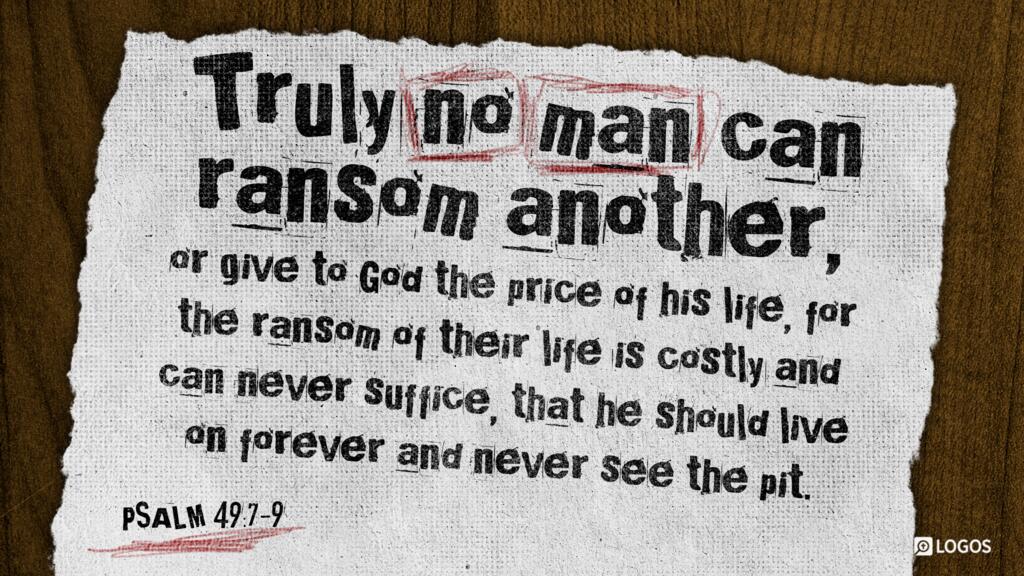
Truly no man can ransom another,
or give to God the price of his life,
for the ransom of their life is costly
and can never suffice,
that he should live on forever
and never see the pit.
For he sees that even the wise die;
the fool and the stupid alike must perish
and leave their wealth to others.
Their graves are their homes forever,
their dwelling places to all generations,
though they called lands by their own names.
Man in his pomp will not remain;
he is like the beasts that perish.
Copyright 2001 Crossway Bibles
NIVNew International Version (2011)
No one can redeem the life of another
or give to God a ransom for them—
the ransom for a life is costly,
no payment is ever enough—
so that they should live on forever
and not see decay.
For all can see that the wise die,
that the foolish and the senseless also perish,
leaving their wealth to others.
Their tombs will remain their houses forever,
their dwellings for endless generations,
though they had named lands after themselves.
People, despite their wealth, do not endure;
they are like the beasts that perish.
Copyright 1973, 1978, 1984, 2011 Biblica, Inc.
CSBChristian Standard Bible
Yet these cannot redeem a person
or pay his ransom to God—
since the price of redeeming him is too costly,
one should forever stop trying—
so that he may live forever
and not see the Pit.
For one can see that the wise die;
the foolish and stupid also pass away.
Then they leave their wealth to others.
Their graves are their permanent homes,
their dwellings from generation to generation,
though they have named estates after themselves.
But despite his assets, mankind will not last;
he is like the animals that perish.
Copyright 2017 Holman Bible Publishers
NLTNew Living Translation
Yet they cannot redeem themselves from death
by paying a ransom to God.
Redemption does not come so easily,
for no one can ever pay enough
to live forever
and never see the grave.
Those who are wise must finally die,
just like the foolish and senseless,
leaving all their wealth behind.
The grave is their eternal home,
where they will stay forever.
They may name their estates after themselves,
but their fame will not last.
They will die, just like animals.
Holy Bible, New Living Translation, copyright © 1996, 2004, 2015 by Tyndale House Foundation. Used by permission of Tyndale House Publishers. All rights reserved.
LEBThe Lexham English Bible
Surely a man cannot redeem a brother.
He cannot give to God his ransom
(since the redemption price for their life is costly
and it always fails),
so that he may stay alive forever
and not see the pit.
For he sees that the wise die,
together with the fool and brute they perish,
and leave their wealth to the next generation.
Within them they think their houses are forever,
their dwelling places from generation to generation.
They name their lands by their own names.
But man cannot continue in his pomp.
He is like the beasts that perish.
Copyright 2012 Lexham Press
KJV 1900King James Version
None of them can by any means redeem his brother,
Nor give to God a ransom for him:
(For the redemption of their soul is precious,
And it ceaseth for ever:)
That he should still live for ever,
And not see corruption.
For he seeth that wise men die,
Likewise the fool and the brutish person perish,
And leave their wealth to others.
Their inward thought is, that their houses shall continue for ever,
And their dwelling places to all generations;
They call their lands after their own names.
Nevertheless man being in honour abideth not:
He is like the beasts that perish.
Public Domain