Psalm 1:2–3
The NET BibleOther versions
English
- NET The NET Bible
- DARBY 1890 Darby Bible
- ASV American Standard Version
- AV 1873 The Cambridge Paragraph Bible of the Authorized English Version
- CSB Christian Standard Bible
- D-R Douay-Rheims Bible
- ESV English Standard Version
- GW GOD’S WORD Translation
- GNB Good News Translation
- HCSB The Holman Christian Standard Bible
- KJV 1900 King James Version
- LSB Legacy Standard Bible
- LEB The Lexham English Bible
- MSG The Message: The Bible in Contemporary Language
- NASB95 New American Standard Bible (1995)
- NCV New Century Version
- NIrV New International Reader’s Version (1998)
- NIV New International Version (2011)
- NKJV The New King James Version
- NLT New Living Translation
- NRSVue New Revised Standard Version: Updated Edition
- RSV The Revised Standard Version
- RSVCE The Revised Standard Version, Catholic Edition
- TNIV Today’s New International Version
- YLT Young’s Literal Translation
Arabic
Czech
French
German
Hebrew
Hungarian
Italian
Korean
Latin
Portuguese
Russian
Simplified Chinese
Spanish
Traditional Chinese
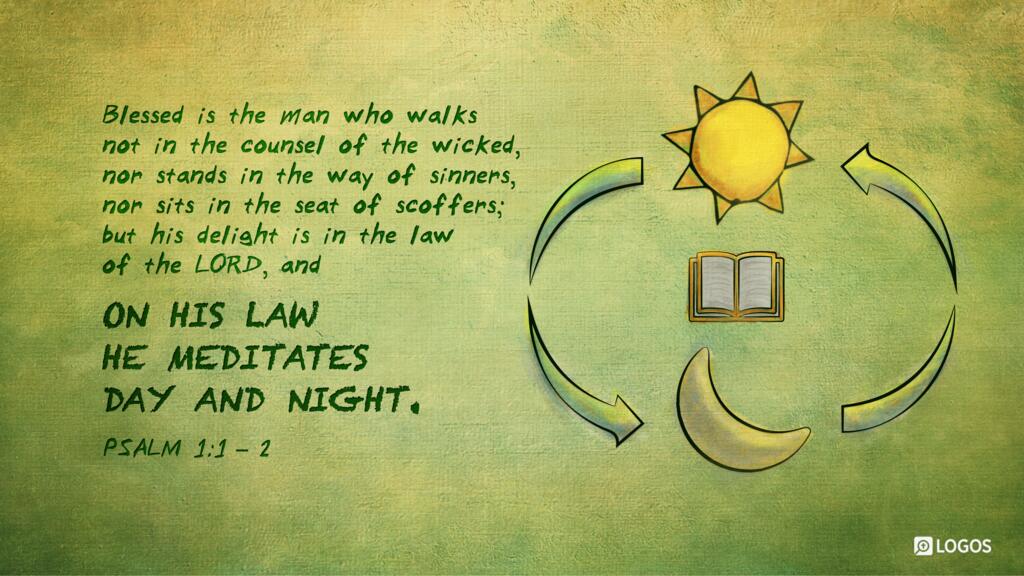
1:2Instead9 he finds pleasure in obeying the Lord’s commands;10
he meditates on11 his commands12 day and night.
1:3He is like13 a tree planted by flowing streams;14
it15 yields16 its fruit at the proper time,17
and its leaves never fall off.18
He succeeds in everything he attempts.19
Footnotes
- 9 Here the Hebrew expression כִּי־אִם (ki-’im, “instead”) introduces a contrast between the sinful behavior depicted in v. 1 and the godly lifestyle described in v. 2.
- 10 Heb “his delight [is] in the law of the Lord.” In light of the following line, which focuses on studying the Lord’s law, one might translate, “he finds pleasure in studying the Lord’s commands.” However, even if one translates the line this way, it is important to recognize that mere study and intellectual awareness are not ultimately what bring divine favor. Study of the law is metonymic here for the correct attitudes and behavior that should result from an awareness of and commitment to God’s moral will; thus “obeying” has been used in the translation rather than “studying.”
- 11 The Hebrew imperfect verbal form draws attention to the characteristic behavior described here and lends support to the hyperbolic adverbial phrase “day and night.” The verb הָגָה (hagag) means “to recite quietly; to meditate” and refers metonymically to intense study and reflection.
- 12 Or “his law.”
- 13 The Hebrew perfect verbal form with vav (ו) consecutive here carries the same characteristic force as the imperfect in the preceding verse. According to the psalmist, the one who studies and obeys God’s commands typically prospers.
- 14 Heb “channels of water.”
- 15 Heb “which.”
- 16 The Hebrew imperfect verbal forms in v. 3 draw attention to the typical nature of the actions/states they describe.
- 17 Heb “in its season.”
- 18 Or “fade”; “wither.” The author compares the godly individual to a tree that has a rich water supply (planted by flowing streams), develops a strong root system, and is filled with leaves and fruit. The simile suggests that the godly have a continual source of life which in turn produces stability and uninterrupted prosperity.
- 19 Heb “and all which he does prospers”; or “and all which he does he causes to prosper.” (The simile of the tree does not extend to this line.) It is not certain if the Hiphil verbal form (יַצְלִיחַ, yatsliakh) is intransitive-exhibitive (“prospers”) or causative (“causes to prosper”) here. If the verb is intransitive, then כֹּל (kol, “all, everything”) is the subject. If the verb is causative, then the godly individual or the Lord himself is the subject and כֹּל is the object. The wording is reminiscent of Josh 1:8, where the Lord tells Joshua: “This law scroll must not leave your lips! You must memorize it day and night so you can carefully obey all that is written in it. Then you will prosper (literally, “cause your way to prosper”) and be successful.”
The NET Bible First Edition, Copyright 1996-2005 by Biblical Studies Press
In other versions
ESVEnglish Standard Version
but his delight is in the law of the Lord,
and on his law he meditates day and night.
He is like a tree
planted by streams of water
that yields its fruit in its season,
and its leaf does not wither.
In all that he does, he prospers.
Copyright 2001 Crossway Bibles
NIVNew International Version (2011)
but whose delight is in the law of the Lord,
and who meditates on his law day and night.
That person is like a tree planted by streams of water,
which yields its fruit in season
and whose leaf does not wither—
whatever they do prospers.
Copyright 1973, 1978, 1984, 2011 Biblica, Inc.
CSBChristian Standard Bible
Instead, his delight is in the Lord’s instruction,
and he meditates on it day and night.
He is like a tree planted beside flowing streams
that bears its fruit in its season,
and its leaf does not wither.
Whatever he does prospers.
Copyright 2017 Holman Bible Publishers
NLTNew Living Translation
But they delight in the law of the Lord,
meditating on it day and night.
They are like trees planted along the riverbank,
bearing fruit each season.
Their leaves never wither,
and they prosper in all they do.
Holy Bible, New Living Translation, copyright © 1996, 2004, 2015 by Tyndale House Foundation. Used by permission of Tyndale House Publishers. All rights reserved.
LEBThe Lexham English Bible
Instead, in the law of Yahweh is his delight,
and on his law he meditates day and night.
And so, he is like a tree planted by streams of water
that gives its fruit in its season;
its leaf also does not wither.
Therefore all that he does prospers.
Copyright 2012 Lexham Press
KJV 1900King James Version
But his delight is in the law of the Lord;
And in his law doth he meditate day and night.
And he shall be like a tree planted by the rivers of water,
That bringeth forth his fruit in his season;
His leaf also shall not wither;
And whatsoever he doeth shall prosper.
Public Domain