Numbers 9:18–23
The NET BibleOther versions
English
- NET The NET Bible
- DARBY 1890 Darby Bible
- ASV American Standard Version
- AV 1873 The Cambridge Paragraph Bible of the Authorized English Version
- CSB Christian Standard Bible
- D-R Douay-Rheims Bible
- ESV English Standard Version
- GW GOD’S WORD Translation
- GNB Good News Translation
- HCSB The Holman Christian Standard Bible
- KJV 1900 King James Version
- LSB Legacy Standard Bible
- LEB The Lexham English Bible
- MSG The Message: The Bible in Contemporary Language
- NASB95 New American Standard Bible (1995)
- NCV New Century Version
- NIrV New International Reader’s Version (1998)
- NIV New International Version (2011)
- NKJV The New King James Version
- NLT New Living Translation
- NRSVue New Revised Standard Version: Updated Edition
- RSV The Revised Standard Version
- RSVCE The Revised Standard Version, Catholic Edition
- TNIV Today’s New International Version
- YLT Young’s Literal Translation
Arabic
Czech
French
German
Hebrew
Hungarian
Italian
Korean
Latin
Portuguese
Russian
Simplified Chinese
Spanish
Traditional Chinese
9:18At the commandment40 of the Lord the Israelites would begin their journey, and at the commandment of the Lord they would make camp; as long as41 the cloud remained settled over the tabernacle they would camp. 9:19When the cloud remained over the tabernacle many days, then the Israelites obeyed the instructions42 of the Lord and did not journey.
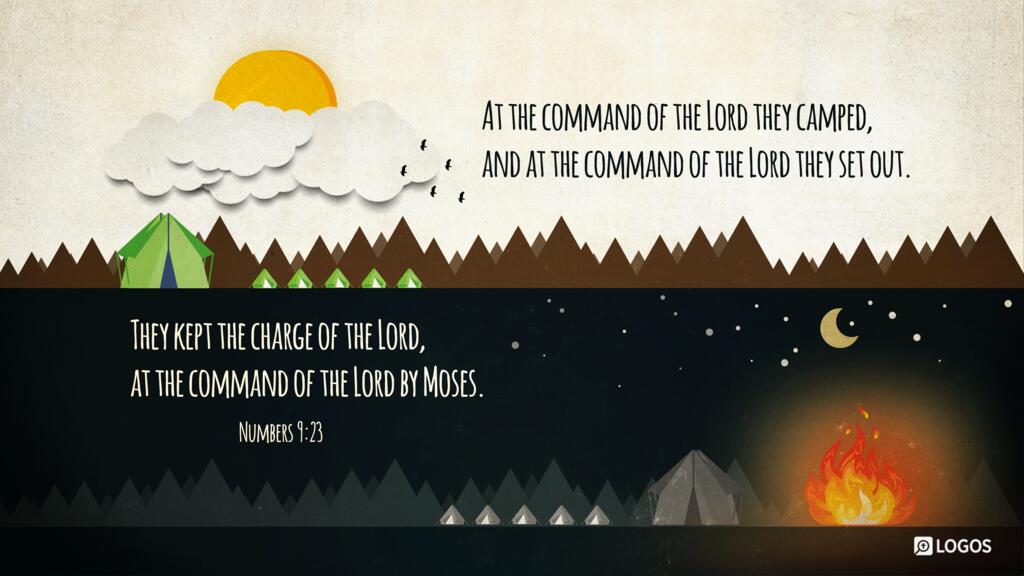
9:20When43 the cloud remained over the tabernacle a number of days,44 they remained camped according to the Lord’s commandment,45 and according to the Lord’s commandment they would journey. 9:21And when46 the cloud remained only47 from evening until morning, when the cloud was taken up48 the following morning, then they traveled on. Whether by day or by night, when the cloud was taken up they traveled. 9:22Whether it was for two days, or a month, or a year,49 that the cloud prolonged its stay50 over the tabernacle, the Israelites remained camped without traveling;51 but when it was taken up, they traveled on. 9:23At the commandment of the Lord they camped, and at the commandment of the Lord they traveled on; they kept the instructions of the Lord according to the commandment of the Lord, by the authority52 of Moses.
Footnotes
- 40 Heb “at the mouth of” (so also in vv. 20, 23).
- 41 Heb “all the days of—that the cloud settled over the tabernacle.” “All” is the adverbial accusative of time telling how long they camped in one spot—all. The word is then qualified by the genitive of the thing measured—“all of the days”—and this in turn is qualified by a noun clause functioning as a genitive after “days of.”
- 42 This is the same Hebrew expression that was used earlier for the Levites “keeping their charge” or more clearly, “fulfilling their obligations” to take care of the needs of the people and the sanctuary. It is a general expression using שָׁמַר (shamar) followed by its cognate noun מִשְׁמֶרֶת (mishmeret).
- 43 The sentence uses וְיֵשׁ (véyesh) followed by a noun clause introduced with אֲשֶׁר (’asher) to express an existing situation; it is best translated as an adverbial clause of time: “and it was when the cloud was.…”
- 44 The word “number” is in apposition to the word “days” to indicate that their stay was prolonged for quite a few days.
- 45 Heb “mouth of the Lord.”
- 46 The construction is the same in the preceding verse.
- 47 “Only” is supplied to reflect the contrast between the two verses.
- 48 The construction in this half of the verse uses two vav (ו) consecutive clauses. The first is subordinated to the second as a temporal clause: “when … then.…”
- 49 The has אוֹ־יָמִים (’o-yamim). Most translators use “or a year” to interpret this expression in view of the sequence of words leading up to it, as well as in comparison with passages like Judg 17:10 and 1 Sam 1:3 and 27:7. See also the uses in Gen 40:4 and 1 Kgs 17:15. For the view that it means four months, see F. S. North, “Four Month Season of the Hebrew Bible,” 11 (1961): 446–48.
- 50 In the Hebrew text this sentence has a temporal clause using the preposition with the Hiphil infinitive construct of אָרַךְ (’arakh) followed by the subjective genitive, “the cloud.” But this infinitive is followed by the infinitive construct לִשְׁכֹּן (lishkon), the two of them forming a verbal hendiadys: “the cloud made long to stay” becomes “the cloud prolonged its stay.”
- 51 Heb “and they would not journey”; the clause can be taken adverbially, explaining the preceding verbal clause.
- 52 Heb “hand.”
The NET Bible First Edition, Copyright 1996-2005 by Biblical Studies Press