Nahum 1:5–6
The NET BibleOther versions
English
- NET The NET Bible
- DARBY 1890 Darby Bible
- ASV American Standard Version
- AV 1873 The Cambridge Paragraph Bible of the Authorized English Version
- CSB Christian Standard Bible
- D-R Douay-Rheims Bible
- ESV English Standard Version
- GW GOD’S WORD Translation
- GNB Good News Translation
- HCSB The Holman Christian Standard Bible
- KJV 1900 King James Version
- LSB Legacy Standard Bible
- LEB The Lexham English Bible
- MSG The Message: The Bible in Contemporary Language
- NASB95 New American Standard Bible (1995)
- NCV New Century Version
- NIrV New International Reader’s Version (1998)
- NIV New International Version (2011)
- NKJV The New King James Version
- NLT New Living Translation
- NRSVue New Revised Standard Version: Updated Edition
- RSV The Revised Standard Version
- RSVCE The Revised Standard Version, Catholic Edition
- TNIV Today’s New International Version
- YLT Young’s Literal Translation
Arabic
Czech
French
German
Hebrew
Hungarian
Italian
Korean
Latin
Portuguese
Russian
Simplified Chinese
Spanish
Traditional Chinese
1:5The mountains tremble before him,20
the hills convulse;21
the earth is laid waste22 before him,
the world and all its inhabitants23 are laid waste.24
1:6No one can withstand25 his indignation!26
No one can resist27 his fierce anger!28
His wrath is poured out like volcanic fire,
Footnotes
- 20 Or “because of him.” The Hebrew preposition מִמֶּנּוּ (mimmenu) is taken in a causal sense (“because of him”) by , ; however, it is taken in a locative sense (“before him”) by , , , . On the other hand, the rendered it in a separative sense: ἀπʼ αὐτοῦ (ap autou, “from him”). The parallelism between 1:5a and 1:5b seems to favor the locative nuance: “The mountains quake before him (מִמֶּנּוּ), the earth is laid waste before him (מִפָּנָיו, mifanayv).”
- 21 Traditionally, “the hills melt.” English versions typically render הִתְמֹגָגוּ (hitmogagu) as “melt” (, , , ) or “dissolve” (). The renders it ἐσαλεύθησαν (esaleuthēsan, “are shaken”). The Hebrew root has a range of meanings: (1) “to melt,” of courage (Ps 107:26) or troops retreating (“melting away” in fear) in battle (1 Sam 14:16); (2) “to dissolve,” of mountains dissolving due to erosion (Amos 9:13); (3) “to quake, shake apart,” of mountains quaking, swaying backwards and forwards, coming apart, and collapsing in an earthquake (Amos 9:5; Pss 46:6 [7]; 75:3 [4]). The latter fits the imagery of v. 5 (violent earthquakes): the earth trembles in fear at the approach of the Divine Warrior (e.g., Hab 3:6).
- 22 Or “is upheaved”; or “heaves.” There is debate whether the originally unpointed Hebrew verb וַתִּשָּׂא (vattissa’) should be vocalized as וְתִּשָּׂא (véttissa’; “is upheaved”; , “heaves”) from the root נָשָׂא (nasa’, “to lift up”) or as וַתִּשָּׁא (vattisha’, “is devastated, laid waste”) from the root שֹׁאָה (sho’ah, “to devastate, lay waste”). The vocalization וְתִּשָּׂא is attested in the Masoretic tradition and the Greek versions: Origen (“was raised up”), Symmachus (“was moved”), and Aquila (“shivered”). However, וְתִּשָּׂא demands an intransitive (“heaves”) or passive (“is upheaved”) sense which is not attested for the Qal stem. The vocalization וַתִּשָּׁא (“is devastated, laid waste”) is supported by the and . The revocalization of the וְתִּשָּׂא (“is lifted up”) to וַתִּשָּׁא (“is devastated”) is suggested by the editors and several Hebrew lexicons ( נשׁא; 670–71 נָשָׂא). The revocalization involves only the difference between the form שׂ (sin) and שׁ (shin) and is followed in the present translation.
- 23 The phrase “the world and all its inhabitants” is used to stress the universal dimensions of God’s revelation of his glory and his acts of judgment (e.g., Pss 33:8; 98:7; Isa 18:3; 26:9, 18; Lam 4:12).
- 24 The words “are laid waste” are not in the Hebrew text, but are an implied repetition from the previous line.
- 25 Heb “stand before” (so , , , ). The Hebrew verb עָמַד (’amad, “stand”) here denotes “to resist, withstand.” It is used elsewhere of warriors taking a stand in battle to hold their ground against enemies (Judg 2:14; Josh 10:8; 21:44; 23:9; 2 Kgs 10:4; Dan 11:16; Amos 2:15). It is also used of people trying to protect their lives from enemy attack (Esth 8:11; 9:16). Like a mighty warrior, the Lord will attack his enemies, but none will be able to make a stand against him; none will be able to hold their ground against him; and none will be able to protect themselves from his onslaught (Pss 76:7[8]; 147:17; Mal 3:2).
- 26 Heb “Who can stand before his indignation?” The rhetorical question expects a negative answer; it is translated here as an emphatic denial. The Hebrew noun זַעַם (za’am, “indignation, curse”) connotes the angry wrath or indignant curse of God (Isa 10:5, 25; 13:5; 26:20; 30:27; Jer 10:10; 15:17; 50:25; Ezek 21:31; 22:24, 31; Hab 3:12; Zeph 3:8; Pss 38:4; 69:25; 78:49; 102:11; Lam 2:6; Dan 8:19; 11:36). It depicts anger expressed in the form of punishment ( ; 1:247).
- 27 Heb “Who can rise up against …?” The verb יָקוּם (yaqum, “arise”) is here a figurative expression connoting resistance. Although the adversative sense of בְּ (bet) with יָקוּם (yaqum, “against him”) is attested, denoting hostile action taken against one’s enemy (Mic 7:6; Ps 27:12), the locative sense (“before him”) is preferred due to the parallelism with לִפְנֵי (lifney, “before him”).
- 28 Heb “Who can rise up against the heat of his anger?” The rhetorical question expects a negative answer which is translated as an emphatic denial to clarify the point.
- 29 Or “burst into flames.” The Niphal perfect נִתְּצוּ (nittétsu) from נָתַץ (natats, “to break up, throw down”) may denote “are broken up” or “are thrown down.” The editors suggest emending the ’s נִתְּצוּ (nittétsu) to נִצְּתּוּ (nitsétu, Niphal perfect from יָצַת [yatsat, “to burn, to kindle, to burst into flames”]): “boulders burst into flames.” This merely involves the simple transposition of the second and third consonants. This emendation is supported by a few Hebrew (cited in apparatus). It is supported contextually by fire and heat motifs in 1:5–6. The same metathesis of נִתְּצוּ and נִצְּתּוּ occurs in Jer 4:26.
- 30 Heb “before him” (so , , ).
The NET Bible First Edition, Copyright 1996-2005 by Biblical Studies Press
In other versions
ESVEnglish Standard Version
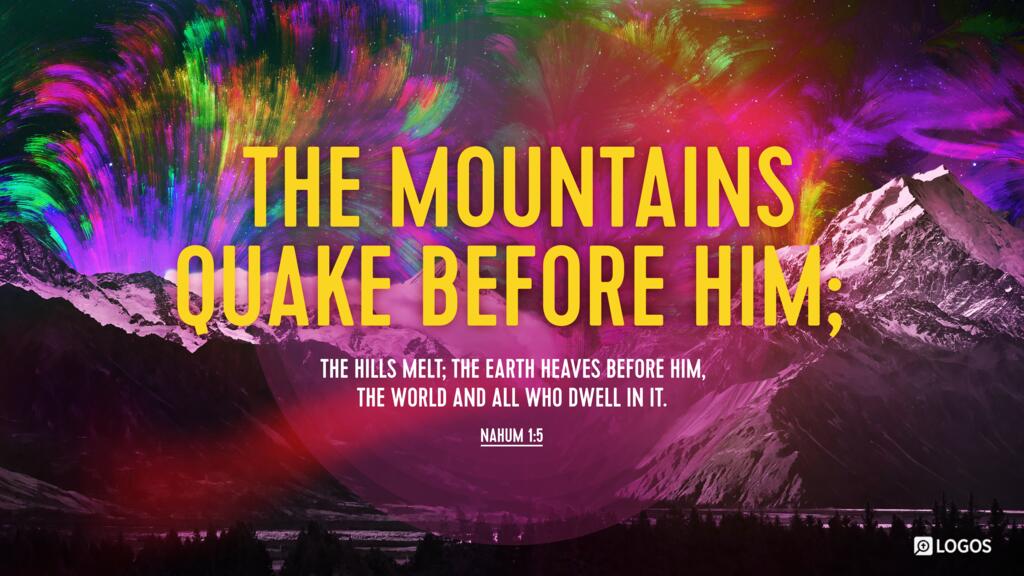
The mountains quake before him;
the hills melt;
the earth heaves before him,
the world and all who dwell in it.
Who can stand before his indignation?
Who can endure the heat of his anger?
His wrath is poured out like fire,
and the rocks are broken into pieces by him.
Copyright 2001 Crossway Bibles
NIVNew International Version (2011)
The mountains quake before him
and the hills melt away.
The earth trembles at his presence,
the world and all who live in it.
Who can withstand his indignation?
Who can endure his fierce anger?
His wrath is poured out like fire;
the rocks are shattered before him.
Copyright 1973, 1978, 1984, 2011 Biblica, Inc.
CSBChristian Standard Bible
The mountains quake before him,
and the hills melt;
the earth trembles at his presence—
the world and all who live in it.
Who can withstand his indignation?
Who can endure his burning anger?
His wrath is poured out like fire;
even rocks are shattered before him.
Copyright 2017 Holman Bible Publishers
NLTNew Living Translation
In his presence the mountains quake,
and the hills melt away;
the earth trembles,
and its people are destroyed.
Who can stand before his fierce anger?
Who can survive his burning fury?
His rage blazes forth like fire,
and the mountains crumble to dust in his presence.
Holy Bible, New Living Translation, copyright © 1996, 2004, 2015 by Tyndale House Foundation. Used by permission of Tyndale House Publishers. All rights reserved.
LEBThe Lexham English Bible
Mountains quake before him;
the hills shake apart.
The earth heaves before him—
the world and all her inhabitants.
His indignation—who can stand before it?
Who can endure his fierce anger?
His wrath is poured out like fire;
rocks are shattered before him.
Copyright 2012 Lexham Press
KJV 1900King James Version
The mountains quake at him, and the hills melt,
And the earth is burned at his presence,
Yea, the world, and all that dwell therein.
Who can stand before his indignation?
And who can abide in the fierceness of his anger?
His fury is poured out like fire,
And the rocks are thrown down by him.
Public Domain