Mark 15:1–21
The NET BibleOther versions
English
- NET The NET Bible
- DARBY 1890 Darby Bible
- ASV American Standard Version
- AV 1873 The Cambridge Paragraph Bible of the Authorized English Version
- CSB Christian Standard Bible
- D-R Douay-Rheims Bible
- ESV English Standard Version
- GW GOD’S WORD Translation
- GNB Good News Translation
- HCSB The Holman Christian Standard Bible
- KJV 1900 King James Version
- LSB Legacy Standard Bible
- LEB The Lexham English Bible
- MSG The Message: The Bible in Contemporary Language
- NASB95 New American Standard Bible (1995)
- NCV New Century Version
- NIrV New International Reader’s Version (1998)
- NIV New International Version (2011)
- NKJV The New King James Version
- NLT New Living Translation
- NRSVue New Revised Standard Version: Updated Edition
- RSV The Revised Standard Version
- RSVCE The Revised Standard Version, Catholic Edition
- TNIV Today’s New International Version
- YLT Young’s Literal Translation
Arabic
Czech
French
German
Greek
Hungarian
Italian
Korean
Latin
Portuguese
Russian
Simplified Chinese
Spanish
Traditional Chinese
Jesus Brought Before Pilate
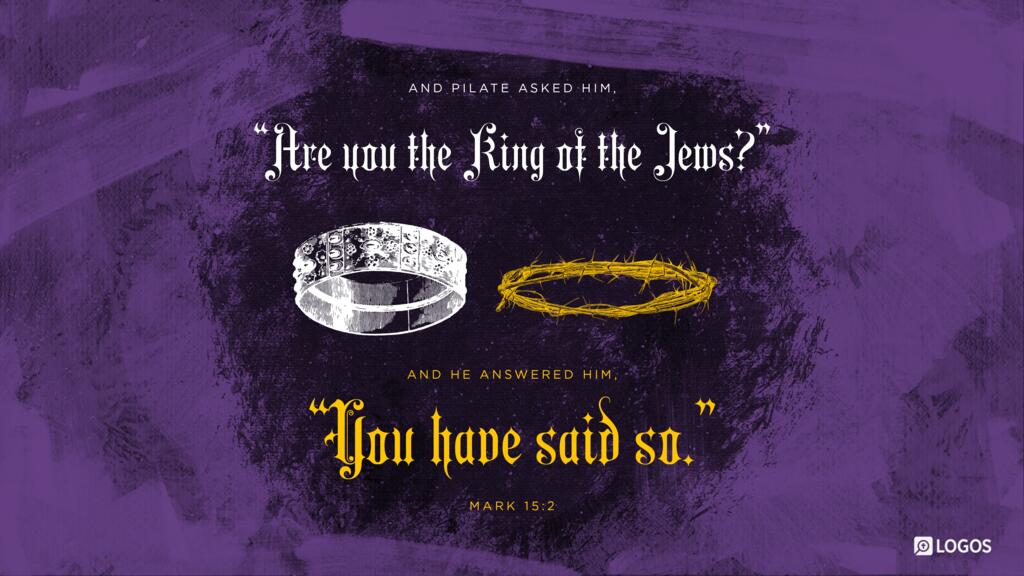
15:1Early in the morning, after forming a plan, the chief priests with the elders and the experts in the law1 and the whole Sanhedrin tied Jesus up, led him away, and handed him over to Pilate.215:2So3 Pilate asked him, “Are you the king4 of the Jews?” He replied,5 “You say so.”615:3Then7 the chief priests began to accuse him repeatedly. 15:4So Pilate asked him again,8 “Have you nothing to say? See how many charges they are bringing against you!” 15:5But Jesus made no further reply, so that Pilate was amazed.
Jesus and Barabbas
15:6During the feast it was customary to release one prisoner to the people,9 whomever they requested. 15:7A man named Barabbas was imprisoned with rebels who had committed murder during an insurrection. 15:8Then the crowd came up and began to ask Pilate to release a prisoner for them, as was his custom.1015:9So Pilate asked them,11 “Do you want me to release the king of the Jews for you?” 15:10(For he knew that the chief priests had handed him over because of envy.)1215:11But the chief priests stirred up the crowd to have him release13 Barabbas instead. 15:12So Pilate spoke to them again,14 “Then what do you want me to do15 with the one you call king of the Jews?” 15:13They shouted back, “Crucify16 him!” 15:14Pilate asked them, “Why? What has he done wrong?” But they shouted more insistently, “Crucify him!” 15:15Because he wanted to satisfy the crowd, Pilate released Barabbas for them. Then,17 after he had Jesus flogged,18 he handed him over19 to be crucified.
Jesus is Mocked
15:16So20 the soldiers led him into the palace (that is, the governor’s residence)21 and called together the whole cohort.2215:17They put a purple cloak23 on him and after braiding24 a crown of thorns,25 they put it on him. 15:18They began to salute him: “Hail, king of the Jews!”2615:19Again and again27 they struck him on the head with a staff28 and spit on him. Then they knelt down and paid homage to him. 15:20When they had finished mocking29 him, they stripped him of the purple cloak and put his own clothes back on him. Then30 they led him away to crucify him.31
The Crucifixion
15:21The soldiers32 forced33 a passerby to carry his cross,34 Simon of Cyrene, who was coming in from the country35 (he was the father of Alexander and Rufus).
Footnotes
- 1 Or “and the scribes.” See the note on the phrase “experts in the law” in .
- 2 The Jews most assuredly wanted to put Jesus to death, but they lacked the authority to do so. For this reason they handed him over to Pilate in hopes of securing a death sentence. The Romans kept close control of the death penalty in conquered territories to prevent it being used to execute Roman sympathizers.
- 3 Here καί (kai) has been translated as “so” to indicate the implied result of previous action in the narrative.
- 4 “Are you the king of the Jews?” Pilate was interested in this charge because of its political implications of sedition against Rome.
- 5 Grk “answering, he said to him.” The participle ἀποκριθείς (apokritheis) is redundant, but the syntax of the phrase has been modified for clarity.
- 6 The reply “You say so” is somewhat enigmatic, like Jesus’ earlier reply to the Jewish leadership (mentioned in Matt 26:64 and Luke 22:70).
- 7 Here καί (kai) has been translated as “then” to indicate the implied sequence of events within the narrative.
- 8 Grk “Pilate asked him again, saying.” The participle λέγων (legōn) is redundant and has not been translated.
- 9 Grk “them”; the referent (the people) has been specified in the translation for clarity. The custom of Pilate to release one prisoner to them is unknown outside the gospels in Jewish writings, but it was a Roman custom at the time and thus probably used in Palestine as well (cf. Matt 27:15; John 18:39); see W. W. Wessel, “Mark,” 8:.
- 10 Grk “Coming up the crowd began to ask [him to do] as he was doing for them.”
- 11 Grk “Pilate answered them, saying.” The participle λέγων (legōn) is redundant and has not been translated.
- 12 This is a parenthetical note by the author.
- 13 Grk “to have him release for them.”
- 14 Grk “answering, Pilate spoke to them again.” The participle ἀποκριθείς (apokritheis) is redundant and has not been translated.
- 15 Instead of “what do you want me to do” several witnesses, including the most important ones (א B C W Δ Ψ f1, 13 33 892 2427 ), lack θέλετε (thelete, “you want”), turning the question into the more abrupt “what should I do?” Although the witnesses for the longer reading are not as significant (A D Θ 0250 𝔐 latt sy), the reading without θέλετε conforms to Matt 27:22 and thus is suspected of being a scribal emendation. The known scribal tendency to assimilate one synoptic passage to another parallel, coupled with the lack of such assimilation in that are otherwise known to do this most frequently (the Western and Byzantine texts), suggests that θέλετε is authentic. Further, Mark’s known style of being generally more verbose and redundant than Matthew’s argues that θέλετε is authentic here. That this is the longer reading, however, and that a good variety of witnesses omit the word, gives one pause. Perhaps the wording without θέλετε would have been perceived as having greater homiletical value, motivating scribes to move in this direction. A decision is difficult, but on the whole internal evidence leads toward regarding θέλετε as authentic.
- 16 Crucifixion was the cruelest form of punishment practiced by the Romans. Roman citizens could not normally undergo it. It was reserved for the worst crimes, like treason and evasion of due process in a capital case. The Roman historian Cicero called it “a cruel and disgusting penalty” (Against Verres 2.5.63–66 §§163–70); Josephus ( 7.6.4 [7.203]) called it the worst of deaths.
- 17 Here καί (kai) has been translated as “then” to indicate the implied sequence of events within the narrative.
- 18 The Greek term φραγελλόω (phragelloō) refers to flogging. states, “flog, scourge, a punishment inflicted on slaves and provincials after a sentence of death had been pronounced on them. So in the case of Jesus before the crucifixion … Mt 27:26; Mk 15:15.” A Roman flogging (traditionally, “scourging”) was an excruciating punishment. The victim was stripped of his clothes and bound to a post with his hands fastened above him (or sometimes he was thrown to the ground). Guards standing on either side of the victim would incessantly beat him with a whip (flagellum) made out of leather with pieces of lead and bone inserted into its ends. While the Jews only allowed 39 lashes, the Romans had no such limit; many people who received such a beating died as a result. See C. Schneider, , 4:515–19.
- 19 Or “delivered him up.”
- 20 Here δέ (de) has been translated as “So” to indicate that the soldiers’ action is in response to Pilate’s condemnation of the prisoner in v. 15.
- 21 Grk “(that is, the praetorium).” The governor’s residence (Grk “praetorium”) was the Roman governor’s official residence. The one in Jerusalem may have been Herod’s palace in the western part of the city, or the fortress Antonia northwest of the temple area.
- 22 A Roman cohort was a tenth of a legion, about 500–600 soldiers.
- 23 The purple cloak probably refers to a military garment which had the color of royal purple, and thus resembled a king’s robe. The soldiers did this to Jesus as a form of mockery in view of the charges that he was a king (cf. 15:2).
- 24 Or “weaving.”
- 25 The crown may have been made from palm spines or some other thorny plant common in Israel. In placing the crown of thorns on his head, the soldiers were unwittingly symbolizing God’s curse on humanity (cf. Gen 3:18) being placed on Jesus. Their purpose would have been to mock Jesus’ claim to be a king; the crown of thorns would have represented the “radiant corona” portrayed on the heads of rulers on coins and other artifacts in the 1st century.
- 26 Or “Long live the King of the Jews!” The statement Hail, King of the Jews! is a mockery patterned after the Romans’ cry of Ave, Caesar (“Hail, Caesar!”).
- 27 The verb here has been translated as an iterative imperfect.
- 28 Or “a reed.” The Greek term can mean either “staff” or “reed.” See κάλαμος 2.
- 29 The aorist tense is taken consummatively here.
- 30 Here καί (kai) has been translated as “then” to indicate the implied sequence of events within the narrative.
- 31 See the note on Crucify in .
- 32 Grk “They”; the referent (the soldiers) has been specified in the translation for clarity.
- 33 Or “conscripted”; or “pressed into service.”
- 34 Jesus was beaten severely with a whip before this (the prelude to crucifixion, known to the Romans as verberatio, mentioned in Matt 27:26; Mark 15:15; John 19:1), so he would have been weak from trauma and loss of blood. Apparently he was unable to bear the cross himself, so Simon was conscripted to help (in all probability this was only the crossbeam, called in Latin the patibulum, since the upright beam usually remained in the ground at the place of execution). Cyrene was located in North Africa where Tripoli is today. Nothing more is known about this Simon.
- 35 Or perhaps, “was coming in from his field” outside the city ( ἀγρός 1).
The NET Bible First Edition, Copyright 1996-2005 by Biblical Studies Press