Luke 20:22–25
The NET BibleOther versions
English
- NET The NET Bible
- DARBY 1890 Darby Bible
- ASV American Standard Version
- AV 1873 The Cambridge Paragraph Bible of the Authorized English Version
- CSB Christian Standard Bible
- D-R Douay-Rheims Bible
- ESV English Standard Version
- GW GOD’S WORD Translation
- GNB Good News Translation
- HCSB The Holman Christian Standard Bible
- KJV 1900 King James Version
- LSB Legacy Standard Bible
- LEB The Lexham English Bible
- MSG The Message: The Bible in Contemporary Language
- NASB95 New American Standard Bible (1995)
- NCV New Century Version
- NIrV New International Reader’s Version (1998)
- NIV New International Version (2011)
- NKJV The New King James Version
- NLT New Living Translation
- NRSVue New Revised Standard Version: Updated Edition
- RSV The Revised Standard Version
- RSVCE The Revised Standard Version, Catholic Edition
- TNIV Today’s New International Version
- YLT Young’s Literal Translation
Arabic
Czech
French
German
Greek
Hungarian
Italian
Korean
Latin
Portuguese
Russian
Simplified Chinese
Spanish
Traditional Chinese
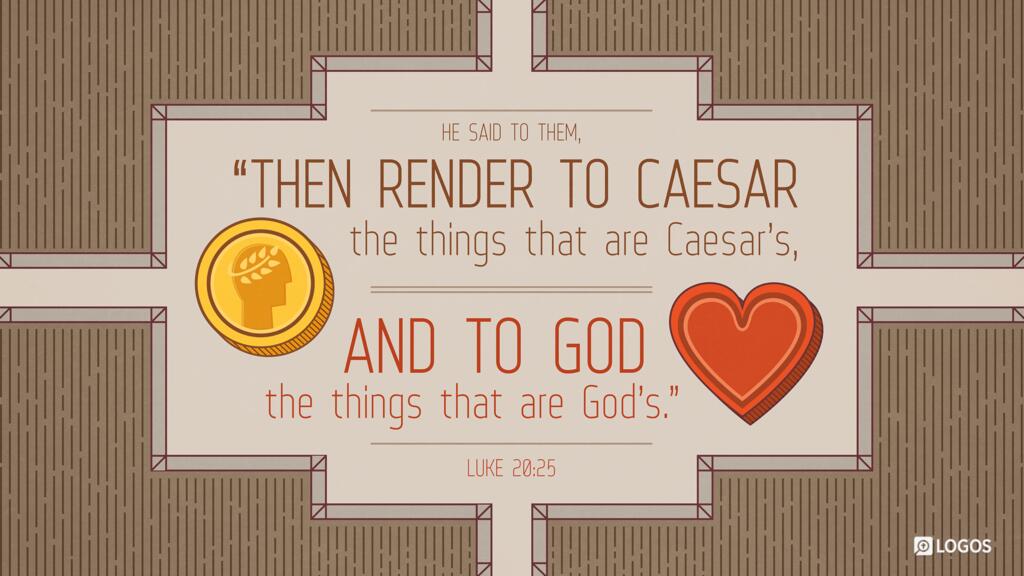
20:22Is it right53 for us to pay the tribute tax54 to Caesar55 or not?” 20:23But Jesus56 perceived their deceit57 and said to them, 20:24“Show me a denarius.58 Whose image59 and inscription are on it?”60 They said, “Caesar’s.” 20:25So61 he said to them, “Then give to Caesar the things that are Caesar’s, and to God the things that are God’s.”62
Footnotes
- 53 Or “lawful,” that is, in accordance with God’s divine law. On the syntax of ἔξεστιν (exestin) with an infinitive and accusative, see §409.3.
- 54 This was a “poll tax.” L&N 57.182 states this was “a payment made by the people of one nation to another, with the implication that this is a symbol of submission and dependence—‘tribute tax.’ ”
- 55 Or “to the emperor” (“Caesar” is a title for the Roman emperor).
- 56 Grk “he”; the referent (Jesus) has been specified in the translation for clarity.
- 57 Or “craftiness.” The term always has negative connotations in the NT (1 Cor 3:19; 2 Cor 4:2; 11:3; Eph 4:14).
- 58 Here the specific name of the coin was retained in the translation, because not all coins in circulation in Palestine at the time carried the image of Caesar. In other places δηνάριον (dēnarion) has been translated simply as “silver coin” with an explanatory note. A denarius was a silver coin worth approximately one day’s wage for a laborer. The fact that the leaders had such a coin showed that they already operated in the economic world of Rome. The denarius would have had a picture of Tiberius Caesar, the Roman emperor, on it.
- 59 Or “whose likeness.” In this passage Jesus points to the image (Grk εἰκών, eikōn) of Caesar on the coin. This same Greek word is used in Gen 1:26 () to state that humanity is made in the “image” of God. Jesus is making a subtle yet powerful contrast: Caesar’s image is on the denarius, so he can lay claim to money through taxation, but God’s image is on humanity, so he can lay claim to each individual life.
- 60 Grk “whose likeness and inscription does it have?”
- 61 Here δέ (de) has been translated as “so” to indicate that Jesus’ pronouncement results from the opponents’ answer to his question.
- 62 Jesus’ answer to give to Caesar the things that are Caesar’s and to God the things that are God’s was a both/and, not the questioners’ either/or. So he slipped out of their trap.
The NET Bible First Edition, Copyright 1996-2005 by Biblical Studies Press
In other versions
ESVEnglish Standard Version
Is it lawful for us to give tribute to Caesar, or not?” But he perceived their craftiness, and said to them, “Show me a denarius. Whose likeness and inscription does it have?” They said, “Caesar’s.” He said to them, “Then render to Caesar the things that are Caesar’s, and to God the things that are God’s.”
Copyright 2001 Crossway Bibles
NIVNew International Version (2011)
Is it right for us to pay taxes to Caesar or not?”
He saw through their duplicity and said to them, “Show me a denarius. Whose image and inscription are on it?”
“Caesar’s,” they replied.
He said to them, “Then give back to Caesar what is Caesar’s, and to God what is God’s.”
Copyright 1973, 1978, 1984, 2011 Biblica, Inc.
CSBChristian Standard Bible
Is it lawful for us to pay taxes to Caesar or not?”
But detecting their craftiness, he said to them, “Show me a denarius. Whose image and inscription does it have?”
“Caesar’s,” they said.
“Well then,” he told them, “give to Caesar the things that are Caesar’s, and to God the things that are God’s.”
Copyright 2017 Holman Bible Publishers
NLTNew Living Translation
Now tell us—is it right for us to pay taxes to Caesar or not?”
He saw through their trickery and said, “Show me a Roman coin. Whose picture and title are stamped on it?”
“Caesar’s,” they replied.
“Well then,” he said, “give to Caesar what belongs to Caesar, and give to God what belongs to God.”
Holy Bible, New Living Translation, copyright © 1996, 2004, 2015 by Tyndale House Foundation. Used by permission of Tyndale House Publishers. All rights reserved.
LEBThe Lexham English Bible
Is it permitted for us to pay taxes to Caesar or not?” But seeing through their craftiness, he said to them, “Show me a denarius! Whose image and inscription does it have?” And they answered and said, “Caesar’s.” So he said to them, “Well then, give to Caesar the things of Caesar, and to God the things of God!”
Copyright 2012 Lexham Press
KJV 1900King James Version
Is it lawful for us to give tribute unto Caesar, or no? But he perceived their craftiness, and said unto them, Why tempt ye me? Shew me a penny. Whose image and superscription hath it? They answered and said, Caesar’s. And he said unto them, Render therefore unto Caesar the things which be Caesar’s, and unto God the things which be God’s.
Public Domain