Luke 2:4–7
The NET BibleOther versions
English
- NET The NET Bible
- DARBY 1890 Darby Bible
- ASV American Standard Version
- AV 1873 The Cambridge Paragraph Bible of the Authorized English Version
- CSB Christian Standard Bible
- D-R Douay-Rheims Bible
- ESV English Standard Version
- GW GOD’S WORD Translation
- GNB Good News Translation
- HCSB The Holman Christian Standard Bible
- KJV 1900 King James Version
- LSB Legacy Standard Bible
- LEB The Lexham English Bible
- MSG The Message: The Bible in Contemporary Language
- NASB95 New American Standard Bible (1995)
- NCV New Century Version
- NIrV New International Reader’s Version (1998)
- NIV New International Version (2011)
- NKJV The New King James Version
- NLT New Living Translation
- NRSVue New Revised Standard Version: Updated Edition
- RSV The Revised Standard Version
- RSVCE The Revised Standard Version, Catholic Edition
- TNIV Today’s New International Version
- YLT Young’s Literal Translation
Arabic
Czech
French
German
Greek
Hungarian
Italian
Korean
Latin
Portuguese
Russian
Simplified Chinese
Spanish
Traditional Chinese
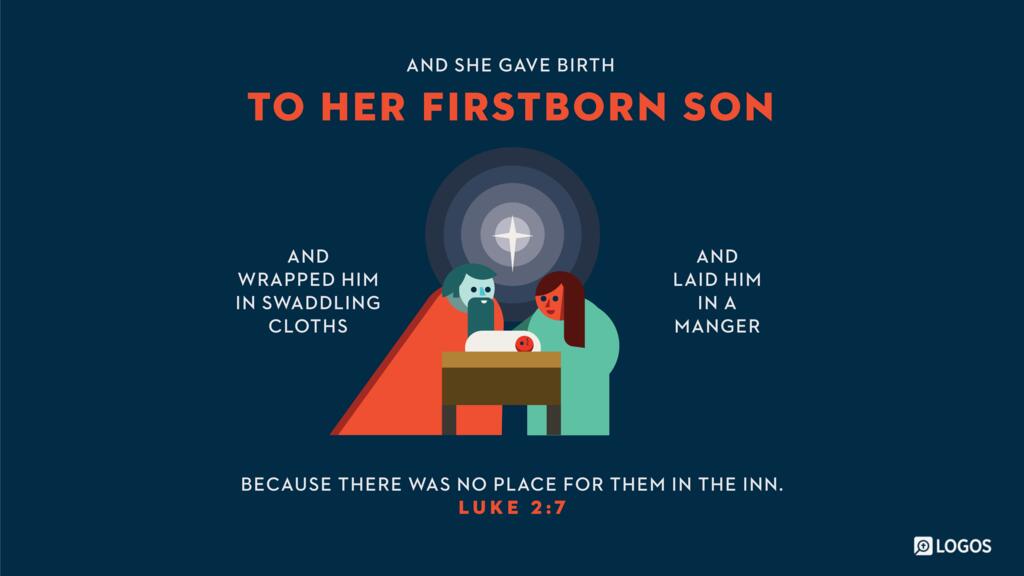
2:4So10 Joseph also went up from the town of Nazareth11 in Galilee to Judea, to the city12 of David called Bethlehem,13 because he was of the house14 and family line15 of David. 2:5He went16 to be registered with Mary, who was promised in marriage to him,17 and who was expecting a child. 2:6While18 they were there, the time came for her to deliver her child.192:7And she gave birth to her firstborn son and wrapped him in strips of cloth20 and laid him in a manger,21 because there was no place for them in the inn.22
Footnotes
- 10 Here καί (kai) has been translated as “so” to indicate the consequential nature of the action.
- 11 On Nazareth see Luke 1:26. For location see ; ; ; ; .
- 12 Or “town.” The translation “city” is used here because of its collocation with “of David,” suggesting its importance, though not its size.
- 13 The journey from Nazareth to the city of David called Bethlehem was a journey of about 90 mi (150 km). Bethlehem was a small village located about 7 miles south-southwest of Jerusalem. For location see ; ; ; .
- 14 Luke’s use of the term “house” probably alludes to the original promise made to David outlined in the Nathan oracle of 2 Sam 7:12–16, especially in light of earlier connections between Jesus and David made in Luke 1:32. Further, the mention of Bethlehem reminds one of the promise of Mic 5:2, namely, that a great king would emerge from Bethlehem to rule over God’s people.
- 15 Or “family,” “lineage.”
- 16 The words “He went” are not in the Greek text, but have been supplied to begin a new sentence in the translation. The Greek sentence is longer and more complex than normal contemporary English usage.
- 17 Traditionally, “Mary, his betrothed.” Although often rendered in contemporary English as “Mary, who was engaged to him,” this may give the modern reader a wrong impression, since Jewish marriages in this period were typically arranged marriages. The term ἐμνηστευμένῃ (emnēsteumenē) may suggest that the marriage is not yet consummated, not necessarily that they are not currently married. Some read “the betrothed to him wife”; others, simply “his wife.” These readings, though probably not original, may give the right sense.
- 18 Grk “And it happened that while.” The introductory phrase ἐγένετο (egeneto, “it happened that”), common in Luke (69 times) and Acts (54 times), is redundant in contemporary English and has not been translated. Here καί (kai) has not been translated because of differences between Greek and English style.
- 19 The words “her child” are not in the Greek text, but have been supplied to clarify what was being delivered. The wording here is like Luke 1:57. Grk “the days for her to give birth were fulfilled.”
- 20 The strips of cloth (traditionally, “swaddling cloths”) were strips of linen that would be wrapped around the arms and legs of an infant to keep the limbs protected.
- 21 Or “a feeding trough.”
- 22 The Greek word κατάλυμα is flexible, and usage in the and NT refers to a variety of places for lodging (see ). Most likely Joseph and Mary sought lodging in the public accommodations in the city of Bethlehem (see J. Nolland, Luke [], 1:), which would have been crude shelters for people and animals. However, it has been suggested by various scholars that Joseph and Mary were staying with relatives in Bethlehem (e.g., C. S. Keener, The IVP Bible Background Commentary: New Testament, 194; B. Witherington, “Birth of Jesus,” , ); if that were so the term would refer to the guest room in the relatives’ house, which would have been filled beyond capacity with all the other relatives who had to journey to Bethlehem for the census. There was no place for them in the inn. There is no drama in how this is told. There is no search for a variety of places to stay or a heartless innkeeper. (Such items are later, nonbiblical embellishments.) Bethlehem was not large and there was simply no other place to stay. The humble surroundings of the birth are ironic in view of the birth’s significance.
The NET Bible First Edition, Copyright 1996-2005 by Biblical Studies Press
In other versions
ESVEnglish Standard Version
And Joseph also went up from Galilee, from the town of Nazareth, to Judea, to the city of David, which is called Bethlehem, because he was of the house and lineage of David, to be registered with Mary, his betrothed, who was with child. And while they were there, the time came for her to give birth. And she gave birth to her firstborn son and wrapped him in swaddling cloths and laid him in a manger, because there was no place for them in the inn.
Copyright 2001 Crossway Bibles
NIVNew International Version (2011)
So Joseph also went up from the town of Nazareth in Galilee to Judea, to Bethlehem the town of David, because he belonged to the house and line of David. He went there to register with Mary, who was pledged to be married to him and was expecting a child. While they were there, the time came for the baby to be born, and she gave birth to her firstborn, a son. She wrapped him in cloths and placed him in a manger, because there was no guest room available for them.
Copyright 1973, 1978, 1984, 2011 Biblica, Inc.
CSBChristian Standard Bible
Joseph also went up from the town of Nazareth in Galilee, to Judea, to the city of David, which is called Bethlehem, because he was of the house and family line of David, to be registered along with Mary, who was engaged to him and was pregnant. While they were there, the time came for her to give birth. Then she gave birth to her firstborn son, and she wrapped him tightly in cloth and laid him in a manger, because there was no guest room available for them.
Copyright 2017 Holman Bible Publishers
NLTNew Living Translation
And because Joseph was a descendant of King David, he had to go to Bethlehem in Judea, David’s ancient home. He traveled there from the village of Nazareth in Galilee. He took with him Mary, to whom he was engaged, who was now expecting a child.
And while they were there, the time came for her baby to be born. She gave birth to her firstborn son. She wrapped him snugly in strips of cloth and laid him in a manger, because there was no lodging available for them.
Holy Bible, New Living Translation, copyright © 1996, 2004, 2015 by Tyndale House Foundation. Used by permission of Tyndale House Publishers. All rights reserved.
LEBThe Lexham English Bible
So Joseph also went up from Galilee, from the town of Nazareth, to Judea, to the city of David which is called Bethlehem, because he was of the house and family line of David, to be registered together with Mary, who was legally promised in marriage to him and was pregnant. And it happened that while they were there, the time came for her to give birth. And she gave birth to her firstborn son, and wrapped him in strips of cloth and laid him in a manger, because there was no place for them in the inn.
Copyright 2012 Lexham Press
KJV 1900King James Version
And Joseph also went up from Galilee, out of the city of Nazareth, into Judaea, unto the city of David, which is called Beth-lehem; (because he was of the house and lineage of David:) To be taxed with Mary his espoused wife, being great with child. And so it was, that, while they were there, the days were accomplished that she should be delivered. And she brought forth her firstborn son, and wrapped him in swaddling clothes, and laid him in a manger; because there was no room for them in the inn.
Public Domain