Judges 6:11–18
The NET BibleOther versions
English
- NET The NET Bible
- DARBY 1890 Darby Bible
- ASV American Standard Version
- AV 1873 The Cambridge Paragraph Bible of the Authorized English Version
- CSB Christian Standard Bible
- D-R Douay-Rheims Bible
- ESV English Standard Version
- GW GOD’S WORD Translation
- GNB Good News Translation
- HCSB The Holman Christian Standard Bible
- KJV 1900 King James Version
- LSB Legacy Standard Bible
- LEB The Lexham English Bible
- MSG The Message: The Bible in Contemporary Language
- NASB95 New American Standard Bible (1995)
- NCV New Century Version
- NIrV New International Reader’s Version (1998)
- NIV New International Version (2011)
- NKJV The New King James Version
- NLT New Living Translation
- NRSVue New Revised Standard Version: Updated Edition
- RSV The Revised Standard Version
- RSVCE The Revised Standard Version, Catholic Edition
- TNIV Today’s New International Version
- YLT Young’s Literal Translation
Arabic
Czech
French
German
Hebrew
Hungarian
Italian
Korean
Latin
Portuguese
Russian
Simplified Chinese
Spanish
Traditional Chinese
Gideon Meets Some Visitors
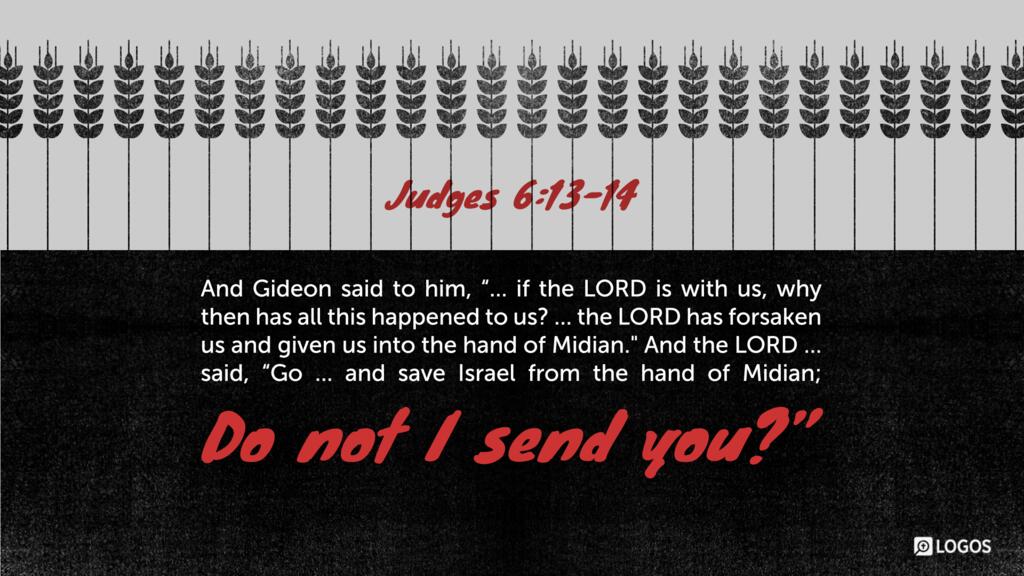
6:11The Lord’s angelic messenger24 came and sat down under the oak tree in Ophrah owned by Joash the Abiezrite. He arrived while Joash’s son Gideon25 was threshing26 wheat in a winepress27 so he could hide it from the Midianites.286:12The Lord’s messenger appeared and said to him, “The Lord is with you, courageous warrior!” 6:13Gideon said to him, “Pardon me,29 but if the Lord is with us, why has such disaster30 overtaken us? Where are all his miraculous deeds our ancestors told us about? They said,31 ‘Did the Lord not bring us up from Egypt?’ But now the Lord has abandoned us and handed us over to Midian.” 6:14Then the Lord himself32 turned to him and said, “You have the strength.33 Deliver Israel from the power of the Midianites!34 Have I not sent you?” 6:15Gideon35 said to him, “But Lord,36 how37 can I deliver Israel? Just look! My clan is the weakest in Manasseh, and I am the youngest in my family.”386:16The Lord said to him, “Ah, but39 I will be with you! You will strike down the whole Midianite army.”406:17Gideon41 said to him, “If you really are pleased with me,42 then give me43 a sign as proof that it is really you speaking with me. 6:18Do not leave this place until I come back44 with a gift45 and present it to you.” The Lord said, “I will stay here until you come back.”
Footnotes
- 24 The adjective “angelic” is interpretive. The Lord’s angelic messenger is also mentioned in Judg 2:1.
- 25 Heb “Now Gideon his son …” The Hebrew circumstantial clause (note the pattern vav [ו] + subject + predicate) breaks the narrative sequence and indicates that the angel’s arrival coincided with Gideon’s threshing.
- 26 Heb “beating out.”
- 27 Threshing wheat in a winepress. One would normally thresh wheat at the threshing floor outside the city. Animals and a threshing sledge would be employed. Because of the Midianite threat, Gideon was forced to thresh with a stick in a winepress inside the city. For further discussion see O. Borowski, Agriculture in Iron Age Israel, 63.
- 28 Heb “Midian.”
- 29 Heb “But my lord.”
- 30 Heb “all this.”
- 31 Heb “saying.”
- 32 Some interpreters equate the Lord and the messenger in this story, but they are more likely distinct. In vv. 22–23 the Lord and Gideon continue to carry on a conversation after the messenger has vanished (v. 21).
- 33 Heb “Go in this strength of yours.”
- 34 Heb “the hand of Midian.”
- 35 Heb “he”; the referent (Gideon) has been specified in the translation for clarity.
- 36 Note the switch to אֲדֹנָי (’adonay, “Lord”). Gideon seems aware that he is speaking to someone other than, and superior to, the messenger, whom he addressed as אֲדֹנִי (’adoniy, “my lord”) in v. 13.
- 37 Heb “with what.”
- 38 Heb “in my father’s house.”
- 39 Or “certainly.”
- 40 Heb “You will strike down Midian as one man.” The idiom “as one man” emphasizes the collective unity of a group (see Judg 20:8, 11). Here it may carry the force, “as if they were just one man.”
- 41 Heb “he”; the referent (Gideon) has been specified in the translation for clarity.
- 42 Heb “If I have found favor in your eyes.”
- 43 Heb “perform for me.”
- 44 The Hebrew text adds “to you,” but this has not been included in the translation for stylistic reasons.
- 45 Heb “and I will bring out my gift.” The precise nuance of the Hebrew word מִנְחָה (minkhah, “gift”) is uncertain in this context. It may refer to a gift offered as a sign of goodwill or submission. In some cases it is used of a gift offered to appease someone whom the offerer has offended. The word can also carry a sacrificial connotation.
The NET Bible First Edition, Copyright 1996-2005 by Biblical Studies Press