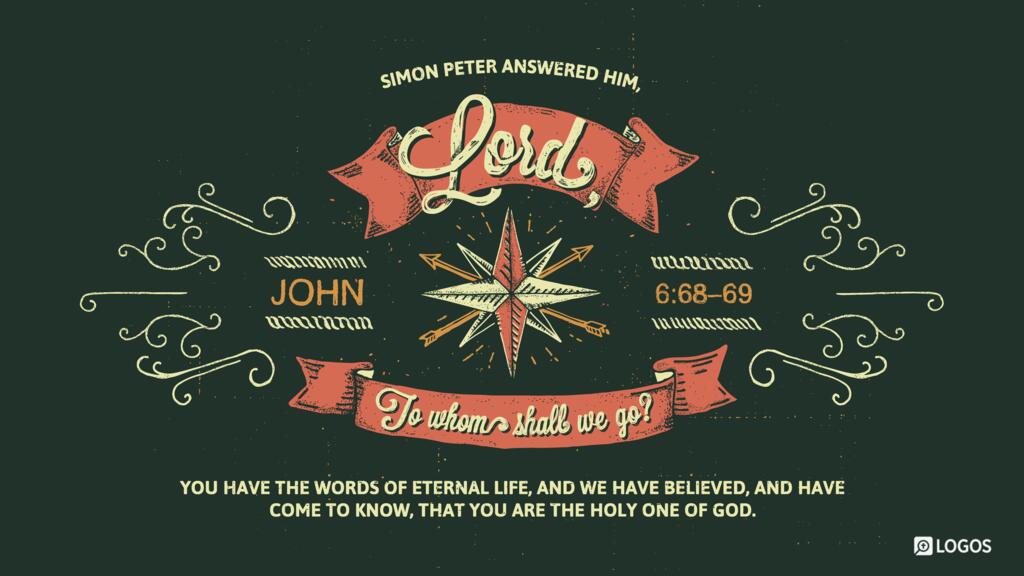
John 6:69
The NET BibleOther versions
English
- NET The NET Bible
- DARBY 1890 Darby Bible
- ASV American Standard Version
- AV 1873 The Cambridge Paragraph Bible of the Authorized English Version
- CSB Christian Standard Bible
- D-R Douay-Rheims Bible
- ESV English Standard Version
- GW GOD’S WORD Translation
- GNB Good News Translation
- HCSB The Holman Christian Standard Bible
- KJV 1900 King James Version
- LSB Legacy Standard Bible
- LEB The Lexham English Bible
- MSG The Message: The Bible in Contemporary Language
- NASB95 New American Standard Bible (1995)
- NCV New Century Version
- NIrV New International Reader’s Version (1998)
- NIV New International Version (2011)
- NKJV The New King James Version
- NLT New Living Translation
- NRSVue New Revised Standard Version: Updated Edition
- RSV The Revised Standard Version
- RSVCE The Revised Standard Version, Catholic Edition
- TNIV Today’s New International Version
- YLT Young’s Literal Translation
Arabic
Czech
French
German
Greek
Hungarian
Italian
Korean
Latin
Portuguese
Russian
Simplified Chinese
Spanish
Traditional Chinese
Footnotes
- 115 Grk “And we.”
- 117 The witnesses display a bewildering array of variants here. Instead of “the Holy One of God” (ὁ ἅγιος τοῦ θεοῦ, ho hagios tou theou), Tertullian has ὁ Χριστός (ho Christos, “the Christ”); C3 Θ* f1 33 565 lat read ὁ Χριστὸς ὁ υἱὸς τοῦ θεοῦ (ho Christos ho huios tou theou, “the Christ, the Son of God”); two versional witnesses (b syc) have ὁ υἱὸς τοῦ θεοῦ (“the Son of God”); the Byzantine text as well as many others (Ψ 0250 f13 33 𝔐) read ὁ Χριστὸς ὁ υἱὸς τοῦ θεοῦ τοῦ ζῶντος (ho Christos ho huios tou theou tou zōntos, “the Christ, the Son of the living God”); and 𝔓66 as well as a few versions have ὁ Χριστὸς ὁ ἅγιος τοῦ θεοῦ (“the Christ, the Holy One of God”). The reading ὁ ἅγιος τοῦ θεοῦ is, however, well supported by 𝔓75 א B C* D L W as well as versional witnesses. It appears that Peter’s confession in the Synoptic Gospels (especially Matt 16:16) supplied the motivation for the variations. Although the witnesses in Matt 16:16; Mark 8:29; and Luke 9:20 vary considerably, the readings are all intra-synoptic, that is, they do not pull in “the Holy One of God” but reflect various permutations of “Christ“/“Christ of God“/“Christ, the Son of God“/“Christ, the Son of the living God.” The wording “the Holy One of God” (without “Christ”) in important witnesses here is thus unique among Peter’s confessions, and best explains the rise of the other readings. You have the words of eternal life … you are the Holy One of God! In contrast to the response of some of his disciples, here is the response of the twelve, whom Jesus then questioned concerning their loyalty to him. This was the big test, and the twelve, with Peter as spokesman, passed with flying colors. The confession here differs considerably from the synoptic accounts (Matt 16:16, Mark 8:29, and Luke 9:20) and concerns directly the disciples’ personal loyalty to Jesus, in contrast to those other disciples who had deserted him (John 6:66).
Cross references
- 116 See 1 John 4:16.
The NET Bible First Edition, Copyright 1996-2005 by Biblical Studies Press
In other versions
ESVEnglish Standard Version
and we have believed, and have come to know, that you are the Holy One of God.”
Copyright 2001 Crossway Bibles
NIVNew International Version (2011)
We have come to believe and to know that you are the Holy One of God.”
Copyright 1973, 1978, 1984, 2011 Biblica, Inc.
CSBChristian Standard Bible
We have come to believe and know that you are the Holy One of God.”
Copyright 2017 Holman Bible Publishers
NLTNew Living Translation
We believe, and we know you are the Holy One of God.”
Holy Bible, New Living Translation, copyright © 1996, 2004, 2015 by Tyndale House Foundation. Used by permission of Tyndale House Publishers. All rights reserved.
LEBThe Lexham English Bible
And we have believed, and have come to know, that you are the Holy One of God.”
Copyright 2012 Lexham Press
KJV 1900King James Version
And we believe and are sure that thou art that Christ, the Son of the living God.
Public Domain