John 10:11–18
The NET BibleOther versions
English
- NET The NET Bible
- DARBY 1890 Darby Bible
- ASV American Standard Version
- AV 1873 The Cambridge Paragraph Bible of the Authorized English Version
- CSB Christian Standard Bible
- D-R Douay-Rheims Bible
- ESV English Standard Version
- GW GOD’S WORD Translation
- GNB Good News Translation
- HCSB The Holman Christian Standard Bible
- KJV 1900 King James Version
- LSB Legacy Standard Bible
- LEB The Lexham English Bible
- MSG The Message: The Bible in Contemporary Language
- NASB95 New American Standard Bible (1995)
- NCV New Century Version
- NIrV New International Reader’s Version (1998)
- NIV New International Version (2011)
- NKJV The New King James Version
- NLT New Living Translation
- NRSVue New Revised Standard Version: Updated Edition
- RSV The Revised Standard Version
- RSVCE The Revised Standard Version, Catholic Edition
- TNIV Today’s New International Version
- YLT Young’s Literal Translation
Arabic
Czech
French
German
Greek
Hungarian
Italian
Korean
Latin
Portuguese
Russian
Simplified Chinese
Spanish
Traditional Chinese
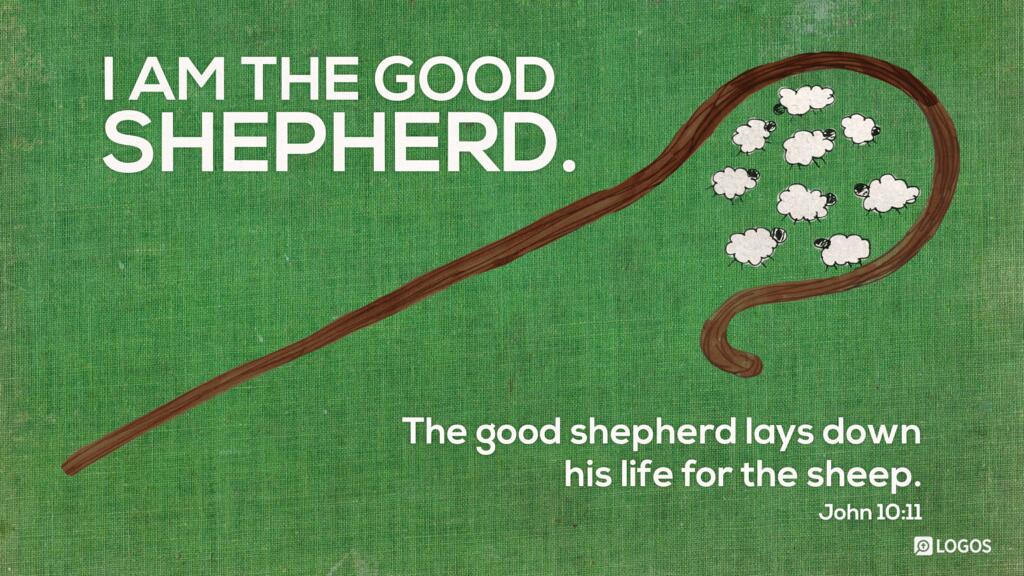
10:11“I am the good25 shepherd. The good shepherd lays down his life26 for the sheep. 10:12The hired hand,27 who is not a shepherd and does not own sheep, sees the wolf coming and abandons28 the sheep and runs away.29 So the wolf attacks30 the sheep and scatters them. 10:13Because he is a hired hand and is not concerned about the sheep,31 he runs away.32
10:14“I am the good shepherd. I33 know my own34 and my own know me—10:15just as the Father knows me and I know the Father—and I lay down my life35 for36 the sheep. 10:16I have37 other sheep that do not come from38 this sheepfold.39 I must bring them too, and they will listen to my voice,40 so that41 there will be one flock and42 one shepherd. 10:17This is why the Father loves me43—because I lay down my life,44 so that I may take it back again. 10:18No one takes it away from me, but I lay it down45 of my own free will.46 I have the authority47 to lay it down, and I have the authority48 to take it back again. This commandment49 I received from my Father.”
Footnotes
- 25 Or “model” (see R. E. Brown, John [], 1:, who argues that “model” is a more exact translation of καλός [kalos] here).
- 26 Or “The good shepherd dies willingly.” Jesus speaks openly of his vicarious death twice in this section (John 10:11, 15). Note the contrast: The thief takes the life of the sheep (10:10), the good shepherd lays down his own life for the sheep. Jesus is not speaking generally here, but specifically: He has his own substitutionary death on the cross in view. For a literal shepherd with a literal flock, the shepherd’s death would have spelled disaster for the sheep; in this instance it spells life for them (Compare the worthless shepherd of Zech 11:17, by contrast).
- 27 Jesus contrasts the behavior of the shepherd with that of the hired hand. This is a worker who is simply paid to do a job; he has no other interest in the sheep and is certainly not about to risk his life for them. When they are threatened, he simply runs away.
- 28 Grk “leaves.”
- 29 Or “flees.”
- 30 Or “seizes.” The more traditional rendering, “snatches,” has the idea of seizing something by force and carrying it off, which is certainly possible here. However, in the sequence in John 10:12, this action precedes the scattering of the flock of sheep, so “attacks” is preferable.
- 31 Grk “does not have a care for the sheep.”
- 32 The phrase “he runs away” is lacking in several important (𝔓44vid,45, 66, 75 א A*vid B D L [W] Θ 1 33 1241 co). Most likely it was added by a later scribe to improve the readability of vv. 12–13, which is one long sentence in Greek. It has been included in the translation for the same stylistic reasons.
- 33 Grk “And I.” Because of the difference between Greek style, which often begins sentences or clauses with “and,” and English style, which generally does not, καί (kai) has not been translated here.
- 34 The direct object is frequently omitted in Greek and must be supplied from the context. Here it could be “sheep,” but Jesus was ultimately talking about “people.”
- 35 Or “I die willingly.”
- 36 Or “on behalf of” or “for the sake of.”
- 37 Grk “And I have.” Because of the difference between Greek style, which often begins sentences or clauses with “and,” and English style, which generally does not, καί (kai) has not been translated here.
- 38 Or “that do not belong to”; Grk “that are not of.”
- 39 The statement I have other sheep that do not come from this sheepfold almost certainly refers to Gentiles. Jesus has sheep in the fold who are Jewish; there are other sheep which, while not of the same fold, belong to him also. This recalls the mission of the Son in 3:16–17, which was to save the world—not just the nation of Israel. Such an emphasis would be particularly appropriate to the author if he were writing to a non-Palestinian and primarily non-Jewish audience.
- 40 Grk “they will hear my voice.”
- 41 Grk “voice, and.”
- 42 The word “and” is not in the Greek text, but must be supplied to conform to English style. In Greek it is an instance of asyndeton (omission of a connective), usually somewhat emphatic.
- 43 Grk “Because of this the Father loves me.”
- 44 Or “die willingly.”
- 45 Or “give it up.”
- 46 Or “of my own accord.” “Of my own free will” is given by ἐμαυτοῦ c.
- 47 Or “I have the right.”
- 48 Or “I have the right.”
- 49 Or “order.”
The NET Bible First Edition, Copyright 1996-2005 by Biblical Studies Press
In other versions
ESVEnglish Standard Version
I am the good shepherd. The good shepherd lays down his life for the sheep. He who is a hired hand and not a shepherd, who does not own the sheep, sees the wolf coming and leaves the sheep and flees, and the wolf snatches them and scatters them. He flees because he is a hired hand and cares nothing for the sheep. I am the good shepherd. I know my own and my own know me, just as the Father knows me and I know the Father; and I lay down my life for the sheep. And I have other sheep that are not of this fold. I must bring them also, and they will listen to my voice. So there will be one flock, one shepherd. For this reason the Father loves me, because I lay down my life that I may take it up again. No one takes it from me, but I lay it down of my own accord. I have authority to lay it down, and I have authority to take it up again. This charge I have received from my Father.”
Copyright 2001 Crossway Bibles
NIVNew International Version (2011)
“I am the good shepherd. The good shepherd lays down his life for the sheep. The hired hand is not the shepherd and does not own the sheep. So when he sees the wolf coming, he abandons the sheep and runs away. Then the wolf attacks the flock and scatters it. The man runs away because he is a hired hand and cares nothing for the sheep.
“I am the good shepherd; I know my sheep and my sheep know me—just as the Father knows me and I know the Father—and I lay down my life for the sheep. I have other sheep that are not of this sheep pen. I must bring them also. They too will listen to my voice, and there shall be one flock and one shepherd. The reason my Father loves me is that I lay down my life—only to take it up again. No one takes it from me, but I lay it down of my own accord. I have authority to lay it down and authority to take it up again. This command I received from my Father.”
Copyright 1973, 1978, 1984, 2011 Biblica, Inc.
CSBChristian Standard Bible
“I am the good shepherd. The good shepherd lays down his life for the sheep. The hired hand, since he is not the shepherd and doesn’t own the sheep, leaves them and runs away when he sees a wolf coming. The wolf then snatches and scatters them. This happens because he is a hired hand and doesn’t care about the sheep.
“I am the good shepherd. I know my own, and my own know me, just as the Father knows me, and I know the Father. I lay down my life for the sheep. But I have other sheep that are not from this sheep pen; I must bring them also, and they will listen to my voice. Then there will be one flock, one shepherd. This is why the Father loves me, because I lay down my life so that I may take it up again. No one takes it from me, but I lay it down on my own. I have the right to lay it down, and I have the right to take it up again. I have received this command from my Father.”
Copyright 2017 Holman Bible Publishers
NLTNew Living Translation
“I am the good shepherd. The good shepherd sacrifices his life for the sheep. A hired hand will run when he sees a wolf coming. He will abandon the sheep because they don’t belong to him and he isn’t their shepherd. And so the wolf attacks them and scatters the flock. The hired hand runs away because he’s working only for the money and doesn’t really care about the sheep.
“I am the good shepherd; I know my own sheep, and they know me, just as my Father knows me and I know the Father. So I sacrifice my life for the sheep. I have other sheep, too, that are not in this sheepfold. I must bring them also. They will listen to my voice, and there will be one flock with one shepherd.
“The Father loves me because I sacrifice my life so I may take it back again. No one can take my life from me. I sacrifice it voluntarily. For I have the authority to lay it down when I want to and also to take it up again. For this is what my Father has commanded.”
Holy Bible, New Living Translation, copyright © 1996, 2004, 2015 by Tyndale House Foundation. Used by permission of Tyndale House Publishers. All rights reserved.
LEBThe Lexham English Bible
“I am the good shepherd. The good shepherd lays down his life for the sheep. The hired hand, who is not the shepherd, whose own the sheep are not, sees the wolf approaching and abandons the sheep and runs away—and the wolf seizes them and scatters them—because he is a hired hand and he is not concerned about the sheep.
“I am the good shepherd, and I know my own, and my own know me, just as the Father knows me and I know the Father, and I lay down my life for the sheep. And I have other sheep which are not from this fold. I must bring these also, and they will hear my voice, and they will become one flock—one shepherd. Because of this the Father loves me, because I lay down my life so that I may take possession of it again. No one takes it from me, but I lay it down voluntarily. I have authority to lay it down, and I have authority to take possession of it again. This commandment I received from my Father.”
Copyright 2012 Lexham Press
KJV 1900King James Version
I am the good shepherd: the good shepherd giveth his life for the sheep. But he that is an hireling, and not the shepherd, whose own the sheep are not, seeth the wolf coming, and leaveth the sheep, and fleeth: and the wolf catcheth them, and scattereth the sheep. The hireling fleeth, because he is an hireling, and careth not for the sheep. I am the good shepherd, and know my sheep, and am known of mine. As the Father knoweth me, even so know I the Father: and I lay down my life for the sheep. And other sheep I have, which are not of this fold: them also I must bring, and they shall hear my voice; and there shall be one fold, and one shepherd. Therefore doth my Father love me, because I lay down my life, that I might take it again. No man taketh it from me, but I lay it down of myself. I have power to lay it down, and I have power to take it again. This commandment have I received of my Father.
Public Domain