John 10:1–30
The NET BibleOther versions
English
- NET The NET Bible
- DARBY 1890 Darby Bible
- ASV American Standard Version
- AV 1873 The Cambridge Paragraph Bible of the Authorized English Version
- CSB Christian Standard Bible
- D-R Douay-Rheims Bible
- ESV English Standard Version
- GW GOD’S WORD Translation
- GNB Good News Translation
- HCSB The Holman Christian Standard Bible
- KJV 1900 King James Version
- LSB Legacy Standard Bible
- LEB The Lexham English Bible
- MSG The Message: The Bible in Contemporary Language
- NASB95 New American Standard Bible (1995)
- NCV New Century Version
- NIrV New International Reader’s Version (1998)
- NIV New International Version (2011)
- NKJV The New King James Version
- NLT New Living Translation
- NRSVue New Revised Standard Version: Updated Edition
- RSV The Revised Standard Version
- RSVCE The Revised Standard Version, Catholic Edition
- TNIV Today’s New International Version
- YLT Young’s Literal Translation
Arabic
Czech
French
German
Greek
Hungarian
Italian
Korean
Latin
Portuguese
Russian
Simplified Chinese
Spanish
Traditional Chinese
Jesus as the Good Shepherd
10:1“I tell you the solemn truth,1 the one who does not enter the sheepfold2 by the door,3 but climbs in some other way, is a thief and a robber. 10:2The one who enters by the door is the shepherd of the sheep. 10:3The doorkeeper4 opens the door5 for him,6 and the sheep hear his voice. He7 calls his own sheep by name and leads them out.810:4When he has brought all his own sheep9 out, he goes ahead of them, and the sheep follow him because they recognize10 his voice. 10:5They will never follow a stranger,11 but will run away from him, because they do not recognize12 the stranger’s voice.”1310:6Jesus told them this parable,14 but they15 did not understand16 what he was saying to them.
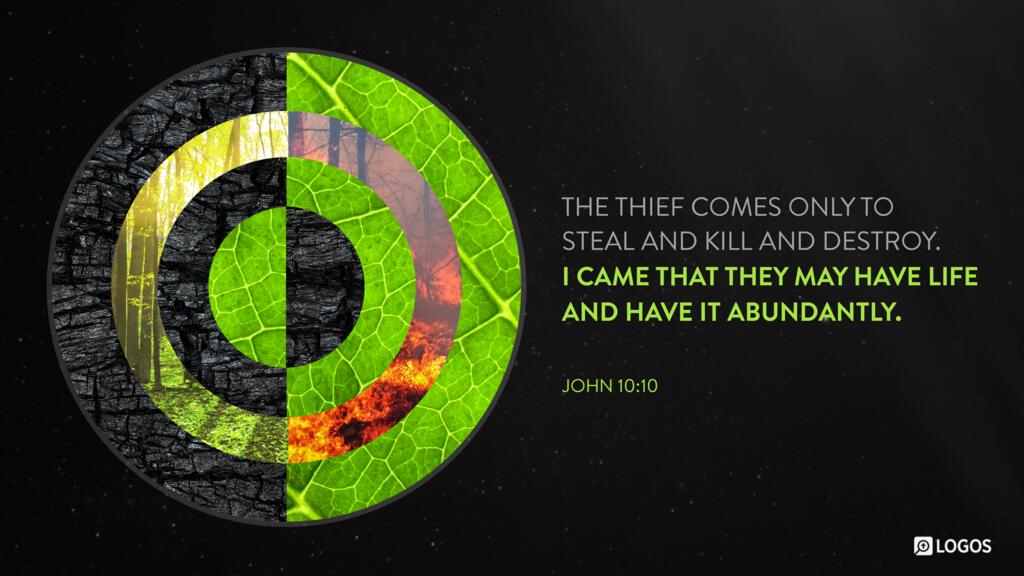
10:7So Jesus said to them again, “I tell you the solemn truth,17 I am the door for the sheep.1810:8All who came before me were19 thieves and robbers, but the sheep did not listen to them.2010:9I am the door. If anyone enters through me, he will be saved, and will come in and go out,21 and find pasture.2210:10The thief comes only to steal and kill23 and destroy; I have come so that they may have life, and may have it abundantly.24
10:11“I am the good25 shepherd. The good shepherd lays down his life26 for the sheep. 10:12The hired hand,27 who is not a shepherd and does not own sheep, sees the wolf coming and abandons28 the sheep and runs away.29 So the wolf attacks30 the sheep and scatters them. 10:13Because he is a hired hand and is not concerned about the sheep,31 he runs away.32
10:14“I am the good shepherd. I33 know my own34 and my own know me—10:15just as the Father knows me and I know the Father—and I lay down my life35 for36 the sheep. 10:16I have37 other sheep that do not come from38 this sheepfold.39 I must bring them too, and they will listen to my voice,40 so that41 there will be one flock and42 one shepherd. 10:17This is why the Father loves me43—because I lay down my life,44 so that I may take it back again. 10:18No one takes it away from me, but I lay it down45 of my own free will.46 I have the authority47 to lay it down, and I have the authority48 to take it back again. This commandment49 I received from my Father.”
10:19Another sharp division took place among the Jewish people50 because of these words. 10:20Many of them were saying, “He is possessed by a demon and has lost his mind!51 Why do you listen to him?” 10:21Others said, “These are not the words52 of someone possessed by a demon. A demon cannot cause the blind to see,53 can it?”54
Jesus at the Feast of Dedication
10:22Then came the feast of the Dedication55 in Jerusalem.5610:23It was winter,57 and Jesus was walking in the temple area58 in Solomon’s Portico.5910:24The Jewish leaders60 surrounded him and asked,61 “How long will you keep us in suspense?62 If you are the Christ,63 tell us plainly.”6410:25Jesus replied,65 “I told you and you do not believe. The deeds66 I do in my Father’s name testify about me. 10:26But you refuse to believe because you are not my sheep. 10:27My sheep listen to my voice, and I know them, and they follow me. 10:28I give67 them eternal life, and they will never perish;68 no one will snatch69 them from my hand. 10:29My Father, who has given them to me, is greater than all,70 and no one can snatch71 them from my Father’s hand. 10:30The Father and I72 are one.”73
Footnotes
- 1 Grk “Truly, truly, I say to you.”
- 2 There was more than one type of sheepfold in use in Palestine in Jesus’ day. The one here seems to be a courtyard in front of a house (the Greek word used for the sheepfold here, αὐλή [aulē] frequently refers to a courtyard), surrounded by a stone wall (often topped with briars for protection).
- 3 Or “entrance.”
- 4 Or “porter” (British English). There have been many attempts to identify who the doorkeeper represents, none of which are convincing. More likely there are some details in this parable that are included for the sake of the story, necessary as parts of the overall picture but without symbolic significance.
- 5 The words “the door” are not in the Greek text but are implied. Direct objects in Greek were often omitted when clear from the context.
- 6 Grk “For this one.”
- 7 Grk “And he.” Because of the difference between Greek style, which often begins sentences or clauses with “and,” and English style, which generally does not, καί (kai) has not been translated here.
- 8 He calls his own sheep by name and leads them out. Some interpreters have suggested that there was more than one flock in the fold, and there would be a process of separation where each shepherd called out his own flock. This may also be suggested by the mention of a doorkeeper in v. 3 since only the larger sheepfolds would have such a guard. But the Gospel of John never mentions a distinction among the sheep in this fold; in fact (10:16) there are other sheep which are to be brought in, but they are to be one flock and one shepherd.
- 9 The word “sheep” is not in the Greek text, but is implied.
- 10 Grk “because they know.”
- 11 Or “someone whom they do not know.”
- 12 Grk “know.”
- 13 Or “the voice of someone they do not know.”
- 14 A parable is a fairly short narrative that has symbolic meaning. The Greek word παροιμίαν (paroimian) is used again in 16:25, 29. This term does not occur in the synoptic gospels, where παραβολή (parabolē) is used. Nevertheless it is similar, denoting a short narrative with figurative or symbolic meaning.
- 15 Grk “these.”
- 16 Or “comprehend.”
- 17 Grk “Truly, truly, I say to you.”
- 18 Or “I am the sheep’s door.”
- 19 Grk “are” (present tense).
- 20 Or “the sheep did not hear them.”
- 21 Since the Greek phrase εἰσέρχομαι καὶ ἐξέρχομαι (eiserchomai kai exerchomai, “come in and go out”) is in some places an idiom for living or conducting oneself in relationship to some community (“to live with, to live among” [cf. Acts 1:21; see also Num 27:17; 2 Chr 1:10]), it may well be that Jesus’ words here look forward to the new covenant community of believers. Another significant NT text is Luke 9:4, where both these verbs occur in the context of the safety and security provided by a given household for the disciples. See also εἰσέρχομαι 1.b.β.
- 22 That is, pasture land in contrast to cultivated land.
- 23 That is, “to slaughter” (in reference to animals).
- 24 That is, more than one would normally expect or anticipate.
- 25 Or “model” (see R. E. Brown, John [], 1:, who argues that “model” is a more exact translation of καλός [kalos] here).
- 26 Or “The good shepherd dies willingly.” Jesus speaks openly of his vicarious death twice in this section (John 10:11, 15). Note the contrast: The thief takes the life of the sheep (10:10), the good shepherd lays down his own life for the sheep. Jesus is not speaking generally here, but specifically: He has his own substitutionary death on the cross in view. For a literal shepherd with a literal flock, the shepherd’s death would have spelled disaster for the sheep; in this instance it spells life for them (Compare the worthless shepherd of Zech 11:17, by contrast).
- 27 Jesus contrasts the behavior of the shepherd with that of the hired hand. This is a worker who is simply paid to do a job; he has no other interest in the sheep and is certainly not about to risk his life for them. When they are threatened, he simply runs away.
- 28 Grk “leaves.”
- 29 Or “flees.”
- 30 Or “seizes.” The more traditional rendering, “snatches,” has the idea of seizing something by force and carrying it off, which is certainly possible here. However, in the sequence in John 10:12, this action precedes the scattering of the flock of sheep, so “attacks” is preferable.
- 31 Grk “does not have a care for the sheep.”
- 32 The phrase “he runs away” is lacking in several important (𝔓44vid,45, 66, 75 א A*vid B D L [W] Θ 1 33 1241 co). Most likely it was added by a later scribe to improve the readability of vv. 12–13, which is one long sentence in Greek. It has been included in the translation for the same stylistic reasons.
- 33 Grk “And I.” Because of the difference between Greek style, which often begins sentences or clauses with “and,” and English style, which generally does not, καί (kai) has not been translated here.
- 34 The direct object is frequently omitted in Greek and must be supplied from the context. Here it could be “sheep,” but Jesus was ultimately talking about “people.”
- 35 Or “I die willingly.”
- 36 Or “on behalf of” or “for the sake of.”
- 37 Grk “And I have.” Because of the difference between Greek style, which often begins sentences or clauses with “and,” and English style, which generally does not, καί (kai) has not been translated here.
- 38 Or “that do not belong to”; Grk “that are not of.”
- 39 The statement I have other sheep that do not come from this sheepfold almost certainly refers to Gentiles. Jesus has sheep in the fold who are Jewish; there are other sheep which, while not of the same fold, belong to him also. This recalls the mission of the Son in 3:16–17, which was to save the world—not just the nation of Israel. Such an emphasis would be particularly appropriate to the author if he were writing to a non-Palestinian and primarily non-Jewish audience.
- 40 Grk “they will hear my voice.”
- 41 Grk “voice, and.”
- 42 The word “and” is not in the Greek text, but must be supplied to conform to English style. In Greek it is an instance of asyndeton (omission of a connective), usually somewhat emphatic.
- 43 Grk “Because of this the Father loves me.”
- 44 Or “die willingly.”
- 45 Or “give it up.”
- 46 Or “of my own accord.” “Of my own free will” is given by ἐμαυτοῦ c.
- 47 Or “I have the right.”
- 48 Or “I have the right.”
- 49 Or “order.”
- 50 Or perhaps “the Jewish religious leaders”; Grk “the Jews.” In NT usage the term Ἰουδαῖοι (Ioudaioi) may refer to the entire Jewish people, the residents of Jerusalem and surrounding territory, the authorities in Jerusalem, or merely those who were hostile to Jesus. (For further information see R. G. Bratcher, “ ‘The Jews’ in the Gospel of John,” 26 [1975]: 401–9.) Here the phrase could be taken to refer to the Jewish religious leaders, since the Pharisees were the last to be mentioned specifically by name, in John 9:40. However, in light of the charge about demon possession, which echoes 8:48, it is more likely that Jewish people in general (perhaps in Jerusalem, if that is understood to be the setting of the incident) are in view here.
- 51 Or “is insane.” To translate simply “he is mad” (so , , ; “raving mad” ) could give the impression that Jesus was angry, while the actual charge was madness or insanity.
- 52 Or “the sayings.”
- 53 Grk “open the eyes of the blind” (“opening the eyes” is an idiom referring to restoration of sight).
- 54 Questions prefaced with μή (mē) in Greek anticipate a negative answer. This can sometimes be indicated by using a “tag” at the end in English (here the tag is “can it?”).
- 55 That is, Hanukkah or the ‘Festival of Lights.’ The Greek name for the feast, τὰ ἐγκαίνια (ta enkainia), literally means “renewal” and was used to translate Hanukkah which means “dedication.” The Greek noun, with its related verbs, was the standard term used in the for the consecration of the altar of the Tabernacle (Num 7:10–11), the altar of the temple of Solomon (1 Kgs 8:63; 2 Chr 7:5), and the altar of the second temple (Ezra 6:16). The word is thus connected with the consecration of all the houses of God in the history of the nation of Israel. The feast of the Dedication (also known as Hanukkah) was a feast celebrating annually the Maccabean victories of 165–164 b.c.—when Judas Maccabeus drove out the Syrians, rebuilt the altar, and rededicated the temple on 25 Kislev (1 Macc 4:41–61). From a historical standpoint, it was the last great deliverance the Jewish people had experienced, and it came at a time when least expected. Josephus ends his account of the institution of the festival with the following statement: “And from that time to the present we observe this festival, which we call the festival of Lights, giving this name to it, I think, from the fact that the right to worship appeared to us at a time when we hardly dared hope for it” ( 12.7.6 [12.325]).
- 56 For location see ; ; ; ; ; ; ; ; .
- 57 It was winter. The feast began on 25 Kislev, in November–December of the modern Gregorian calendar.
- 58 Grk “in the temple.”
- 59 Or “portico,” “colonnade”; Grk “stoa.” Solomon’s Portico was a covered walkway formed by rows of columns supporting a roof and open on the inner side facing the center of the temple complex.
- 60 Or “the Jewish authorities”; Grk “the Jews.” Here the phrase refers to the Jewish leaders. The question they ask Jesus (“Are you the Christ?”) is the same one they sent and asked of John the Baptist in the desert (see John 1:19–34). See also the note on the phrase “the Jewish people” in v. .
- 61 Grk “said to him.” This has been translated as “asked” for stylistic reasons.
- 62 Grk “How long will you take away our life?” (an idiom which meant to keep one from coming to a conclusion about something). The use of the phrase τὴν ψυχὴν ἡμῶν αἴρεις (tēn psuchēn hēmōn aireis) meaning “to keep in suspense” is not well attested, although it certainly fits the context here. In modern Greek the phrase means “to annoy, bother.”
- 63 Or “the Messiah” (Both Greek “Christ” and Hebrew and Aramaic “Messiah” mean “one who has been anointed”). See the note on Christ in .
- 64 Or “publicly.”
- 65 Grk “answered them.”
- 66 Or “the works.”
- 67 Grk “And I give.”
- 68 Or “will never die” or “will never be lost.”
- 69 Or “no one will seize.”
- 70 Or “is superior to all.”
- 71 Or “no one can seize.”
- 72 Grk “I and the Father.” The order has been reversed to reflect English style.
- 73 The phrase ἕν ἐσμεν (hen esmen) is a significant assertion with trinitarian implications. ἕν is neuter, not masculine, so the assertion is not that Jesus and the Father are one person, but one “thing.” Identity of the two persons is not what is asserted, but essential unity (unity of essence).
The NET Bible First Edition, Copyright 1996-2005 by Biblical Studies Press