John 1:29–34
The NET BibleOther versions
English
- NET The NET Bible
- DARBY 1890 Darby Bible
- ASV American Standard Version
- AV 1873 The Cambridge Paragraph Bible of the Authorized English Version
- CSB Christian Standard Bible
- D-R Douay-Rheims Bible
- ESV English Standard Version
- GW GOD’S WORD Translation
- GNB Good News Translation
- HCSB The Holman Christian Standard Bible
- KJV 1900 King James Version
- LSB Legacy Standard Bible
- LEB The Lexham English Bible
- MSG The Message: The Bible in Contemporary Language
- NASB95 New American Standard Bible (1995)
- NCV New Century Version
- NIrV New International Reader’s Version (1998)
- NIV New International Version (2011)
- NKJV The New King James Version
- NLT New Living Translation
- NRSVue New Revised Standard Version: Updated Edition
- RSV The Revised Standard Version
- RSVCE The Revised Standard Version, Catholic Edition
- TNIV Today’s New International Version
- YLT Young’s Literal Translation
Arabic
Czech
French
German
Greek
Hungarian
Italian
Korean
Latin
Portuguese
Russian
Simplified Chinese
Spanish
Traditional Chinese
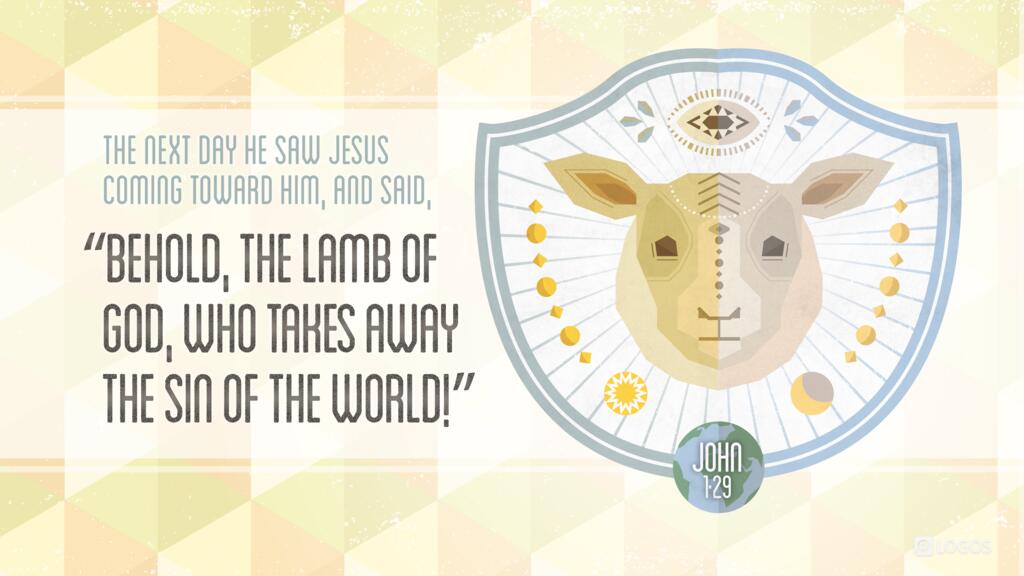
1:29On the next day John75 saw Jesus coming toward him and said, “Look, the Lamb of God76 who takes away the sin of the world! 1:30This is the one about whom I said, ‘After me comes a man who is greater than I am,77 because he existed before me.’ 1:31I did not recognize78 him, but I came baptizing with water so that he could be revealed to Israel.”79
1:32Then80 John testified,81 “I saw the Spirit descending like a dove82 from heaven,83 and it remained on him.841:33And I did not recognize him, but the one who sent me to baptize with water said to me, ‘The one on whom you see the Spirit descending and remaining—this is the one who baptizes with the Holy Spirit.’ 1:34I have both seen and testified that this man is the Chosen One of God.”85
Footnotes
- 75 Grk “he”; the referent (John) has been supplied in the translation for clarity.
- 76 Gen 22:8 is an important passage in the background of the title Lamb of God as applied to Jesus. In Jewish thought this was held to be a supremely important sacrifice. G. Vermès stated: “For the Palestinian Jew, all lamb sacrifice, and especially the Passover lamb and the Tamid offering, was a memorial of the Akedah with its effects of deliverance, forgiveness of sin and messianic salvation” (Scripture and Tradition in Judaism [], 225).
- 77 Or “has a higher rank than I.”
- 78 Or “know.”
- 79 John the Baptist, who has been so reluctant to elaborate his own role, now more than willingly gives his testimony about Jesus. For the author, the emphasis is totally on John the Baptist as a witness to Jesus. No attention is given to the Baptist’s call to national repentance and very little to his baptizing. Everything is focused on what he has to say about Jesus: so that he could be revealed to Israel.
- 80 Here καί (kai) has been translated as “then” to indicate the implied sequence of events in the narrative. Greek style often begins sentences or clauses with “and,” but English style generally does not.
- 81 Grk “testified, saying.” The participle λέγων (legōn) is redundant in contemporary English and has not been translated.
- 82 The phrase like a dove is a descriptive comparison. The Spirit is not a dove, but descended like one in some sort of bodily representation.
- 83 Or “from the sky.” The Greek word οὐρανός (ouranos) may be translated “sky” or “heaven,” depending on the context.
- 84 John says the Spirit remained on Jesus. The Greek verb μένω (menō) is a favorite Johannine word, used 40 times in the Gospel and 27 times in the Epistles (67 together) against 118 times total in the NT. The general significance of the verb μένω for John is to express the permanency of relationship between Father and Son and Son and believer. Here the use of the word implies that Jesus permanently possesses the Holy Spirit, and because he does, he will dispense the Holy Spirit to others in baptism. Other notes on the dispensation of the Spirit occur at John 3:5 and following (at least implied by the wordplay), John 3:34, 7:38–39, numerous passages in John 14–16 (the Paraclete passages) and John 20:22. Note also the allusion to Isa 42:1—“Behold my servant … my chosen one in whom my soul delights. I have put my Spirit on him.”
- 85 What did John the Baptist declare about Jesus on this occasion? Did he say, “This is the Son of God” (οὖτός ἐστιν ὁ υἱὸς τοῦ θεοῦ, houtos estin ho huios tou theou), or “This is the Chosen One of God” (οὖτός ἐστιν ὁ ἐκλεκτὸς τοῦ θεοῦ, outos estin ho eklektos tou theou)? The majority of the witnesses, impressive because of their diversity in age and locales, read “This is the Son of God” (so {𝔓66, 75 A B C L Θ Ψ 0233vid f1, 13 33 1241 aur c f l g bo as well as the majority of Byzantine minuscules and many others}). Most scholars take this to be sufficient evidence to regard the issue as settled without much of a need to reflect on internal evidence. On the other hand, one of the earliest for this verse, {𝔓5} (3rd century), evidently read οὖτός ἐστιν ὁ ἐκλεκτὸς τοῦ θεοῦ. (There is a gap in the at the point of the disputed words; it is too large for υἱός especially if written, as it surely would have been, as a nomen sacrum [Υ Σ]. The term ἐκλεκτός was not a nomen sacrum and would have therefore taken up much more space [ΕΚΛΕΚΤΟΣ]. Given these two variants, there is hardly any question as to what 𝔓5 read.) This papyrus has many affinities with א*, which here also has ὁ ἐκλεκτός. In addition to their combined testimony 𝔓106vid b e ff2* sys,c also support this reading. 𝔓106 is particularly impressive, for it is a second third-century papyrus in support of ὁ ἐκλεκτός. A third reading combines these two: “the elect Son” (electus filius in ff2c sa and a [with slight variation]). Although the evidence for ἐκλεκτός is not as impressive as that for υἱός, the reading is found in early Alexandrian and Western witnesses. Turning to the internal evidence, “the Chosen One” clearly comes out ahead. “Son of God” is a favorite expression of the author (cf. 1:49; 3:18; 5:25; 10:36; 11:4, 27; 19:7; 20:31); further, there are several other references to “his Son,” “the Son,” etc. Scribes would be naturally motivated to change ἐκλεκτός to υἱός since the latter is both a Johannine expression and is, on the surface, richer theologically in 1:34. On the other hand, there is not a sufficient reason for scribes to change υἱός to ἐκλεκτός. The term never occurs in John; even its verbal cognate (ἐκλέγω, eklegō) is never affirmed of Jesus in this Gospel. ἐκλεκτός clearly best explains the rise of υἱός. Further, the third reading (“Chosen Son of God”) is patently a conflation of the other two. It has all the earmarks of adding υἱός to ἐκλεκτός. Thus, ὁ υἱός τοῦ θεοῦ is almost certainly a motivated reading. As R. E. Brown notes (John [], 1:), “On the basis of theological tendency … it is difficult to imagine that Christian scribes would change ‘the Son of God’ to ‘God’s chosen one,’ while a change in the opposite direction would be quite plausible. Harmonization with the Synoptic accounts of the baptism (‘You are [This is] my beloved Son’) would also explain the introduction of ‘the Son of God’ into John; the same phenomenon occurs in 6:69. Despite the weaker textual evidence, therefore, it seems best—with Lagrange, Barrett, Boismard, and others—to accept ‘God’s chosen one’ as original.”
The NET Bible First Edition, Copyright 1996-2005 by Biblical Studies Press
In other versions
ESVEnglish Standard Version
The next day he saw Jesus coming toward him, and said, “Behold, the Lamb of God, who takes away the sin of the world! This is he of whom I said, ‘After me comes a man who ranks before me, because he was before me.’ I myself did not know him, but for this purpose I came baptizing with water, that he might be revealed to Israel.” And John bore witness: “I saw the Spirit descend from heaven like a dove, and it remained on him. I myself did not know him, but he who sent me to baptize with water said to me, ‘He on whom you see the Spirit descend and remain, this is he who baptizes with the Holy Spirit.’ And I have seen and have borne witness that this is the Son of God.”
Copyright 2001 Crossway Bibles
NIVNew International Version (2011)
The next day John saw Jesus coming toward him and said, “Look, the Lamb of God, who takes away the sin of the world! This is the one I meant when I said, ‘A man who comes after me has surpassed me because he was before me.’ I myself did not know him, but the reason I came baptizing with water was that he might be revealed to Israel.”
Then John gave this testimony: “I saw the Spirit come down from heaven as a dove and remain on him. And I myself did not know him, but the one who sent me to baptize with water told me, ‘The man on whom you see the Spirit come down and remain is the one who will baptize with the Holy Spirit.’ I have seen and I testify that this is God’s Chosen One.”
Copyright 1973, 1978, 1984, 2011 Biblica, Inc.
CSBChristian Standard Bible
The next day John saw Jesus coming toward him and said, “Look, the Lamb of God, who takes away the sin of the world! This is the one I told you about: ‘After me comes a man who ranks ahead of me, because he existed before me.’ I didn’t know him, but I came baptizing with water so that he might be revealed to Israel.” And John testified, “I saw the Spirit descending from heaven like a dove, and he rested on him. I didn’t know him, but he who sent me to baptize with water told me, ‘The one you see the Spirit descending and resting on—he is the one who baptizes with the Holy Spirit.’ I have seen and testified that this is the Son of God.”
Copyright 2017 Holman Bible Publishers
NLTNew Living Translation
The next day John saw Jesus coming toward him and said, “Look! The Lamb of God who takes away the sin of the world! He is the one I was talking about when I said, ‘A man is coming after me who is far greater than I am, for he existed long before me.’ I did not recognize him as the Messiah, but I have been baptizing with water so that he might be revealed to Israel.”
Then John testified, “I saw the Holy Spirit descending like a dove from heaven and resting upon him. I didn’t know he was the one, but when God sent me to baptize with water, he told me, ‘The one on whom you see the Spirit descend and rest is the one who will baptize with the Holy Spirit.’ I saw this happen to Jesus, so I testify that he is the Chosen One of God.”
Holy Bible, New Living Translation, copyright © 1996, 2004, 2015 by Tyndale House Foundation. Used by permission of Tyndale House Publishers. All rights reserved.
LEBThe Lexham English Bible
On the next day he saw Jesus coming to him and said, “Look! The Lamb of God who takes away the sin of the world! This one is the one about whom I said, ‘After me is coming a man who is ahead of me, because he existed before me.’ And I did not know him, but in order that he could be revealed to Israel, because of this I came baptizing with water.”
And John testified, saying, “I have seen the Spirit descending like a dove from heaven and remaining upon him. And I did not know him, but the one who sent me to baptize with water, that one said to me, ‘The one upon whom you see the Spirit descending and remaining upon him—this one is the one who baptizes with the Holy Spirit.’ And I have seen and testify that this one is the Chosen One of God.
Copyright 2012 Lexham Press
KJV 1900King James Version
The next day John seeth Jesus coming unto him, and saith, Behold the Lamb of God, which taketh away the sin of the world. This is he of whom I said, After me cometh a man which is preferred before me: for he was before me. And I knew him not: but that he should be made manifest to Israel, therefore am I come baptizing with water. And John bare record, saying, I saw the Spirit descending from heaven like a dove, and it abode upon him. And I knew him not: but he that sent me to baptize with water, the same said unto me, Upon whom thou shalt see the Spirit descending, and remaining on him, the same is he which baptizeth with the Holy Ghost. And I saw, and bare record that this is the Son of God.
Public Domain