James 2:18–22
The NET BibleOther versions
English
- NET The NET Bible
- DARBY 1890 Darby Bible
- ASV American Standard Version
- AV 1873 The Cambridge Paragraph Bible of the Authorized English Version
- CSB Christian Standard Bible
- D-R Douay-Rheims Bible
- ESV English Standard Version
- GW GOD’S WORD Translation
- GNB Good News Translation
- HCSB The Holman Christian Standard Bible
- KJV 1900 King James Version
- LSB Legacy Standard Bible
- LEB The Lexham English Bible
- MSG The Message: The Bible in Contemporary Language
- NASB95 New American Standard Bible (1995)
- NCV New Century Version
- NIrV New International Reader’s Version (1998)
- NIV New International Version (2011)
- NKJV The New King James Version
- NLT New Living Translation
- NRSVue New Revised Standard Version: Updated Edition
- RSV The Revised Standard Version
- RSVCE The Revised Standard Version, Catholic Edition
- TNIV Today’s New International Version
- YLT Young’s Literal Translation
Arabic
Czech
French
German
Greek
Hungarian
Italian
Korean
Latin
Portuguese
Russian
Simplified Chinese
Spanish
Traditional Chinese
2:18But someone will say, “You have faith and I have works.”29 Show me your faith without works and I will show you faith by30 my works. 2:19You believe that God is one; well and good.31 Even the demons believe that—and tremble with fear.32
2:20But would you like evidence,33 you empty fellow,34 that faith without works is useless?352:21Was not Abraham our father justified by works when he offered Isaac his son on the altar? 2:22You see that his faith was working together with his works and his faith was perfected by works.
Footnotes
- 29 There is considerable doubt about where the words of the “someone” end and where James’ reply begins. Some see the quotation running to the end of v. 18; others to the end of v. 19. But most punctuate as shown above. The “someone” is then an objector, and the sense of his words is something like, “Some have faith; others have works; don’t expect everyone to have both.” James’ reply is that faith cannot exist or be seen without works.
- 30 Or “from.”
- 31 Grk “you do well.”
- 32 Grk “believe and tremble.” The words “with fear” are implied.
- 33 Grk “do you want to know.”
- 34 Grk “O empty man.” Here the singular vocative ἄνθρωπε (anthrōpe, “man”) means “person” or even “fellow.” Cf. ἄνθρωπος 8 which views this as an instance of rhetorical address in a letter; the pejorative sense is also discussed under the previous heading (7).
- 35 Most witnesses, including several important ones (א A C2 P Ψ 33 𝔐 sy bo), have νεκρά (nekra, “dead”) here, while 𝔓74 reads κενή (kenē, “empty”). Both variants are most likely secondary, derived from ἀργή (argē, “useless”). The reading of the majority is probably an assimilation to the statements in vv. 17 and 26, while 𝔓74’s reading picks up on κενέ (kene) earlier in the verse. The external evidence (B C* 323 945 1739 sa) for ἀργή is sufficient for authenticity; coupled with the strong internal evidence for the reading (if νεκρά were original, how would ἀργή have arisen here and not in vv. 17 or 26?), it is strongly preferred.
The NET Bible First Edition, Copyright 1996-2005 by Biblical Studies Press
In other versions
ESVEnglish Standard Version
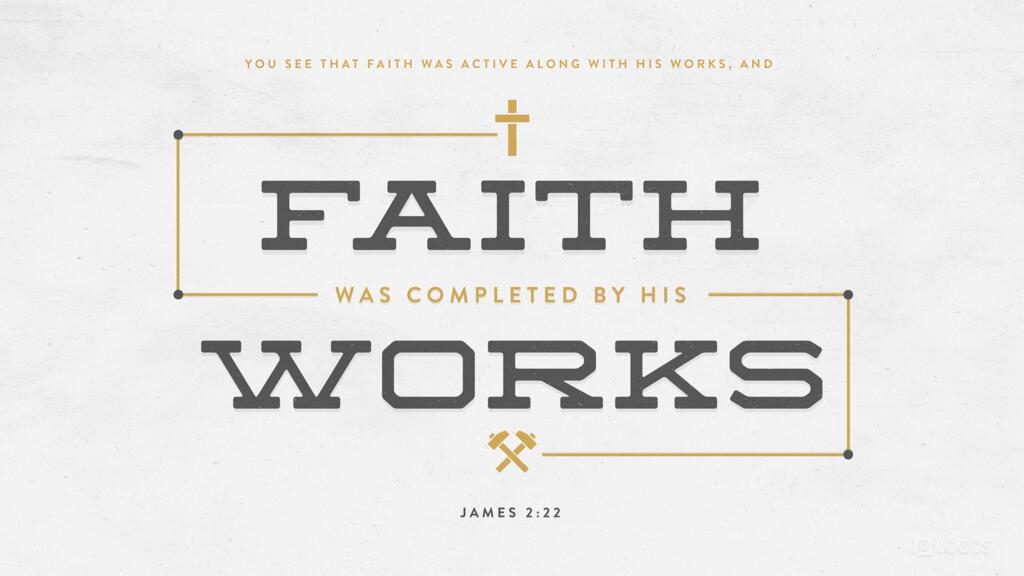
But someone will say, “You have faith and I have works.” Show me your faith apart from your works, and I will show you my faith by my works. You believe that God is one; you do well. Even the demons believe—and shudder! Do you want to be shown, you foolish person, that faith apart from works is useless? Was not Abraham our father justified by works when he offered up his son Isaac on the altar? You see that faith was active along with his works, and faith was completed by his works;
Copyright 2001 Crossway Bibles
NIVNew International Version (2011)
But someone will say, “You have faith; I have deeds.”
Show me your faith without deeds, and I will show you my faith by my deeds. You believe that there is one God. Good! Even the demons believe that—and shudder.
You foolish person, do you want evidence that faith without deeds is useless? Was not our father Abraham considered righteous for what he did when he offered his son Isaac on the altar? You see that his faith and his actions were working together, and his faith was made complete by what he did.
Copyright 1973, 1978, 1984, 2011 Biblica, Inc.
CSBChristian Standard Bible
But someone will say, “You have faith, and I have works.” Show me your faith without works, and I will show you faith by my works. You believe that God is one. Good! Even the demons believe—and they shudder.
Senseless person! Are you willing to learn that faith without works is useless? Wasn’t Abraham our father justified by works in offering Isaac his son on the altar? You see that faith was active together with his works, and by works, faith was made complete,
Copyright 2017 Holman Bible Publishers
NLTNew Living Translation
Now someone may argue, “Some people have faith; others have good deeds.” But I say, “How can you show me your faith if you don’t have good deeds? I will show you my faith by my good deeds.”
You say you have faith, for you believe that there is one God. Good for you! Even the demons believe this, and they tremble in terror. How foolish! Can’t you see that faith without good deeds is useless?
Don’t you remember that our ancestor Abraham was shown to be right with God by his actions when he offered his son Isaac on the altar? You see, his faith and his actions worked together. His actions made his faith complete.
Holy Bible, New Living Translation, copyright © 1996, 2004, 2015 by Tyndale House Foundation. Used by permission of Tyndale House Publishers. All rights reserved.
LEBThe Lexham English Bible
But someone will say, “You have faith and I have works.” Show me your faith apart from your works, and I will show you my faith by my works. You believe that God is one; you do well. Even the demons believe, and shudder! But do you want to know, O foolish person, that faith apart from works is useless? Was not Abraham our father justified by works when he offered up his son Isaac on the altar? You see that faith was working together with his works, and by the works the faith was perfected.
Copyright 2012 Lexham Press
KJV 1900King James Version
Yea, a man may say, Thou hast faith, and I have works: shew me thy faith without thy works, and I will shew thee my faith by my works. Thou believest that there is one God; thou doest well: the devils also believe, and tremble. But wilt thou know, O vain man, that faith without works is dead? Was not Abraham our father justified by works, when he had offered Isaac his son upon the altar? Seest thou how faith wrought with his works, and by works was faith made perfect?
Public Domain